Temperature19 – 24 °C
Natural range
- Guangdong Province area
- Hong Kong area
- China area
LoachesConservation status: Least concern LC
Other scientific names: Hemimyzon myersi, Pseudogastromyzon maculatum, Pseudogastromyzon myseri
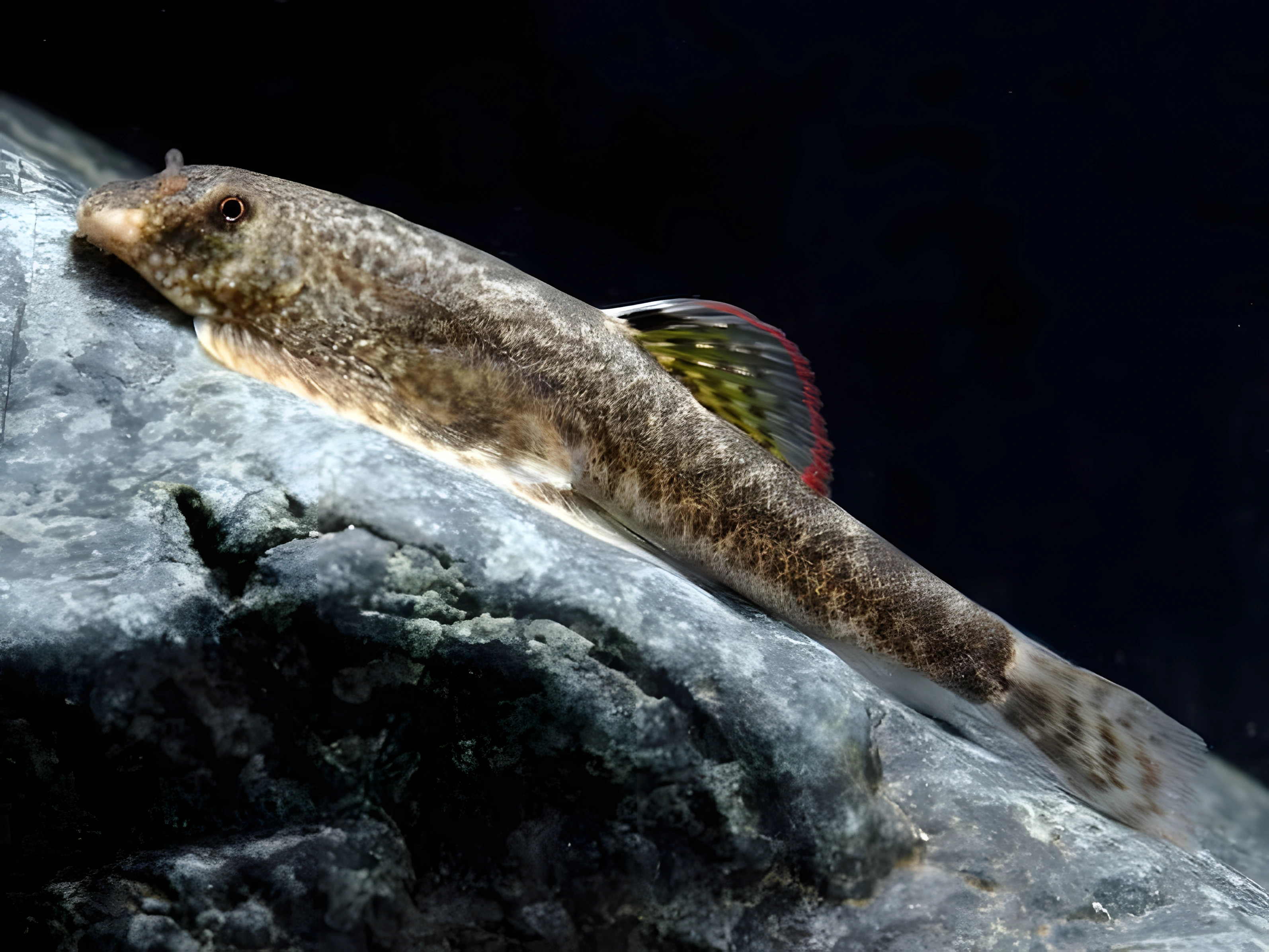
Myers's Hillstream Loach (Pseudogastromyzon myersi) belongs to the family Balitoridae, also known as river loaches. This fish is considered one of the most undemanding species for keeping in an aquarium environment that recreates the features of mountain rivers.
- Required aquarium volume
- 100 L
- Size in aquarium
- 5 – 6 cm
- Temperature
- 19 – 24 °C
- Temperament
- Semi-peaceful (including aggression during spawning / intraspecific conflicts)
Parameters
Water pHNeutral (7) – Slightly alkaline (8)
Water dHVery soft (1) – Hard (12)
Water salinityno salt (freshwater)
Size in aquarium5 – 6 cm
Lifespan3 years
TemperamentSemi-peaceful (including aggression during spawning / intraspecific conflicts)
Toward small fishnot a predator
Required aquarium volume100 L
Lightingbright
Substratepebble (regular)
Water flowmoderate or strong
FeedingSinking (plant-based)
CareSchooling (usually from 5–6 individuals and more)
Description
Adults can reach a length of 5–6 cm. The fish's body appears slightly flattened, and large pectoral fins serve as reliable support, allowing it to hold onto the surface of rocks and boulders, counteracting the force of the current. Their function is less about swimming. The dorsal fin is adorned with a spotted pattern and has a red edge. The fish's body itself has a yellowish-brown coloration. There is a closely related species, Pseudogastromyzon cheni, widely known as the Chinese Hillstream Loach, which inhabits the same geographical areas and has an almost identical appearance. These species can only be distinguished by precise measurements of certain morphological parameters. Specifically, it is necessary to measure the distance between the beginning of the pectoral fin and the beginning of the pelvic fin (these are points B and C). Then, the distance from the beginning of the pelvic fin to the anus (points B and A) must be determined. If these two measurements are equal, you have P. myersi. If the first measurement (1) exceeds the second (2), it can be confidently stated that it is P. cheni. For the average aquarist, these subtleties of species identification are not of great importance, as both species require exactly the same keeping conditions.
Habitat
The species inhabits fast-flowing, well-aerated shallow streams and tributaries with rocky bottoms in Guangdong Province, China, and Hong Kong. In natural conditions, the fish prefer areas with clear water where a rich layer of periphyton and biofilm develops on the surface of rocks. The climate in the range is subtropical, monsoon, which causes seasonal fluctuations in water level and current velocity.
Behavior and Compatibility
In their natural habitat, these fish compete with conspecifics and other species for limited food resources, although they also need the company of their own kind. In the confined space of an aquarium, they may exhibit aggression towards other individuals of their species. The possibility of cohabiting Myers's Hillstream Loaches depends on having a sufficiently spacious tank where each will have enough room. These creatures can be compatible with other species that thrive in similar conditions with moderate to strong currents and relatively cool water. Potential tank mates include members of the genera Barilius (e.g., Barilius dogarsinghii), Garra (such as Garra rufa, Garra mullya, Garra cambodgiensis), Devario (including Devario devario, Devario aequipinnatus, Devario malabaricus), Rhinogobius (such as Rhinogobius candidianus), Akysis (Akysis variegatus, Akysis hendricksoni, Akysis vespa), and Hara (Hara jerdoni, Hara hara).
Care and Maintenance
For a group of 6–8 fish, the optimal aquarium volume is from 100 liters. The fundamental conditions for successful keeping are clean, oxygen-rich water and the presence of a moderate to strong current. A powerful filter will help create the necessary water movement and ensure a sufficient level of dissolved oxygen. It is recommended to choose a filter whose hourly output exceeds the aquarium volume by 10 times. For example, for a 100-liter aquarium, a filter capable of pumping about 1000 liters per hour would be required. In a home aquarium, slightly lower values are acceptable, as the suggested ratio might create too turbulent a flow. The decor should include pebbles, rocks, boulders, snags, and other secure elements that will not be moved by the water flow. Live plants are not an essential element, but if desired, aquatic mosses and ferns can be used, attaching them to the surfaces of rocks or snags. The lighting level should be high, as bright light promotes the growth of some algae, which can serve as an additional food source for the fish. In their natural environment, Pseudogastromyzon feed on diatoms and filamentous algae, as well as various microorganisms living in the algal film. Therefore, it is advisable to stimulate the growth of such algae in the aquarium. The main diet can consist of sinking plant-based foods (granules, tablets). Additionally, it is recommended to include protein supplements in the menu, such as bloodworms or Artemia. The source of scientific data is The Catalogue of Life.
Diet
In the wild, Pseudogastromyzon feed on diatoms and filamentous algae, as well as various organisms living in the algal film. Based on this, it is desirable to create conditions for the growth of such algae in the aquarium environment. The main diet can consist of sinking foods (e.g., granules or tablets) primarily plant-based. It is also recommended to add protein-rich foods, such as bloodworms and Artemia. Source of scientific data: The Catalogue of Life.
Breeding and Reproduction
Breeding is possible in aquarium conditions but requires the creation of a specific environment. In nature, spawning occurs once a year, usually in June or July. The male prepares a spawning site by digging a depression under a rock or pebble, where eggs are laid after courtship. To stimulate spawning, it is recommended to simulate seasonal changes, including periods with cooler water and increased current. Fry develop within the substrate, feeding on microorganisms and organic detritus.
Diseases
Fish are sensitive to water quality and dissolved oxygen levels, so keeping them in immature or poorly filtered aquariums often leads to weakened immunity. Secondary bacterial infections, developing against the background of parasitic infestations caused by stress during transportation or unsuitable conditions, are characteristic. Prevention involves maintaining high aeration, stable water parameters, and avoiding sharp temperature fluctuations.
How to choose
When purchasing, choose active individuals that move confidently across hard surfaces using their sucker mouth. Avoid fish with signs of emaciation, sunken bellies, or skin damage, as the recovery of weakened specimens is extremely difficult. In the store, it is important to assess the overall cleanliness of the aquarium and ensure that the fish are kept with sufficient current, as prolonged stay in stagnant water negatively affects their health.
Frequently asked questions
The essentials: size, tank volume, water parameters and care
How big does Myers's Hillstream Loach get?
An adult reaches 5–6 cm in length. Plan the tank around the maximum size: the fish quickly outgrows a cramped setup.
What size aquarium does Myers's Hillstream Loach need?
The minimum recommended volume is 100 L. A smaller tank speeds up nitrate build-up and raises stress levels.
What water parameters does Myers's Hillstream Loach need?
Temperature 19–24 °C, pH 7–8, hardness 1–12 dGH. Stability matters more than exact values: sudden swings are harder on the fish than a small deviation from the ideal.
How long does Myers's Hillstream Loach live?
Around 3 years when kept properly. Lifespan depends directly on tank volume, water quality and a varied diet.
Is Myers's Hillstream Loach aggressive?
Temperament: semi-peaceful (including aggression during spawning / intraspecific conflicts). Keep this in mind when choosing tank mates.
How many Myers's Hillstream Loach should be kept together?
Recommended setup: schooling (usually from 5–6 individuals and more). Ignoring this is a common cause of stress and disease.
What does Myers's Hillstream Loach eat?
Diet type: sinking (plant-based). Feed small portions that are finished within a couple of minutes — overfeeding does more harm than underfeeding.
What is the scientific name of Myers's Hillstream Loach?
The scientific name of the species is Pseudogastromyzon myersi, family Balitoridae. It also appears in the literature as: Hemimyzon myersi, Pseudogastromyzon maculatum, Pseudogastromyzon myseri.