Temperature23 – 27 °C
Natural range
- Amazon River Basin
- Peru area
- Brazil area
- Guyana area
CharacinsConservation status: Least concern LC
Other scientific names: Anostomus trimaculatus, Pithecocharax trimaculatus, Schizodon trimaculatus
The Three-spot Anostomus, scientifically known as Pseudanos trimaculatus, belongs to the family Anostomidae, or Headstanders. Previously, this fish was classified as Anostomus trimaculatus, and this name is still found in various publications.
- Required aquarium volume
- 300 L
- Size in aquarium
- 12 cm
- Temperature
- 23 – 27 °C
- Temperament
- Semi-peaceful (including aggression during spawning / intraspecific conflicts)
Parameters
Water pHSlightly acidic (6) – Neutral (7.5)
Water dHVery soft (1) – Very hard (18)
Water salinityno salt (freshwater)
Size in aquarium12 cm
Lifespan6 years
TemperamentSemi-peaceful (including aggression during spawning / intraspecific conflicts)
Toward small fishnot a predator
Required aquarium volume300 L
Lightingdimmed or moderate
Substrateany (no restrictions)
Water flowmoderate
FeedingPlant-based (algae, vegetables)
CareBoth solitary and in group (flexible)
Description
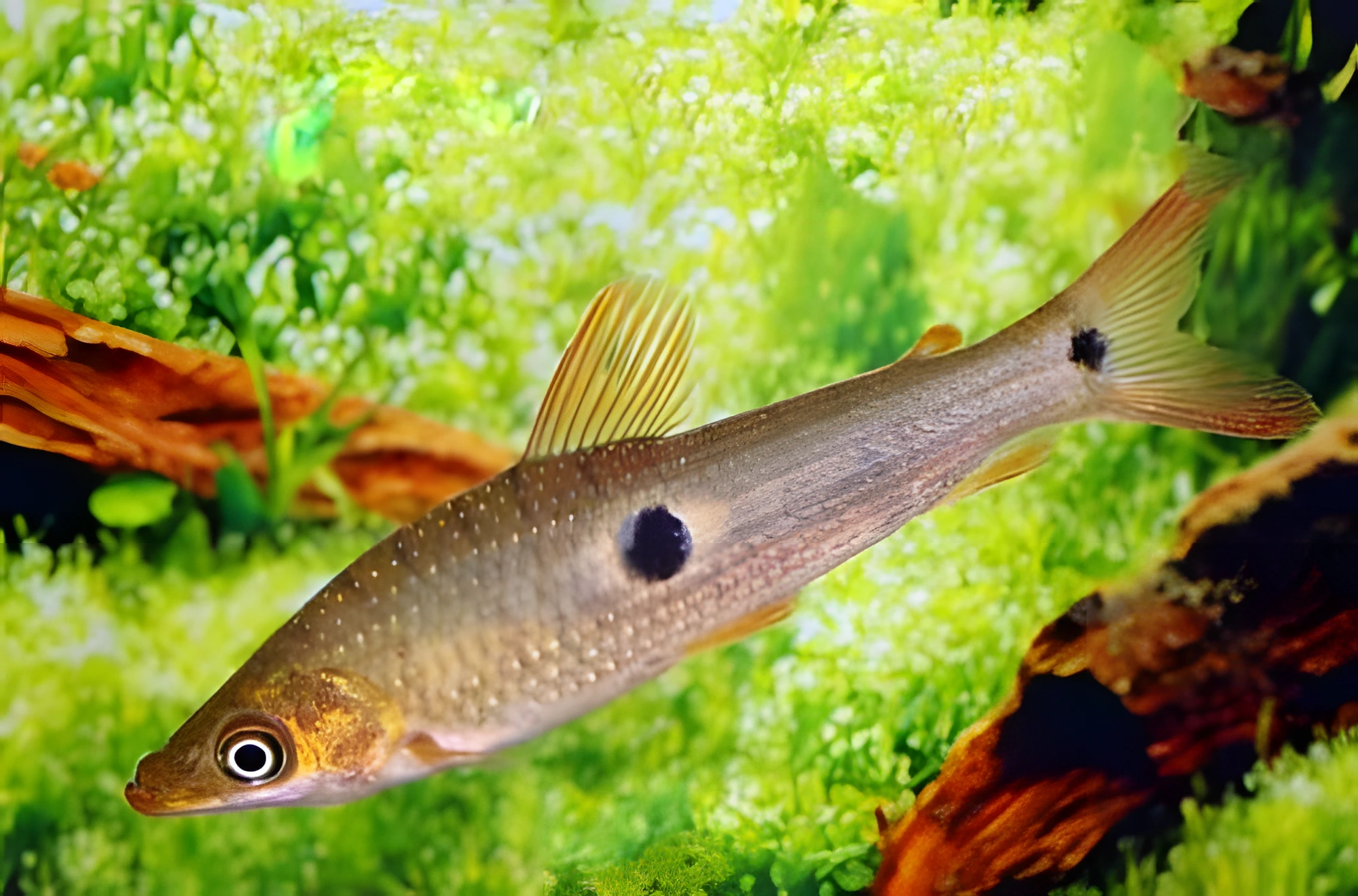
Adults of this fish can reach up to 18 cm in length. Their primary coloration is gray, but under certain lighting, it sometimes acquires yellowish hues. Two black spots are usually clearly visible on the body: one is located in the middle of the body, the other at the base of the caudal fin. Sometimes, a third, less pronounced spot is also observed behind the gill cover. Sexual dimorphism in Pseudanos trimaculatus is weakly expressed; males and females have virtually no noticeable external differences.
Habitat
This fish originates from the waters of South America. Its range covers a wide region – it is found throughout the Amazon River basin, both in Peru and Brazil, as well as in other river systems of Guyana and Suriname. Preferring to stay at medium depths, the Three-spot Anostomus inhabits the main river channels, near the shoreline, among dense thickets of aquatic plants and snags.
Behavior and Compatibility
Pseudanos trimaculatus is a schooling species, and in its natural habitat, the fish live in large groups of 50 or more individuals. When kept in an aquarium, it is important to maintain a school of at least 6–8 fish. It has been noted that with fewer numbers, these fish may show aggression towards their conspecifics. In small aquariums, for this reason, solitary keeping of the Three-spot Anostomus with other species is recommended. Good compatibility is observed with peaceful fish of comparable size, such as Corydoras, armored or Loricariid catfishes, as well as with calm, large South American cichlids. Close relatives of the Anostomidae family are an exception, as these fish may show intolerance towards them.
Care and Maintenance
This is a very mobile and active fish that requires sufficient swimming space. For keeping a single specimen of Pseudanos trimaculatus, an aquarium of 80 L or more will be needed. However, for a group of 6–8 individuals, an aquarium of significantly larger size – 350–400 L or more – will be required. When decorating the aquarium, it is important to provide hiding places: these can be dense thickets of plants, snags, as well as various artificial or natural decorations. At the same time, sufficient open water space for swimming must be left. Given the predominantly herbivorous diet of these fish, when decorating the aquarium, preference should be given to fast-growing plant species with tough leaves. Plants with soft and delicate leaves are likely to be damaged or completely eaten. Extensive natural habitats have allowed this species to successfully adapt to a wide range of hydrochemical parameters. For the aquarist, this greatly simplifies the water preparation process during aquarium maintenance. The main condition is to ensure the stability of pH and dGH parameters and to prevent excessive accumulation of organic waste. The main element of the daily diet should be plant-based foods, but with sufficient protein components. Blanched spinach, lettuce leaves, as well as pieces of cucumbers and zucchini will serve as an excellent addition to the diet. Although the Three-spot Anostomus can eat algae, it should not be considered an effective means of combating them.
Diet
The daily diet of this fish should predominantly consist of plant-based foods that also contain necessary protein components. Blanched spinach, lettuce leaves, as well as chopped pieces of cucumber and zucchini can be offered as an excellent supplement to the main diet. Although Pseudanos trimaculatus does feed on algae, one should not rely on it as the primary method for controlling their proliferation in the aquarium.
Breeding and Reproduction
Currently, reliable information about the reproduction of this species in aquarium conditions is unavailable. In nature, these fish are egg-layers, spawning in pairs in densely vegetated areas. They likely do not exhibit parental care.
Diseases
No specific diseases characteristic only of this species have been described. Like other members of the Anostomidae family, these fish are sensitive to water quality and keeping conditions. Violations of environmental parameters, overcrowding, or solitary keeping (for a schooling species) lead to severe stress, immune suppression, and increased susceptibility to infectious and invasive diseases. For prevention, it is necessary to maintain water cleanliness, ensure regular partial water changes, and avoid sharp fluctuations in the chemical composition of the environment.
How to choose
When selecting individuals, attention should be paid to the fish's overall condition: it should be active, without visible skin damage, ulcers, or signs of emaciation. Avoid purchasing fish that appear timid, apathetic, or show signs of stress, as this species is sensitive to keeping conditions and quickly loses immunity if store keeping rules are violated.
Frequently asked questions
The essentials: size, tank volume, water parameters and care
How big does Three-spot Anostomus get?
An adult reaches 12 cm in length. Plan the tank around the maximum size: the fish quickly outgrows a cramped setup.
What size aquarium does Three-spot Anostomus need?
The minimum recommended volume is 300 L. A smaller tank speeds up nitrate build-up and raises stress levels.
What water parameters does Three-spot Anostomus need?
Temperature 23–27 °C, pH 6–7.5, hardness 1–18 dGH. Stability matters more than exact values: sudden swings are harder on the fish than a small deviation from the ideal.
How long does Three-spot Anostomus live?
Around 6 years when kept properly. Lifespan depends directly on tank volume, water quality and a varied diet.
Is Three-spot Anostomus aggressive?
Temperament: semi-peaceful (including aggression during spawning / intraspecific conflicts). Keep this in mind when choosing tank mates.
How many Three-spot Anostomus should be kept together?
Recommended setup: both solitary and in group (flexible). Ignoring this is a common cause of stress and disease.
What does Three-spot Anostomus eat?
Diet type: plant-based (algae, vegetables). Feed small portions that are finished within a couple of minutes — overfeeding does more harm than underfeeding.
What is the scientific name of Three-spot Anostomus?
The scientific name of the species is Pseudanos trimaculatus, family Anostomidae. It also appears in the literature as: Anostomus trimaculatus, Pithecocharax trimaculatus, Schizodon trimaculatus.