Temperature22 – 28 °C
Natural range
- Venezuela area
- Guyana area
- Suriname area
- French Guiana area
CharacinsConservation status: Least concern LC
Other scientific names: Aphyocarax maxillaris, Aphyocharax maxillaris, Holopristes riddlei, Holopristis riddlei, Pristella riddlei
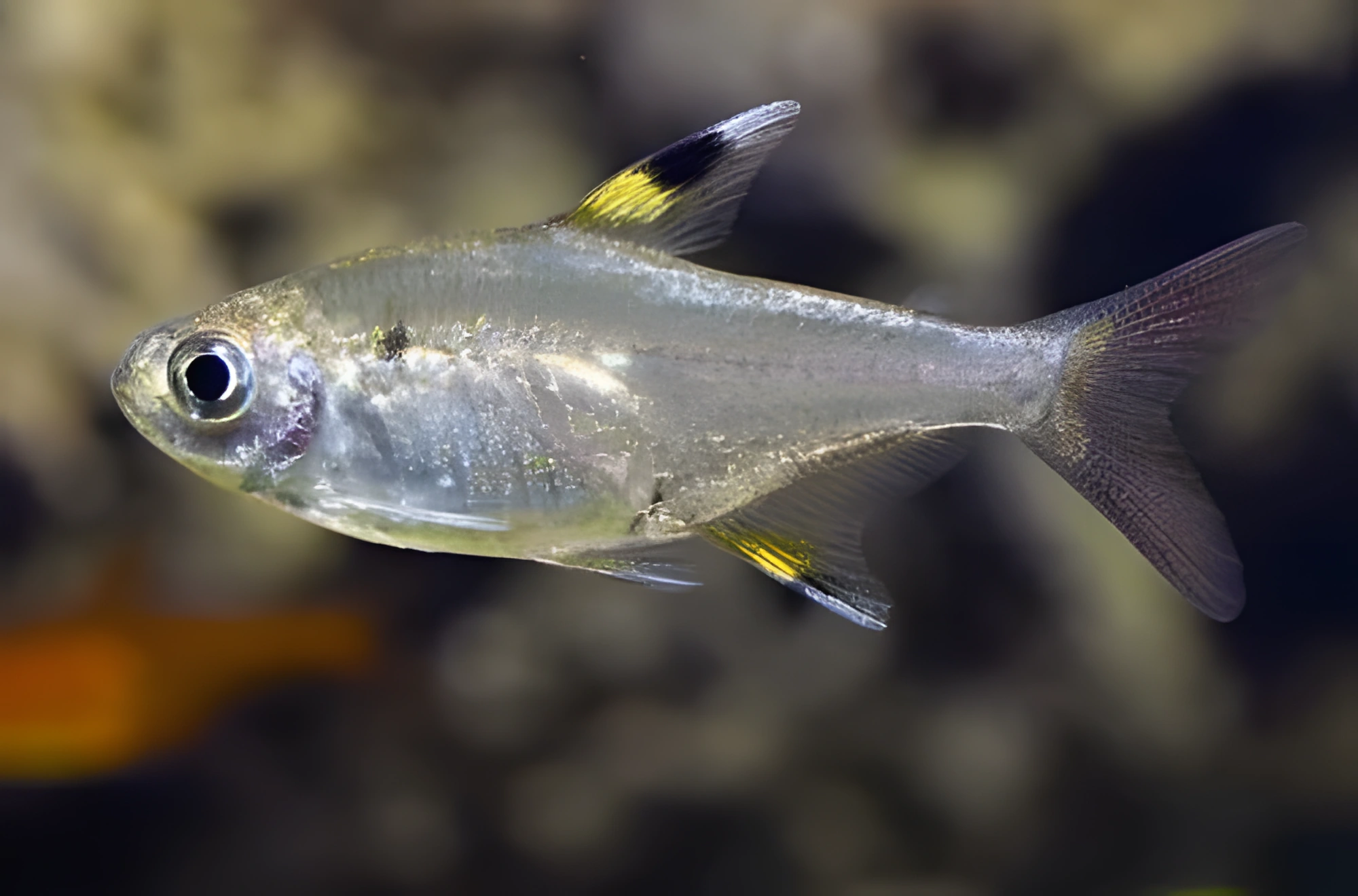
The Albino Pristella, also known as the Albino X-Ray Tetra, scientifically classified as Pristella maxillaris, belongs to the Characidae family. This species is considered one of the most common and accessible representatives of Tetras. Due to their ease of care, peaceful nature, simple breeding, and low cost, these fish are well-suited for beginner aquarists.
- Required aquarium volume
- 60 L
- Size in aquarium
- 4 – 5 cm
- Temperature
- 22 – 28 °C
- Temperament
- Peaceful, calm/shy/inactive
Parameters
Water pHSlightly acidic (6) – Neutral (7.5)
Water dHVery soft (2) – Very hard (20)
Water salinityno salt (freshwater)
Size in aquarium4 – 5 cm
Lifespan5 years
TemperamentPeaceful, calm/shy/inactive
Toward small fishnot a predator
Required aquarium volume60 L
Lightingweak or moderate
Substrateany (no restrictions)
Water flowweak or moderate
FeedingAny (universal)
CareGroup (8–10 individuals)
Description
Adult Pristellas reach a length of approximately 4.5 cm. Their body is semi-transparent, allowing the skeleton and some internal organs to be clearly seen through the skin. Sexual dimorphism in this species is weakly expressed; males and females are quite difficult to distinguish. Essentially, this is an albino form of the common X-Ray Tetra.
Habitat
Its natural habitat includes coastal waters and river systems located in Venezuela, Guyana, Suriname, French Guiana, and northern Brazil. During the rainy season, the fish move into flooded areas of river floodplains, including savannas and forest canopies, for spawning. Currently, it is almost impossible to find wild-caught specimens for sale. Due to their great popularity, these fish are mass-bred for commercial purposes on fish farms in Eastern Europe and the Far East.
Behavior and Compatibility
These fish are peaceful, calm, and prefer to live in shoals, so it is recommended to keep them in groups of at least 6–10 individuals. They do not tolerate well the company of noisy or overly active fish. They get along excellently with other South American species, such as small Tetras, catfish, Pencilfish, Hatchetfish, as well as with Rasboras and livebearers.
Care and Maintenance
This species is undemanding and hardy, adapting well to various water conditions. There are no special requirements for aquarium design; the setup is determined by the owner's taste and budget, or the needs of other inhabitants. As for the Albino Pristella, it successfully adapts to a wide range of pH and dGH values. However, when setting up the aquarium, it's important to consider the following: subdued lighting should be provided, and a dark substrate should be used. Aquarium maintenance includes regular cleaning of the substrate from organic pollutants (such as uneaten food remnants, excrement) and weekly partial water changes (15–20% of the total volume) with fresh water.
Diet
The diet of the Albino Pristella can include all common types of food: dry, frozen, and live. The fish does not show particular dietary requirements and thrives if its diet consists of flakes and granules. When choosing food, it is important to prefer products from well-known manufacturers.
Breeding and Reproduction
Even in a community tank, it is possible for fry to appear, but their number will be extremely small and will decrease day by day if they are not promptly moved to a separate tank. To increase the chances of offspring survival and to give the breeding process a systematic character, avoiding spontaneous spawning, it is recommended to use a spawning tank. Adult fish are placed in it during the breeding period. Usually, a small tank of about 20 liters is suitable for this. The decor can be arbitrary; the main emphasis is on the choice of substrate. To protect the eggs from being eaten, it is desirable to line the bottom with a fine-mesh net, or use fine-leaved plants and mosses (for example, Java moss). Alternatively, a layer of glass marbles with a diameter of at least 1 cm can be placed. The lighting should be subdued, and the equipment only needs a heater and a simple air-driven filter. A gradual change in water parameters in the community tank to the following indicators will serve as a stimulus for the start of the breeding period: pH 5.5–6.5, dH 2–8 at a temperature of about 26–28°C. The basis of the diet during this period should be frozen or live foods. Observe the fish carefully; soon, some of them will have noticeably rounded bellies — these are females full of eggs. Prepare and fill the spawning tank with water from the main aquarium. First, place the females there, and the next day, a pair of the most brightly colored large males. Then it remains to wait for spawning; its completion can be determined by the appearance of the females, who will become very “thin,” as well as by visible eggs among the plants or under the fine-mesh net. After spawning, the parents are returned. The fry will hatch within 24–48 hours, and after another 3–4 days, they will begin to swim freely, actively searching for food. They should be fed specialized micro-foods.
Diseases
The best guarantee of fish health from any disease is a balanced aquarium biosystem with optimal keeping conditions. Therefore, if you notice changes in behavior, fish coloration, the appearance of uncharacteristic spots, or other symptoms, you should first check the water parameters, and only after that proceed with treatment measures.
How to choose
When choosing albino Pristella maxillaris, preference should be given to individuals with a clean, uniform coloration without signs of fin or scale damage. Healthy fish should be active, stay in a school, and react quickly to external stimuli. Avoid purchasing fish with sunken bellies, whitish growths on the body, or unnaturally bloated abdomens, as this may indicate the presence of parasites or bacterial infections. In the store, pay attention to the keeping conditions: the water in the aquarium should be clear, without a strong odor, and neighboring fish should look healthy. Since Pristella maxillaris are schooling fish, it is recommended to acquire a group of 6 or more individuals at once to reduce stress during adaptation in a new aquarium.
Frequently asked questions
The essentials: size, tank volume, water parameters and care
How big does Albino Pristella get?
An adult reaches 4–5 cm in length. Plan the tank around the maximum size: the fish quickly outgrows a cramped setup.
What size aquarium does Albino Pristella need?
The minimum recommended volume is 60 L. A smaller tank speeds up nitrate build-up and raises stress levels.
What water parameters does Albino Pristella need?
Temperature 22–28 °C, pH 6–7.5, hardness 2–20 dGH. Stability matters more than exact values: sudden swings are harder on the fish than a small deviation from the ideal.
How long does Albino Pristella live?
Around 5 years when kept properly. Lifespan depends directly on tank volume, water quality and a varied diet.
Is Albino Pristella aggressive?
Temperament: peaceful, calm/shy/inactive. Keep this in mind when choosing tank mates.
How many Albino Pristella should be kept together?
Recommended setup: group (8–10 individuals). Ignoring this is a common cause of stress and disease.
What does Albino Pristella eat?
Diet type: any (universal). Feed small portions that are finished within a couple of minutes — overfeeding does more harm than underfeeding.
What is the scientific name of Albino Pristella?
The scientific name of the species is Pristella maxillaris, family Characidae. It also appears in the literature as: Aphyocarax maxillaris, Aphyocharax maxillaris, Holopristes riddlei.