Temperature22 – 28 °C
Natural range
- Sulawesi area
- Indonesia area
Livebearers
Ravnaki's Halfbeak, scientifically known as Nomorhamphus ravnaki, belongs to the family Zenarchopteridae. This species is often compared to guppies, noted for its unpretentiousness and high endurance. It does not require complex care and breeds easily, provided that the aquarium water is kept clean and maintenance is performed regularly.
- Required aquarium volume
- 120 L
- Size in aquarium
- 6 – 12 cm
- Temperature
- 22 – 28 °C
- Temperament
- Semi-peaceful (including aggression during spawning / intraspecific conflicts)
Parameters
Water pHNeutral (6.5) – Neutral (7)
Water dHSoft (4) – Very hard (18)
Water salinityno salt (freshwater)
Size in aquarium6 – 12 cm
Lifespan3 years
TemperamentSemi-peaceful (including aggression during spawning / intraspecific conflicts)
Toward small fishnot a predator
Required aquarium volume120 L
Lightingmoderate (regular)
Substrateany (no restrictions)
Water flowmoderate or strong
FeedingMeat / protein (live, frozen, fresh)
CareHarem (1 male and several females)
Description
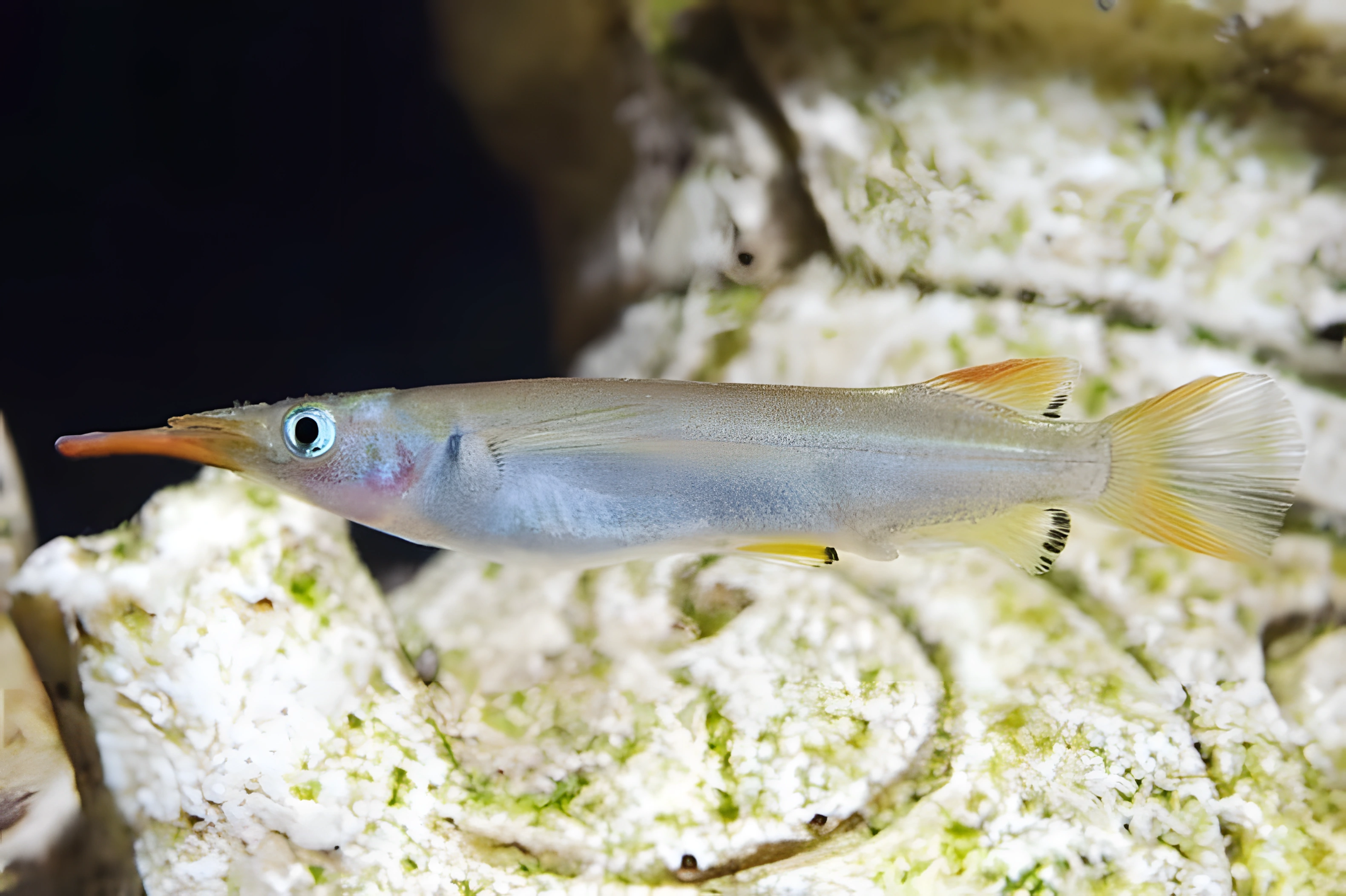
The species is a close relative of various subspecies of Nomorhamphus liemi (liemi and snijdersi). They have similar coloration, which often leads to confusion during shipments when one species is sold under the name of another. However, this circumstance does not cause problems, as the keeping requirements for both fish are identical. The body of Nomorhamphus ravnaki is elongated, somewhat compressed laterally. Its jaws are long, resembling those of a pike, with the upper jaw shorter than the lower. Males grow to about 6 cm in length, while females can reach up to 12 cm. The coloration is usually gray with a silvery belly. Differences from related species lie in the fin coloration: the caudal, dorsal, and anal fins are reddish, with a thin black edging along the margins. Another feature of Ravnaki's Halfbeak is its red lower jaw and the absence of a characteristic hook-like outgrowth.
Habitat
This fish originates from Sulawesi Island (Celebes) in Indonesia, located in Southeast Asia. Its natural habitats are numerous streams and rivers flowing through hilly terrain, predominantly in the southeast of the island.
Behavior and Compatibility
Males of this species display pronounced aggression towards each other, which can lead to fierce skirmishes, especially in confined spaces. If reliable hiding places are present in the aquarium, a weaker male will likely use them for protection, but this does not resolve the conflict problem. In small aquariums, it is recommended to keep only one male Ravnaki's Halfbeak, providing him with the company of 3–4 females. Females, unlike males, exhibit a peaceful disposition and can comfortably coexist in a group. The aggressive behavior of Ravnaki's Halfbeak is directed exclusively at individuals of its own and closely related species. This species successfully coexists with many freshwater fish of similar size.
Care and Maintenance
For a group of 4–5 Ravnaki's Halfbeaks, the optimal aquarium volume starts from 120–130 liters. The aquascape should be based on a balanced combination of open swimming areas and zones rich in hiding places. These can be dense plant thickets, intertwined driftwood, or other decorative elements. For the long-term well-being of these fish, clean, flowing water, well-saturated with dissolved oxygen, is important. Moderate current is also beneficial. These conditions are achieved through regular aquarium maintenance and proper equipment operation. Weekly partial water changes are mandatory and can be combined with the removal of organic waste using a siphon.
Diet
In their natural habitat, their diet consists of small invertebrates such as insects and their larvae, crustaceans, worms, and other zooplankton. Occasionally, they may prey on small fish or fry. In aquarium conditions, a protein-rich diet must be provided. It has been observed that the fish prefer to feed in the upper and middle water layers, so floating foods should be chosen or special feeders for live foods should be used.
Breeding and Reproduction
In aquarium conditions, there is no breeding seasonality, and fry can appear every 4–6 weeks. Since parental instincts are undeveloped in these fish, the young quickly fall victim to adult individuals if not promptly relocated. Fry are born quite large and are immediately able to feed on foods such as Artemia, Daphnia, or mosquito larvae.
Diseases
Fish rarely get sick if kept in favorable conditions. The main causes of diseases are poor-quality food, poor water quality, and injuries. Often, it is enough to eliminate the negative impact for the fish's body to cope with the ailment on its own. In advanced cases, medication may be required; more detailed information can be found in the "Aquarium Fish Diseases" section.
How to choose
When purchasing Ravnaki's Halfbeak, one should choose active individuals that stay in the upper water layers and show interest in food. It is important to carefully inspect the fish for jaw damage, as any injuries to the "beak" can lead to an inability to feed properly. Avoid specimens with signs of emaciation, sunken bellies, or body film, which often indicate transport stress or bacterial infections. Since the species is sensitive to abrupt changes in conditions, it is recommended to acquire fish from reputable suppliers who guarantee proper adaptation after import. In the store, they should be kept in clean water with good aeration and without aggressive tankmates that could damage their fins.
Frequently asked questions
The essentials: size, tank volume, water parameters and care
How big does Ravnaki's Halfbeak get?
An adult reaches 6–12 cm in length. Plan the tank around the maximum size: the fish quickly outgrows a cramped setup.
What size aquarium does Ravnaki's Halfbeak need?
The minimum recommended volume is 120 L. A smaller tank speeds up nitrate build-up and raises stress levels.
What water parameters does Ravnaki's Halfbeak need?
Temperature 22–28 °C, pH 6.5–7, hardness 4–18 dGH. Stability matters more than exact values: sudden swings are harder on the fish than a small deviation from the ideal.
How long does Ravnaki's Halfbeak live?
Around 3 years when kept properly. Lifespan depends directly on tank volume, water quality and a varied diet.
Is Ravnaki's Halfbeak aggressive?
Temperament: semi-peaceful (including aggression during spawning / intraspecific conflicts). Keep this in mind when choosing tank mates.
How many Ravnaki's Halfbeak should be kept together?
Recommended setup: harem (1 male and several females). Ignoring this is a common cause of stress and disease.
What does Ravnaki's Halfbeak eat?
Diet type: meat / protein (live, frozen, fresh). Feed small portions that are finished within a couple of minutes — overfeeding does more harm than underfeeding.
What is the scientific name of Ravnaki's Halfbeak?
The scientific name of the species is Nomorhamphus ravnaki, family Halfbeaks (Zenarchopteridae).