Temperature22 – 27 °C
Natural range
CyprinidsConservation status: Least concern LC
Other scientific names: Cyprinus anjana, Cyprinus daniconius, Leuciscus anjana, Leuciscus daniconius, Leuciscus flavus, Leuciscus lateralis
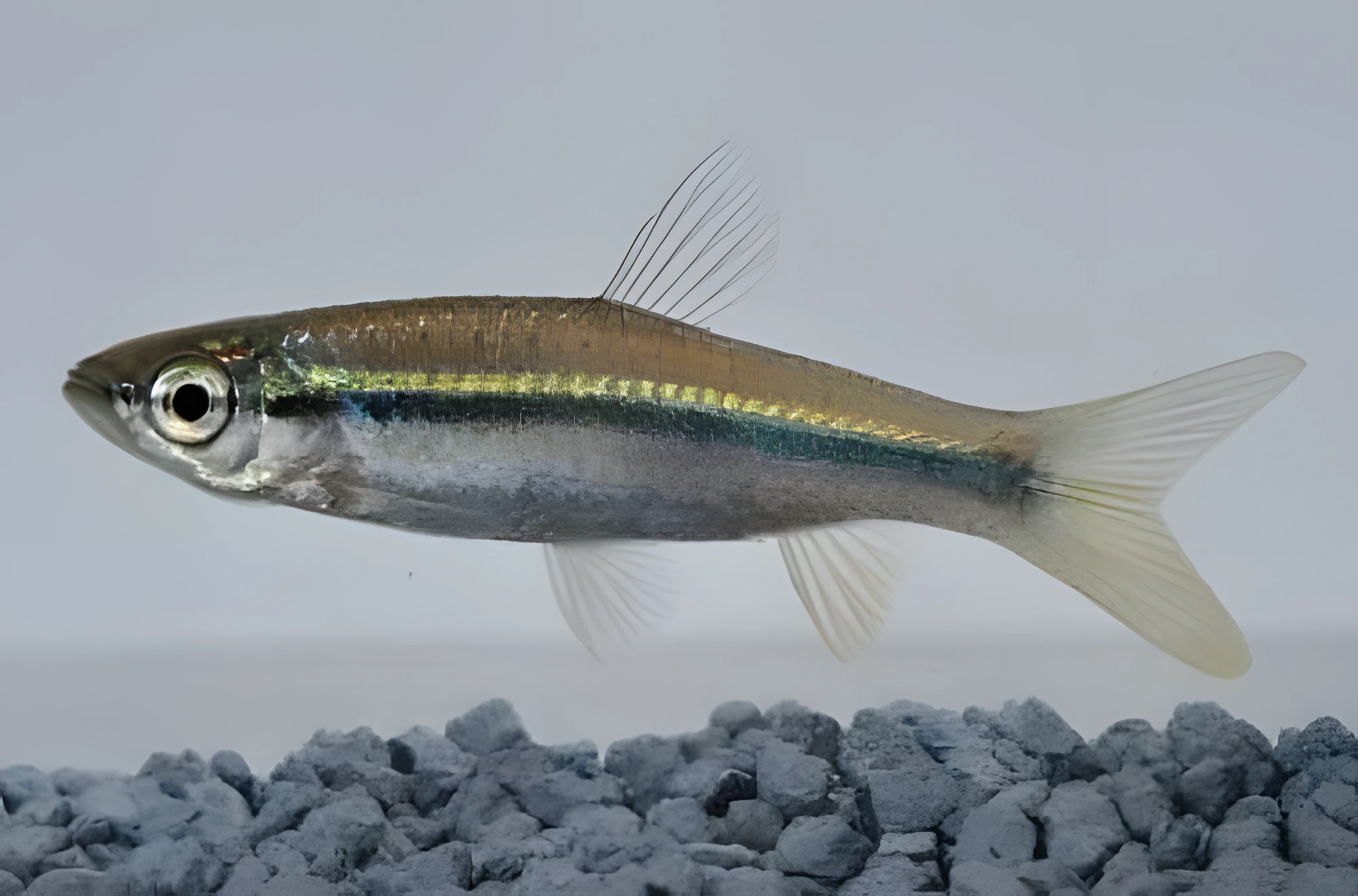
The Striped Rasbora, or Indian Rasbora (scientific name Rasbora daniconius), is a member of the Cyprinidae family. Although this species is not distinguished by its bright coloration among its relatives, it can still attract the attention of aquarists. The fish's scales have high light-reflecting properties, so a school of just ten individuals can create a magnificent sparkling effect that will undoubtedly adorn any aquarium.
- Required aquarium volume
- 80 L
- Size in aquarium
- 9 – 15 cm
- Temperature
- 22 – 27 °C
- Temperament
- Peaceful (regular)
Parameters
Water pHSlightly acidic (6) – Neutral (7)
Water dHVery soft (2) – Hard (12)
Water salinityno salt (freshwater)
Size in aquarium9 – 15 cm
Lifespan8 years
TemperamentPeaceful (regular)
Toward small fishnot a predator
Required aquarium volume80 L
Lightingbright
Substratesandy (regular, light)
Water flowmoderate
FeedingAny (universal)
CareSchooling (usually from 5–6 individuals and more)
Description
The Indian Rasbora is a slender, medium-sized fish, reaching about 9 cm in length. Its streamlined body shape indicates high activity. These fish have small fins, typically yellowish. The main body coloration is silvery-olive. Males have a lighter belly, while females may have a yellow or reddish one. A distinctive feature is a dark line that runs from head to tail along the entire body against a golden background. The high light-reflecting ability of the scales creates the impression that the fish sparkle when moving.
Males are smaller and have a more slender build compared to females. Their belly is light, while in females it has a yellowish or red tint.
Habitat
These fish were first discovered in the first half of the 19th century in Southeast Asia. Their natural habitats include the Mekong, Chao Phraya, and Salween rivers, as well as the Indus River. They prefer rivers with sandy bottoms and slow currents, inhabiting rather murky water. They can be found not only in large water systems but also in ditches near human settlements, in fields flooded during the rainy season, and even in brackish waters. Indian Rasboras form large schools, feeding on small aquatic insects.
Behavior and Compatibility
This is a schooling species, and a mandatory condition for their keeping is maintaining a group of at least 6 individuals. When kept alone, the fish begin to decline and become more susceptible to diseases. Within the school, there is competition between males for the attention of females, which can lead to minor skirmishes, but they never result in injuries. The fish are peaceful but quite active, so species of similar size and temperament should be chosen as tankmates; some catfish species are also suitable.
Care and Maintenance
Despite the fact that in their natural habitat these fish are found in murky water, in the aquarium the water must be clean, without any impurities. Powerful filtration effectively cleans the water and helps create a moderate current (which should not be too strong), maintaining the fish's tone. It is recommended to use a filter with peat filler, which additionally acidifies the pH value. Half of the water volume should be changed monthly, and the substrate should be cleaned with a siphon. Lighting should be bright; brief (no more than 30 minutes at a time) direct sunlight is permissible. Sand or fine gravel with a few smooth stones or pebbles will serve as a suitable substrate. Plants can be varied – both fine-leaved and broad-leaved, planted in dense groups to provide the fish with a sense of security. It is important to leave enough open space for swimming in the mid-water column, avoiding excessive vegetation. To further mimic the natural habitat, bamboo (specially prepared for aquariums) can be used, placing it along the walls to create the effect of reed beds along the shoreline.
Diet
The Striped Rasbora is undemanding in terms of diet and readily accepts various types of food, including live, frozen, and dry commercial foods. A diet consisting of dry foods (granules, flakes) can be supplemented with plant components, such as lettuce leaves. It is recommended to blanch the lettuce in boiling water to soften it, then chop it finely and offer it to the fish. It is also advisable to include live foods, such as bloodworms, in their diet.
Breeding and Reproduction
Like other members of the Cyprinidae family, the Indian Rasbora does not exhibit parental care and may eat its own eggs, so a separate tank is required for spawning. A tank of 40 L will be quite sufficient. Equipment needed includes a heater, an aerator, and a simple mechanical filter. The spawning tank setup includes a substrate of fine gravel and thickets of fine-leaved plants. Create several such zones, for example, in each corner. Spawning can begin at any time; signs of its approach include increased feeding with meaty foods for 2-3 weeks and a temperature increase of 2°C above normal, with water hardness set at 12°dH. When females are ready to spawn, their bellies swell with eggs, and males begin to actively pursue their chosen mates. At this point, the pair should be moved to a separate tank, where the water parameters should match those of the main aquarium. After acclimatization to the new place, the pair hides among the plants, where the eggs are laid. Upon completion of spawning, the fish are returned to the main aquarium, and the temperature is lowered to normal. Fry appear within 3-4 days and begin to swim freely around the tank on the third day. They should be fed micro-food for fry.
Diseases
Under optimal conditions, these fish usually do not develop diseases. However, even a short-term deterioration in water quality can provoke various diseases. The most common among them are dropsy, fin rot, and ichthyophthiriasis. Detailed information on symptoms and treatment methods can be found in the "Aquarium Fish Diseases" section.
How to choose
When selecting individuals, attention should be paid to the cleanliness of the skin and fins: the absence of white spots, ulcers, plaque, or signs of damage is a mandatory condition. A healthy fish should be active, demonstrate pronounced schooling behavior, and show interest in food. Avoid purchasing fish with deformed spines, sunken bellies, or unnaturally sluggish behavior, as this may indicate chronic diseases or emaciation. Since the species is active and prone to jumping, ensure that transport conditions exclude the risk of injury to individuals.
Frequently asked questions
The essentials: size, tank volume, water parameters and care
How big does Striped Rasbora get?
An adult reaches 9–15 cm in length. Plan the tank around the maximum size: the fish quickly outgrows a cramped setup.
What size aquarium does Striped Rasbora need?
The minimum recommended volume is 80 L. A smaller tank speeds up nitrate build-up and raises stress levels.
What water parameters does Striped Rasbora need?
Temperature 22–27 °C, pH 6–7, hardness 2–12 dGH. Stability matters more than exact values: sudden swings are harder on the fish than a small deviation from the ideal.
How long does Striped Rasbora live?
Around 8 years when kept properly. Lifespan depends directly on tank volume, water quality and a varied diet.
Is Striped Rasbora aggressive?
Temperament: peaceful (regular). Keep this in mind when choosing tank mates.
How many Striped Rasbora should be kept together?
Recommended setup: schooling (usually from 5–6 individuals and more). Ignoring this is a common cause of stress and disease.
What does Striped Rasbora eat?
Diet type: any (universal). Feed small portions that are finished within a couple of minutes — overfeeding does more harm than underfeeding.
What is the scientific name of Striped Rasbora?
The scientific name of the species is Rasbora daniconius, family Cyprinids (Cyprinidae). It also appears in the literature as: Cyprinus anjana, Cyprinus daniconius, Leuciscus anjana.