Temperature25 – 28 °C
Natural range
- Africa area
- Equatorial Africa area
Predators UnusualConservation status: Least concern LC
Other scientific names: Polypterus arnaudii, Polypterus senagalus, Polypterus senegalensis
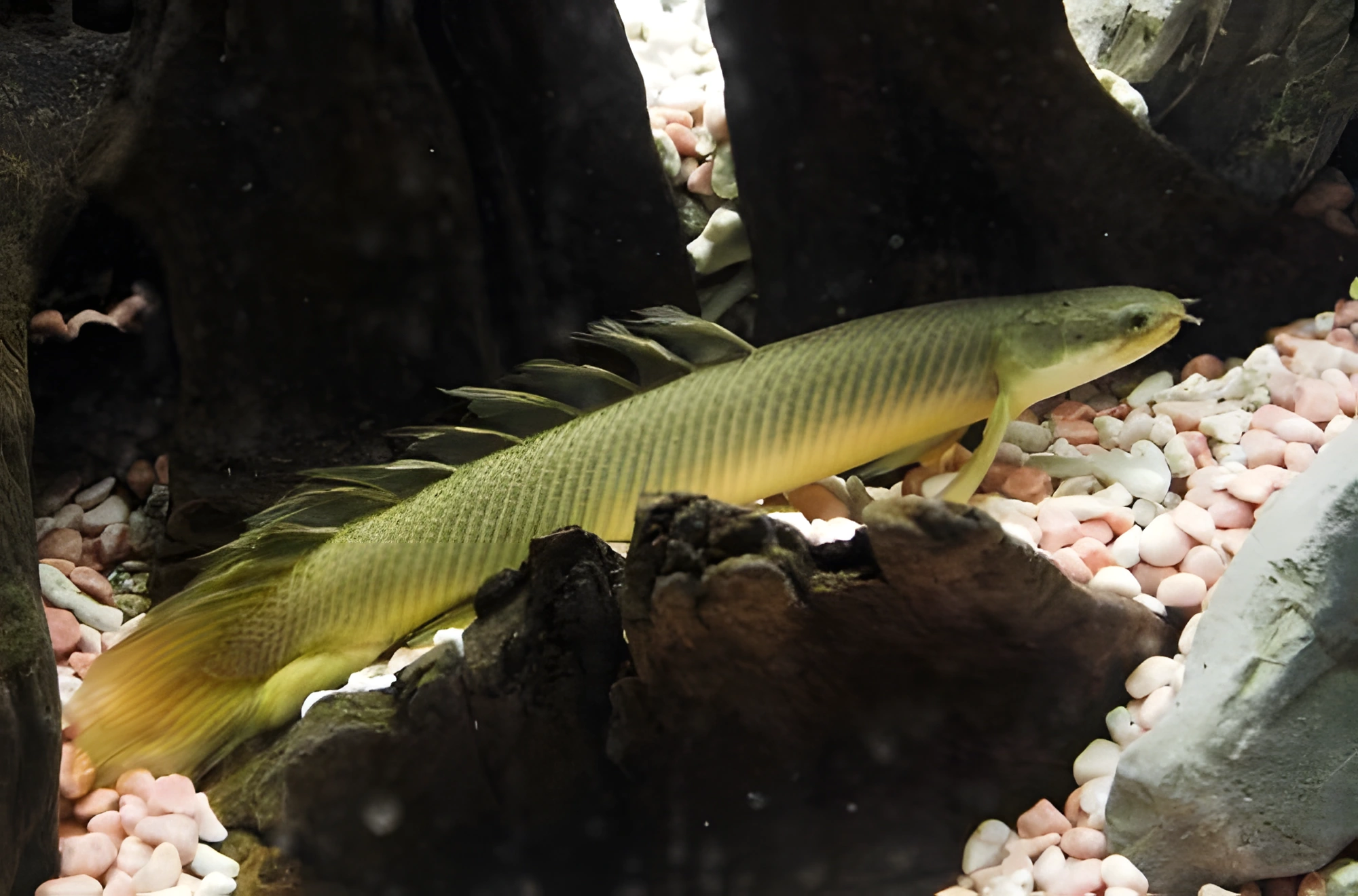
A representative of an ancient genus of fish that existed more than 200 million years ago, during the Triassic period, is the Polypterus, or Senegal Bichir (scientific name Polypterus senegalus). It belongs to the family Polypteridae. The appearance of this fish, preserved from those times, is quite impressive. Despite this, the Senegal Bichir is undemanding in its care and is quite simple for aquarists with little experience, although it is not widely popular.
- Required aquarium volume
- 500 L
- Size in aquarium
- 50 cm
- Temperature
- 25 – 28 °C
- Temperament
- Semi-peaceful (including aggression during spawning / intraspecific conflicts)
Parameters
Water pHSlightly acidic (6.2) – Slightly alkaline (7.8)
Water dHSoft (5) – Very hard (20)
Water salinityno salt (freshwater)
Size in aquarium50 cm
Lifespan30 years
TemperamentSemi-peaceful (including aggression during spawning / intraspecific conflicts)
Toward small fishpredator
Required aquarium volume500 L
Lightingdimmed (dull)
Substratesoft silted
Water flowweak
FeedingMeat / protein (live, frozen, fresh)
CareBoth solitary and in group (flexible)
Description
Adult Senegal Bichirs reach approximately 50 cm in length and have an eel-like body. The massive pelvic and anal fins serve not so much for swimming as for resting on the substrate. The dorsal fin consists of several large, interconnected rays that smoothly transition into the caudal part. The fish's coloration is typically gray or pale green, resembling a swampy hue. Since this species inhabits bodies of water that periodically dry up, it has developed the ability to breathe atmospheric air. Its swim bladder is divided into two parts, one of which functions as a lung. Gills cannot fully provide the fish with oxygen, so constant access to the water surface is necessary for this species. If the body of water dries up, the Polypterus can move short distances in search of water, using its fins.
Habitat
Its origin is linked to the African continent, where it can be found in the equatorial and tropical belts, spanning at least 26 countries. This fish prefers shallow waters with moderate currents, as well as swamps and freshwater lagoons. Droughts are often a part of this species' natural habitat.
Behavior and Compatibility
Despite its predatory nature, this fish is calm and does not show aggression. The Polypterus poses a threat only to fish small enough to fit into its mouth. It is compatible with other members of its own species, as well as with large African fish, including Synodontis catfish, butterflyfish, Anabantids, and large characins.
Care and Maintenance
The optimal aquarium volume for keeping a single fish starts from 500 liters. It is important to note that for this species, the bottom area is much more important than the water column height. The nocturnal lifestyle of the Senegal Bichir implies the use of dim lighting. For aquarium decoration, it is recommended to use a soft substrate and create shelters from snags and rock formations. The presence of live plants is secondary and chosen at the aquarist's discretion; shade-loving varieties should be preferred. An effective water purification system must be provided. Maintaining high water quality, in addition to equipment, includes standard care procedures: regular removal of organic waste, cleaning of glass and decorative elements, and weekly partial water changes with fresh water.
Diet
This predatory species is carnivorous. In a home aquarium, it readily accepts live foods, as well as fresh or frozen shrimp, mussels, earthworms, pieces of fish meat, and mollusks. Additionally, it can be trained to eat dry granulated foods with high protein content.
Breeding and Reproduction
Breeding Senegal Bichirs in home aquarium conditions presents significant difficulties and is unlikely to be accessible to aquarists without sufficient experience. In their natural habitat, spawning occurs during the rainy season, where it is stimulated by a decrease in water temperature and changes in its hydrochemical composition. The male and female scatter their eggs among aquatic vegetation, after which they do not participate in the subsequent development of the offspring. Fry emerge after 3–4 days and are capable of independently feeding on small crustaceans and worms.
Diseases
This species is distinguished by its hardiness and unpretentiousness. Diseases are rare and usually result from unsuitable keeping conditions. More detailed information on symptoms and treatment methods can be found in the "Aquarium Fish Diseases" section.
How to choose
When choosing a Polypterus, pay attention to the fish's activity and the condition of its skin. A healthy individual should show curiosity, move smoothly along the bottom, and have clean, undamaged fins without signs of growths or white film. It is important to ensure the integrity of the scales and the absence of visible wounds, as damage can be a consequence of aggression from tank mates or improper keeping conditions.
- Avoid purchasing individuals with signs of emaciation, sunken bellies, or lethargic behavior.
- Keep in mind that most fish for sale may be wild-caught and therefore require quarantine for several weeks to rule out parasitic infections.
- Inspect the fish's eyes: they should be clear, without cloudiness, which is an indicator of overall health and water quality in the retail aquarium.
Frequently asked questions
The essentials: size, tank volume, water parameters and care
How big does Polypterus get?
An adult reaches 50 cm in length. Plan the tank around the maximum size: the fish quickly outgrows a cramped setup.
What size aquarium does Polypterus need?
The minimum recommended volume is 500 L. A smaller tank speeds up nitrate build-up and raises stress levels.
What water parameters does Polypterus need?
Temperature 25–28 °C, pH 6.2–7.8, hardness 5–20 dGH. Stability matters more than exact values: sudden swings are harder on the fish than a small deviation from the ideal.
How long does Polypterus live?
Around 30 years when kept properly. Lifespan depends directly on tank volume, water quality and a varied diet.
Is Polypterus aggressive?
Temperament: semi-peaceful (including aggression during spawning / intraspecific conflicts). This is a predatory species — any fish small enough to fit in its mouth will eventually be eaten.
How many Polypterus should be kept together?
Recommended setup: both solitary and in group (flexible). Ignoring this is a common cause of stress and disease.
What does Polypterus eat?
Diet type: meat / protein (live, frozen, fresh). Feed small portions that are finished within a couple of minutes — overfeeding does more harm than underfeeding.
What is the scientific name of Polypterus?
The scientific name of the species is Polypterus senegalus, family Polypteridae. It also appears in the literature as: Polypterus arnaudii, Polypterus senagalus, Polypterus senegalensis.