Temperature23 – 28 °C
Labyrinth fishConservation status: Least concern LC
Other scientific names: Colisa maculatus, Labrus trichopterus, Labrvs trichoptervs, Nemaphoerus maculosus, Osphromenus insulatus, Osphromenus siamensis
The Platinum Gourami, scientifically known as Trichopodus trichopterus, is a member of the Osphronemidae family. This variety, magnificent in its coloration, originated from the Blue Gourami. Through long-term selective breeding and the stabilization of desired traits over several generations, this species was artificially developed. It is noteworthy that, despite its artificial origin, it has fully retained the hardiness and unpretentiousness of its progenitor.
- Required aquarium volume
- 140 L
- Size in aquarium
- 13 cm
- Temperature
- 23 – 28 °C
- Temperament
- Semi-peaceful (including aggression during spawning / intraspecific conflicts)
Parameters
Water pHSlightly acidic (6) – Slightly alkaline (8)
Water dHSoft (5) – Very hard (19)
Water salinityno salt (freshwater)
Size in aquarium13 cm
Lifespan4 years
TemperamentSemi-peaceful (including aggression during spawning / intraspecific conflicts)
Toward small fishnot a predator
Required aquarium volume140 L
Lightingmoderate (regular)
Substrateany, but dark
Water flownone or stagnant (no flow)
FeedingAny (universal)
CarePair (male/female)
Description
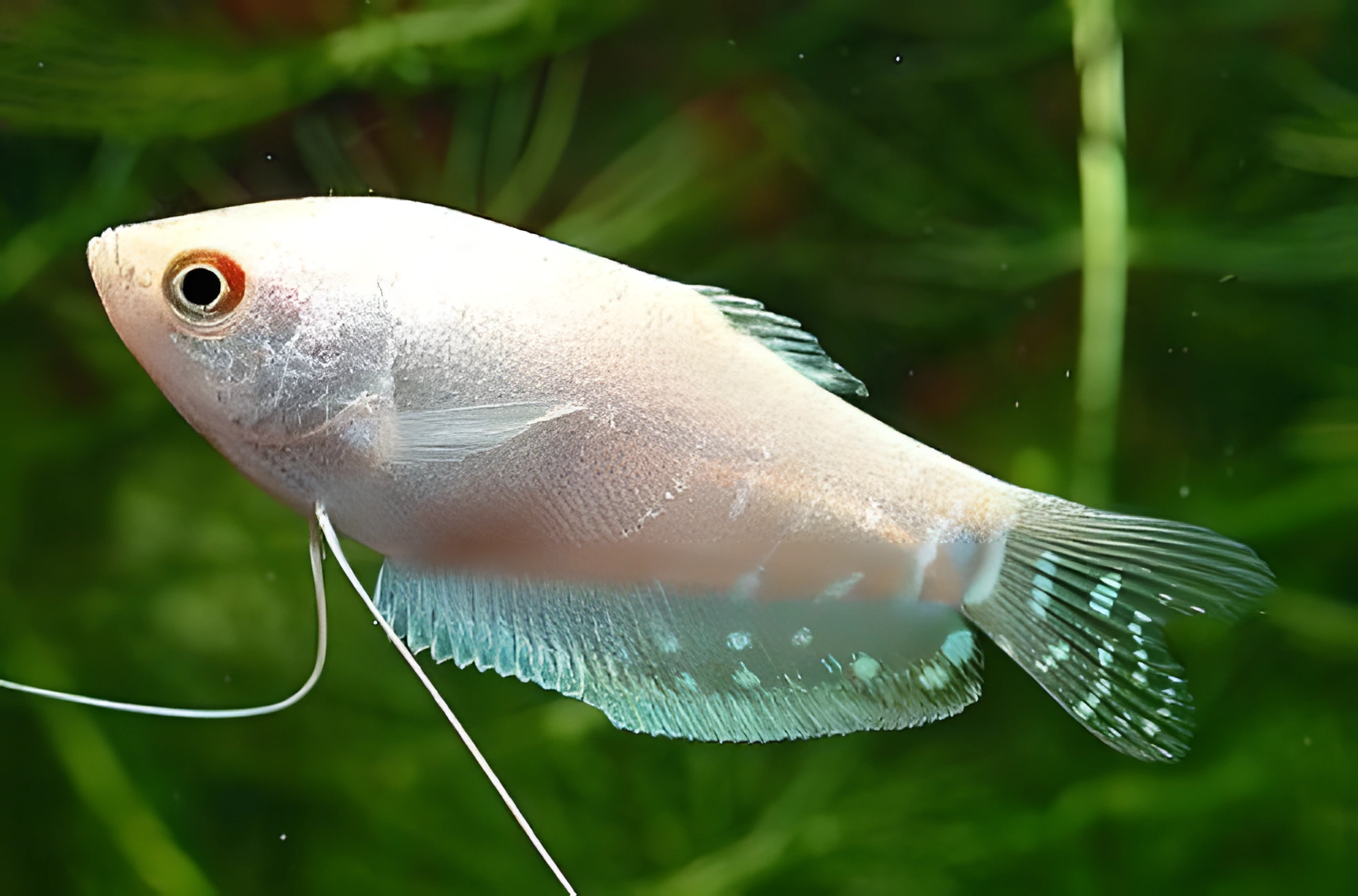
These fish differ from their ancestors mainly in coloration, retaining similar features otherwise. Their body is predominantly white, with soft yellow and silvery reflections visible. Towards the back and belly, the hue becomes more saturated, and these tones also extend to the fins and caudal fin. Sometimes two dark spots become visible on the body — one at the base of the tail, the other in the middle of the body; this is a legacy of the Blue Gourami.
The distinguishing feature of the male is an elongated and pointed dorsal fin, while in females it is noticeably shorter and has more rounded shapes.
Habitat
The Platinum Gourami is not found in the wild, as it is a product of artificial selection, first achieved in the USA in the 1970s. The main centers for commercial breeding of this fish are located predominantly in Southeast Asia and Eastern Europe.
Behavior and Compatibility
At a young age, these fish coexist perfectly with all peaceful species. However, as they mature, they may exhibit aggression towards other aquarium inhabitants. The more fish there are in the aquarium, the higher the likelihood of aggression, with weaker male gouramis being primarily targeted. The ideal keeping option is considered to be a pair (male/female) or a male with several females. As tank mates, one should choose similarly sized and peaceful fish, as smaller species may be perceived as prey.
Care and Maintenance
Given the behavioral characteristics of adult specimens, an aquarium of approximately 150 L is recommended for two or three fish. Standard equipment includes a filter, heater, aerator, and lighting system. It is important that the filter provides minimal water movement but is sufficiently powerful. Gouramis do not tolerate strong currents well, which can cause stress and excessive physical exertion. Various shelters, such as grottoes, driftwood, and dense plant thickets adjacent to open swimming areas, are of great importance for aquarium decoration. It is necessary to provide the fish with unhindered access to the water surface by timely thinning overgrown floating plants. A dark substrate successfully emphasizes the fish's coloration, and the size of the substrate particles is not critical.
Diet
Platinum Gouramis readily consume all varieties of dry commercial foods, whether flakes or pellets. A wide selection of specialized gourami foods, balanced in essential vitamins and trace elements, is available on the market. As supplementary food, bloodworms, mosquito larvae, or finely chopped vegetables can be offered. Feeding is done once or twice a day; when using specialized foods, follow the manufacturer's recommendations.
Breeding and Reproduction
Males, like most gouramis, build a nest of small sticky air bubbles on the water surface, into which the female lays her eggs. For successful breeding, it is recommended to prepare a separate spawning aquarium of about 80 L, filling it with water from the main aquarium to a height of 13–15 cm. The water parameters in the spawning tank should match those of the main aquarium. The standard set of equipment includes a lighting system, aerator, heater, and a filter that provides a weak water flow. In terms of decor, it is desirable to use floating plants with small leaves, such as riccia, as they will become part of the nest. Spawning can be stimulated by including meaty foods (live or frozen) in the daily diet. After the female becomes noticeably rounded, the pair is placed in a separate tank, where the male begins to build the nest, usually in a corner. Upon completion of construction, the male begins courtship: he swims around the female, raising his tail above his head, and touches her with his fins. The female lays up to 800 eggs in the nest, after which she returns to the main aquarium. The male remains to guard the clutch and joins the female only after the fry appear.
Diseases
Despite the fact that many artificially bred species show increased vulnerability to various diseases, the Platinum Gourami is an exception to this rule. It has retained high endurance and resistance to various infections. More detailed information on symptoms and treatment methods can be found in the section "Diseases of Aquarium Fish."
How to choose
When choosing a Platinum Gourami, carefully inspect the fish for external signs of disease: clean fins without signs of rot, absence of white film or sores on the body, and clear eyes. A healthy specimen should swim actively, show interest in its surroundings, and not exhibit signs of emaciation or an unnaturally bloated abdomen. Avoid purchasing fish that constantly hide in corners, lie at the bottom, or at the surface, as this may indicate stress or hidden pathologies. It is also recommended to observe the behavior of the group in the store: preference should be given to fish that do not show excessive timidity or, conversely, do not display pronounced aggression towards conspecifics.
Frequently asked questions
The essentials: size, tank volume, water parameters and care
How big does Platinum Gourami get?
An adult reaches 13 cm in length. Plan the tank around the maximum size: the fish quickly outgrows a cramped setup.
What size aquarium does Platinum Gourami need?
The minimum recommended volume is 140 L. A smaller tank speeds up nitrate build-up and raises stress levels.
What water parameters does Platinum Gourami need?
Temperature 23–28 °C, pH 6–8, hardness 5–19 dGH. Stability matters more than exact values: sudden swings are harder on the fish than a small deviation from the ideal.
How long does Platinum Gourami live?
Around 4 years when kept properly. Lifespan depends directly on tank volume, water quality and a varied diet.
Is Platinum Gourami aggressive?
Temperament: semi-peaceful (including aggression during spawning / intraspecific conflicts). Keep this in mind when choosing tank mates.
How many Platinum Gourami should be kept together?
Recommended setup: pair (male/female). Ignoring this is a common cause of stress and disease.
What does Platinum Gourami eat?
Diet type: any (universal). Feed small portions that are finished within a couple of minutes — overfeeding does more harm than underfeeding.
What is the scientific name of Platinum Gourami?
The scientific name of the species is Trichopodus trichopterus, family Osphronemidae. It also appears in the literature as: Colisa maculatus, Labrus trichopterus, Labrvs trichoptervs.