Temperature23 – 27 °C
Natural range
- Upper Amazon Basin
- Brazil area
- Peru area
- Bolivia area
CharacinsConservation status: Least concern LC
The Striped Pyrrhulina, also known as Pyrrhulina vittata, belongs to the family Lebiasinidae. This species originates from South America, where it is found in the upper reaches of the Amazon River basin. The fish inhabits small streams and river systems that flow under the shaded canopy of the tropical rainforest.
- Required aquarium volume
- 80 L
- Size in aquarium
- 5 cm
- Temperature
- 23 – 27 °C
- Temperament
- Peaceful (regular)
Parameters
Water pHSlightly acidic (6) – Neutral (7.5)
Water dHSoft (5) – Very hard (20)
Water salinityno salt (freshwater)
Size in aquarium5 cm
Lifespan4 years
TemperamentPeaceful (regular)
Toward small fishnot a predator
Required aquarium volume80 L
Lightingdimmed
Substrateany (no restrictions)
Water flowweak
FeedingFloating (protein)
CareGroup (8–10 individuals)
Description
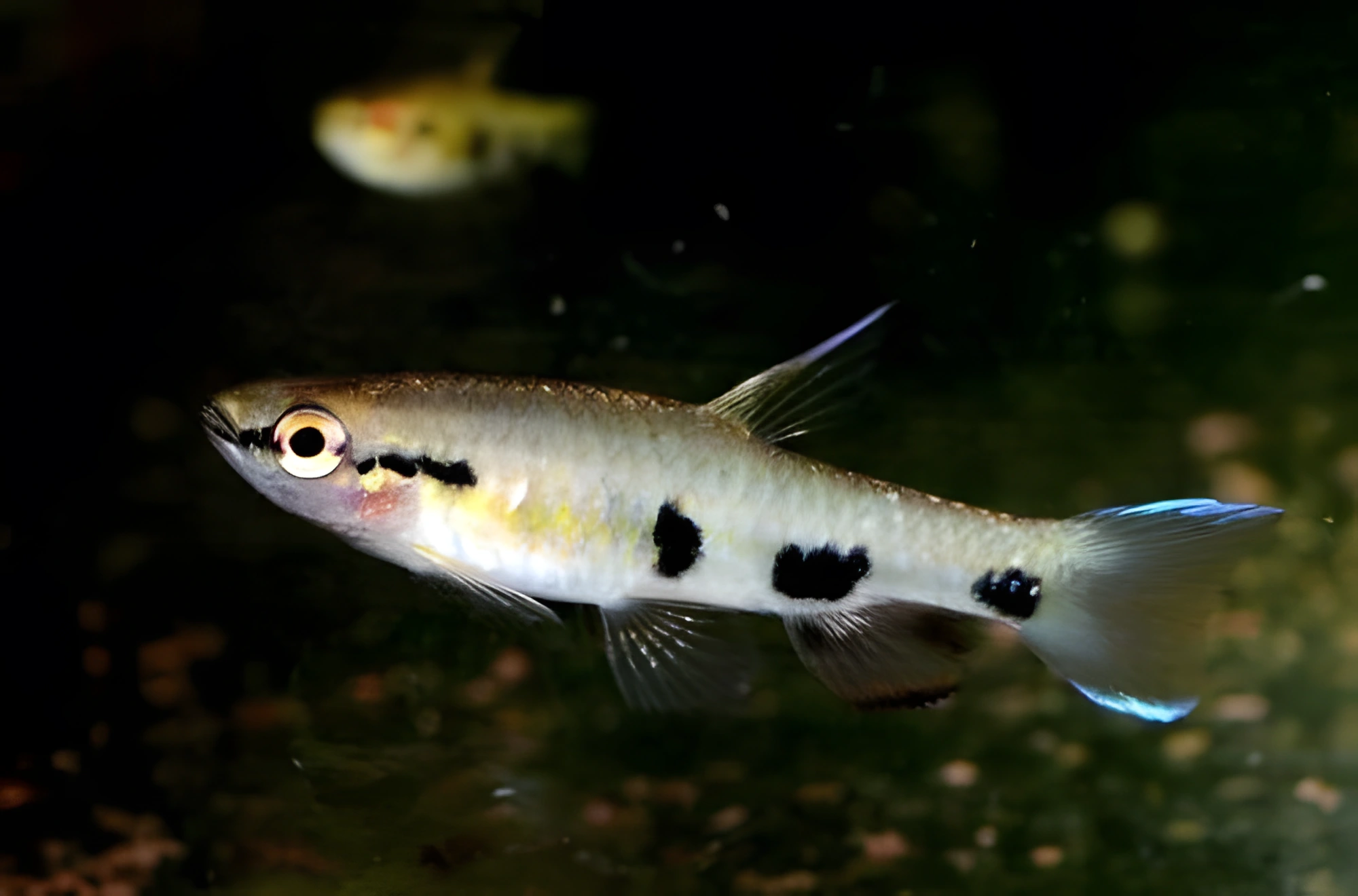
Adults of this species reach just over 3 centimeters in length. Their coloration is a greyish-silver background, adorned with a characteristic pattern of three expressive dark spots. The fins of the fish are translucent, often with a slight bluish edge. Differences between sexes are not pronounced; males are distinguished by a more slender physique compared to females, especially noticeable during spawning.
Habitat
The species inhabits river basins in South America, including the upper Amazon in Brazil, Peru, and Bolivia. In nature, the fish primarily inhabit shallow streams and channels with slow currents. They prefer areas with dense vegetation, where they find shelter and food.
Behavior and Compatibility
This active fish is characterized by a peaceful disposition. It feels best in a group of 8–10 individuals. The Striped Pyrrhulina coexists well with other species of similar size and temperament. However, larger tank mates can pose a potential danger to it. If larger fish are planned for the aquarium, it is recommended to choose species that prefer the bottom layers and rarely rise to the surface, such as some catfishes.
Care and Maintenance
For a small group of Striped Pyrrhulinas, an aquarium of 80 liters or more will be optimal. In this case, the surface area of the water plays a more important role than depth, as the fish need enough space for swimming. It is also important to provide shelters in the form of floating plants. The presence of broad-leaved plants reaching the water surface is welcome, as they can be used by the fish for spawning. The design of the lower tier of the reservoir is not critical and can be adapted according to the aquarist's preferences or the needs of other species. Pyrrhulina vittata requires clean and warm water. It is sensitive to elevated nitrate concentrations, which indicates the need for regular aquarium maintenance and effective filter system operation. When choosing a filter, preference should be given to models that do not create excessively strong currents, as Pyrrhulinas are not adapted to conditions of intense water movement. It is important to note that these fish are prone to jumping out of the water, so the aquarium must be covered or have a secure lid. The diet should consist of non-sinking foods with a high protein content. Live foods will be an excellent addition to the main diet.
Diet
Non-sinking, protein-rich foods are ideal as the main diet. The diet can be diversified by offering live foods. For laying eggs, the fish choose the underside of leaves floating on the water surface. If suitable leaves are not available, the eggs are often placed directly on the aquarium walls, right at the boundary between the wet and air environments. Egg development takes approximately 3 days. After the fry hatch, the parents do not show further care for the offspring.
Breeding and Reproduction
These fish choose the underside of floating leaves for spawning; if suitable plants are not available, the eggs are laid directly on the aquarium wall, right at the water surface. The incubation period is approximately 3 days. After the fry hatch, parental care is usually not observed.
Diseases
The species is sensitive to water quality and the accumulation of organic compounds, particularly nitrates. Under poor keeping conditions, fish are susceptible to bacterial infections and the development of fungal lesions on damaged skin areas. Prevention involves regular water changes, maintaining stable environmental parameters, and ensuring effective but gentle filtration. Fish are prone to stress from sudden changes in conditions, which can weaken their immunity and provoke disease outbreaks.
How to choose
When selecting individuals, attention should be paid to the activity of the fish and the cleanliness of their skin. A healthy Pyrrhulina should have clear eyes, tightly clamped fins without signs of erosion or film, and even scales. Avoid specimens with sunken bellies, signs of emaciation, or unnatural behavior, such as constantly hovering near the bottom or attempting to stay separate from the group. Given the schooling nature of the species, it is recommended to acquire a group of 5–6 individuals at once to reduce stress during adaptation.
Frequently asked questions
The essentials: size, tank volume, water parameters and care
How big does Striped Pyrrhulina get?
An adult reaches 5 cm in length. Plan the tank around the maximum size: the fish quickly outgrows a cramped setup.
What size aquarium does Striped Pyrrhulina need?
The minimum recommended volume is 80 L. A smaller tank speeds up nitrate build-up and raises stress levels.
What water parameters does Striped Pyrrhulina need?
Temperature 23–27 °C, pH 6–7.5, hardness 5–20 dGH. Stability matters more than exact values: sudden swings are harder on the fish than a small deviation from the ideal.
How long does Striped Pyrrhulina live?
Around 4 years when kept properly. Lifespan depends directly on tank volume, water quality and a varied diet.
Is Striped Pyrrhulina aggressive?
Temperament: peaceful (regular). Keep this in mind when choosing tank mates.
How many Striped Pyrrhulina should be kept together?
Recommended setup: group (8–10 individuals). Ignoring this is a common cause of stress and disease.
What does Striped Pyrrhulina eat?
Diet type: floating (protein). Feed small portions that are finished within a couple of minutes — overfeeding does more harm than underfeeding.
What is the scientific name of Striped Pyrrhulina?
The scientific name of the species is Pyrrhulina vittata, family Lebiasinidae.