Temperature24 – 30 °C
Natural range
- Pará area
- Brazil area
CatfishConservation status: Least concern LC
Other scientific names: Chaetostomus oligospilus
This catfish, known scientifically as Peckoltia oligospila, belongs to the extensive family Loricariidae, also called Armored Catfish. The fish owes its name to the German botanist and pharmacist Gustav Peckolt, whose research on the Brazilian flora and fauna of the Amazon was published in the early 19th century. Peckoltia enjoys well-deserved popularity among aquarists due to its attractive coloration, unpretentious care, and excellent ability to coexist peacefully with other inhabitants of freshwater aquariums.
- Required aquarium volume
- 100 L
- Size in aquarium
- 9 – 10 cm
- Temperature
- 24 – 30 °C
- Temperament
- Peaceful (regular)
Parameters
Water pHSlightly acidic (5.5) – Neutral (7.5)
Water dHVery soft (1) – Hard (15)
Water salinityno salt (freshwater)
Size in aquarium9 – 10 cm
Lifespan10 years
TemperamentPeaceful (regular)
Toward small fishnot a predator
Required aquarium volume100 L
Lightingdimmed
Substrateany (no restrictions)
Water flowweak or moderate
FeedingSinking (any)
CareBoth solitary and in group (flexible)
Description
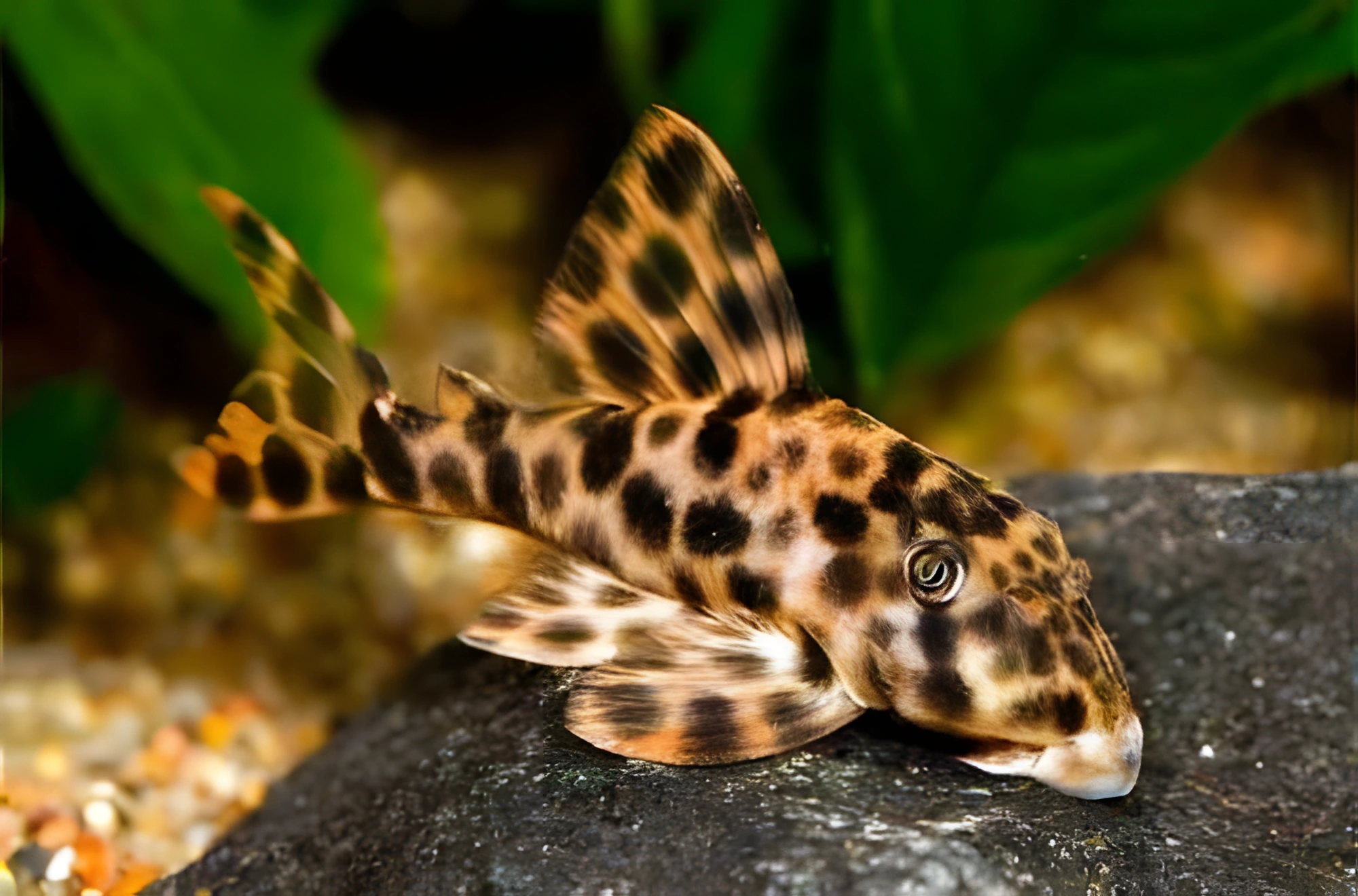
Adults of this species reach a length of 9–10 cm. The catfish is characterized by a large, robust physique, especially noticeable in females. Males, on the other hand, appear somewhat more graceful. The coloration consists of dark spots on a background that can be gray or yellowish; the exact shade depends on the specific population and its region of origin.
Habitat
Its natural habitat is the waters of South America, specifically the Tocantins River basin, located in the Brazilian state of Pará. The catfish is found in a wide variety of biotopes, from overgrown swampy areas to fast-flowing river currents. These fish prefer to stay in the bottom layers, finding refuge among snags.
Behavior and Compatibility
This is a peaceful and calm representative of catfish, especially if kept in the company of fish that inhabit the water column or its surface. Intraspecific competition (mainly among males) or rivalry with other bottom-dwelling species for territory on the bottom may arise if the tank volume is insufficient.
Care and Maintenance
For one or two fish, the optimal aquarium volume starts from 100 liters. Keeping Peckoltia is considered quite simple, provided that a suitable environment is created for it. Favorable conditions are ensured by maintaining stable water parameters within acceptable limits of temperature and hydrochemical indicators (pH and dGH). In aquarium design, hiding places play a key role. Otherwise, the catfish is very undemanding and can adapt to various conditions. High water quality directly depends on regular aquarium maintenance (including partial water changes and waste removal) and the uninterrupted operation of equipment, primarily the filtration system.
Diet
This species is omnivorous. Its diet should be varied, including dry, frozen, and live foods, as well as fresh pieces of vegetables and fruits. It is important to note that all foods must be sinking, as the fish does not rise to the water surface to feed.
Breeding and Reproduction
Cases of breeding these catfish are not uncommon. When the breeding season begins, males begin to jealously guard their territory, while actively courting females. As soon as the female shows readiness to spawn, the pair retires to a shelter to lay eggs. After spawning, the female leaves the clutch site, and the male remains to protect and care for the eggs. The male's parental instincts fade with the appearance of fry.
Diseases
Most health problems in fish often arise from unsuitable keeping conditions. Maintaining a stable and comfortable habitat is a key factor for successful keeping. If symptoms of illness appear, the first step is to check the water quality. If deviations are found, it is important to take immediate measures to eliminate them. If the symptoms do not disappear or worsen, medicinal treatment may be required. More detailed information on symptoms and treatment methods can be found in the "Diseases of Aquarium Fish" section.
How to choose
When choosing Peckoltia, attention should be paid to the fish's activity and the condition of its skin. Healthy individuals should be mobile, without visible damage, ulcers, white plaque, or signs of emaciation, where the abdomen appears sunken. It is important to consider that these are nocturnal fish, so in the store they may be inactive and hide in shelters, which is normal behavior.
- Avoid buying fish that show signs of timidity or apathy, if they lie motionless on the bottom or near the water surface.
- Check the cleanliness of the fins and the absence of signs of rot or damage on them.
- Ask the seller what the specific individual eats, as adaptation to dry foods in captivity can vary individually.
Frequently asked questions
The essentials: size, tank volume, water parameters and care
How big does Peckoltia get?
An adult reaches 9–10 cm in length. Plan the tank around the maximum size: the fish quickly outgrows a cramped setup.
What size aquarium does Peckoltia need?
The minimum recommended volume is 100 L. A smaller tank speeds up nitrate build-up and raises stress levels.
What water parameters does Peckoltia need?
Temperature 24–30 °C, pH 5.5–7.5, hardness 1–15 dGH. Stability matters more than exact values: sudden swings are harder on the fish than a small deviation from the ideal.
How long does Peckoltia live?
Around 10 years when kept properly. Lifespan depends directly on tank volume, water quality and a varied diet.
Is Peckoltia aggressive?
Temperament: peaceful (regular). Keep this in mind when choosing tank mates.
How many Peckoltia should be kept together?
Recommended setup: both solitary and in group (flexible). Ignoring this is a common cause of stress and disease.
What does Peckoltia eat?
Diet type: sinking (any). Feed small portions that are finished within a couple of minutes — overfeeding does more harm than underfeeding.
What is the scientific name of Peckoltia?
The scientific name of the species is Peckoltia oligospila, family Armored Catfishes (Loricariidae). It also appears in the literature as: Chaetostomus oligospilus.