Temperature22 – 28 °C
Natural range
- Guyana area
CharacinsConservation status: Least concern LC
Other scientific names: Poecilobrycon espei
Nannostomus espei, known as the Banded Pencilfish, belongs to the family Lebiasinidae. It is quite popular in the aquarium hobby, but its widespread distribution is hindered by certain difficulties in breeding. However, this fish is peaceful, coexists well with other species, and is not particularly demanding in terms of care.
- Required aquarium volume
- 40 L
- Size in aquarium
- 3 cm
- Temperature
- 22 – 28 °C
- Temperament
- Peaceful (regular)
Parameters
Water pHAcidic (4) – Neutral (6.5)
Water dHVery soft (1) – Medium hardness (9)
Water salinityno salt (freshwater)
Size in aquarium3 cm
Lifespan4 years
TemperamentPeaceful (regular)
Toward small fishnot a predator
Required aquarium volume40 L
Lightingdimmed
Substrateany, but dark
Water flownone or stagnant (no flow)
FeedingAny (universal)
CareLarge group (10+ individuals)
Description
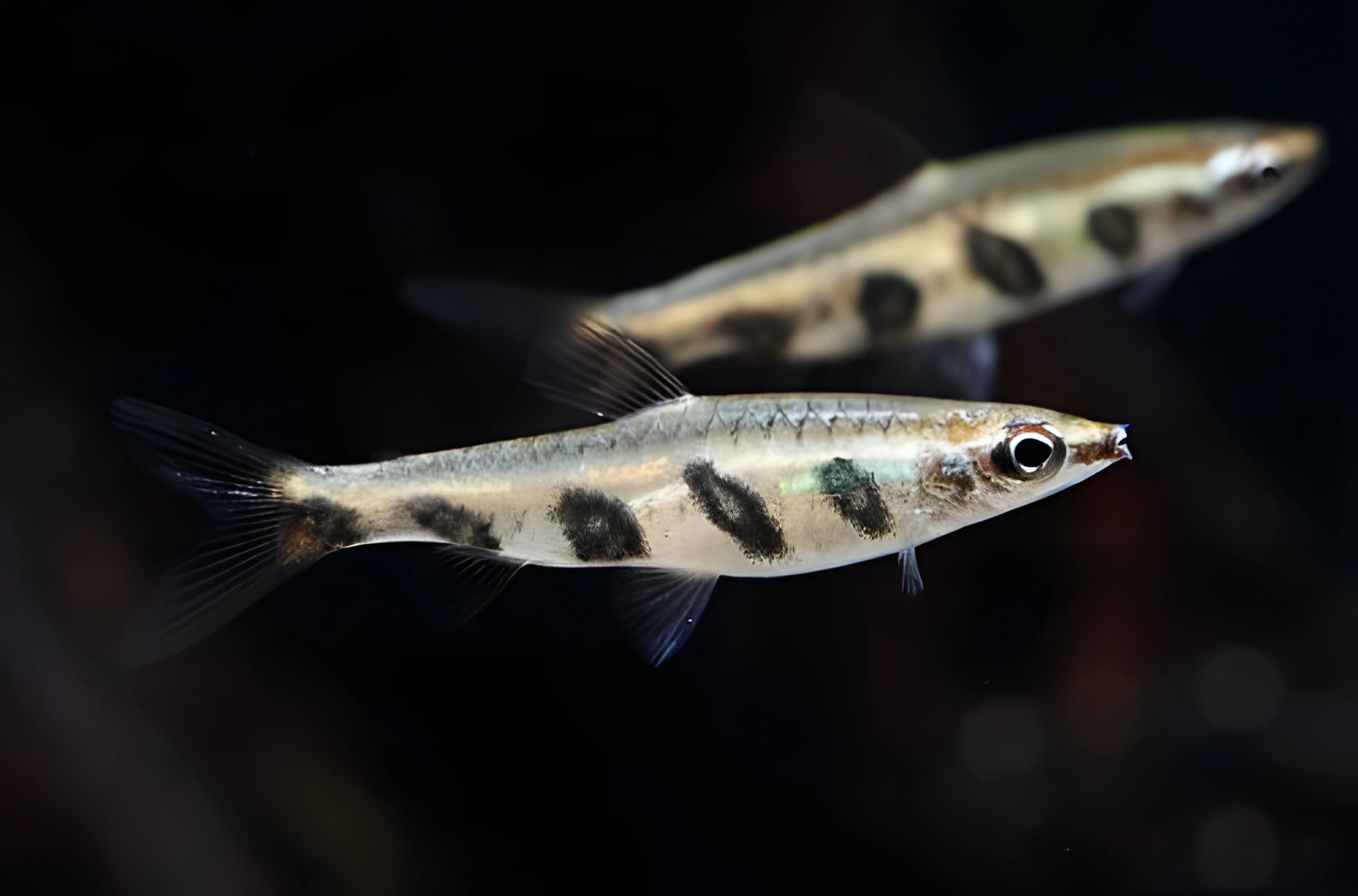
Adults reach a length of 2–3 cm. Distinguishing males and females is quite difficult, as sexual dimorphism is weakly expressed. Their coloration is light gray, adorned with five large, oval-shaped dark spots. The fins and tail are translucent.
Habitat
This species inhabits exclusively South America, being endemic to the Mazaruni River basin, located in Guyana. Its natural habitat includes shallow tributaries, flooded river areas, and oxbow lakes. The Pencilfish prefers areas with abundant riparian vegetation and numerous shelters formed by submerged snags and roots. Often, these bodies of water are stagnant, rich in dissolved tannins, which appear as a result of organic decomposition and give the water a characteristic brown tint.
Behavior and Compatibility
This peaceful and active fish, due to its shyness and small size, coexists well only with species of similar temperament and size. Although these fish stay together, their community can hardly be called a true school, as there are elements of competition among males within the group, but serious clashes do not occur. It is recommended to keep at least 10 individuals; if their number is smaller, Pencilfish may become excessively timid.
Care and Maintenance
For a group of 10 fish, an aquarium of 40–50 liters will be optimal. It is desirable to recreate natural living conditions: subdued lighting, abundant aquatic plants (including floating ones), snags, and dark substrate. An additional element can be the leaves of certain trees. As they decompose, they will release tannins, enriching the water with a chemical composition similar to the natural environment. Successful and long-term keeping of Banded Pencilfish directly depends on the stability of water parameters, which must be within the acceptable range of hydrochemical values and temperatures. For this, the aquarium should be equipped with everything necessary, and regular maintenance should be carried out, including water changes and cleaning of organic waste. It is important to carefully choose the filtration system. Originating from stagnant waters, these fish are sensitive to current, the main source of which in the aquarium is the filter. In some cases, a simple air-driven sponge filter may be suitable for a small aquarium.
Diet
These fish readily accept any appropriately sized food intended for aquarium inhabitants. The daily diet can consist exclusively of dry foods, such as flakes or granules, or include live/frozen brine shrimp, daphnia, and similar organisms.
Breeding and Reproduction
Breeding in home aquariums is possible, but it can present certain difficulties and may not be suitable for a beginner. In an artificial environment, there is no clearly defined breeding season. Fish do not enter spawning condition simultaneously. It often happens that some females are full of eggs while others are not, but the males court all of them. It should be noted that females are very selective about their partner, and not every male will be able to attract their interest. To guarantee the formation of a temporary pair, a large group of fish is necessary. Once a pair forms, the female attaches the eggs to the underside of broad-leaved plants, such as Anubias or Echinodorus, and the male fertilizes them. After this, their short-term relationship ends. Parental instincts are absent in these fish, and adult individuals tend to eat their eggs and fry. Offspring can be saved by transferring the plant with the clutch to a separate aquarium with similar water conditions. The incubation period lasts 1–2 days, and after about a week, the fry begin to swim freely in search of food. Such tiny fry should be fed specialized powdered foods, suspensions, or, if available, infusoria.
Diseases
Health problems in these fish arise only in the presence of injuries or keeping in unsuitable conditions, which leads to a weakening of the immune system and the subsequent occurrence of various diseases. At the first signs of illness, it is necessary first to check the water parameters for exceeding permissible values or the presence of toxic substances (such as nitrites, nitrates, ammonia). If deviations are found, all indicators should be normalized, and then treatment should begin. More detailed information on symptoms and treatment methods is available in the "Diseases of Aquarium Fish" section.
How to choose
When selecting individuals, attention should be paid to their activity and the integrity of their skin. A healthy fish should exhibit typical species-specific mobility, stay in a school, and have a clear, distinct pattern on its body without signs of damage, ulcers, or frayed scales. Avoid purchasing fish with signs of emaciation, sunken bellies, or unnaturally clamped fins.
- Assess the condition of the fins: they should be transparent, without cloudy spots or signs of edge deterioration.
- Observe their behavior: healthy fish often adopt a characteristic tilted position in the water column.
- Check for external parasites and spots on the body, which may indicate poor keeping conditions in the store.
Frequently asked questions
The essentials: size, tank volume, water parameters and care
How big does Banded Pencilfish get?
An adult reaches 3 cm in length. Plan the tank around the maximum size: the fish quickly outgrows a cramped setup.
What size aquarium does Banded Pencilfish need?
The minimum recommended volume is 40 L. A smaller tank speeds up nitrate build-up and raises stress levels.
What water parameters does Banded Pencilfish need?
Temperature 22–28 °C, pH 4–6.5, hardness 1–9 dGH. Stability matters more than exact values: sudden swings are harder on the fish than a small deviation from the ideal.
How long does Banded Pencilfish live?
Around 4 years when kept properly. Lifespan depends directly on tank volume, water quality and a varied diet.
Is Banded Pencilfish aggressive?
Temperament: peaceful (regular). Keep this in mind when choosing tank mates.
How many Banded Pencilfish should be kept together?
Recommended setup: large group (10+ individuals). Ignoring this is a common cause of stress and disease.
What does Banded Pencilfish eat?
Diet type: any (universal). Feed small portions that are finished within a couple of minutes — overfeeding does more harm than underfeeding.
What is the scientific name of Banded Pencilfish?
The scientific name of the species is Nannostomus espei, family Lebiasinidae. It also appears in the literature as: Poecilobrycon espei.