Temperature24 – 28 °C
Natural range
- Upper Amazon River basin
- Brazil area
- Peru area
- Colombia area
CharacinsConservation status: Least concern LC
Other scientific names: Nannobrycon eques, Poecilobrycon auratus, Poecilobrycon eques
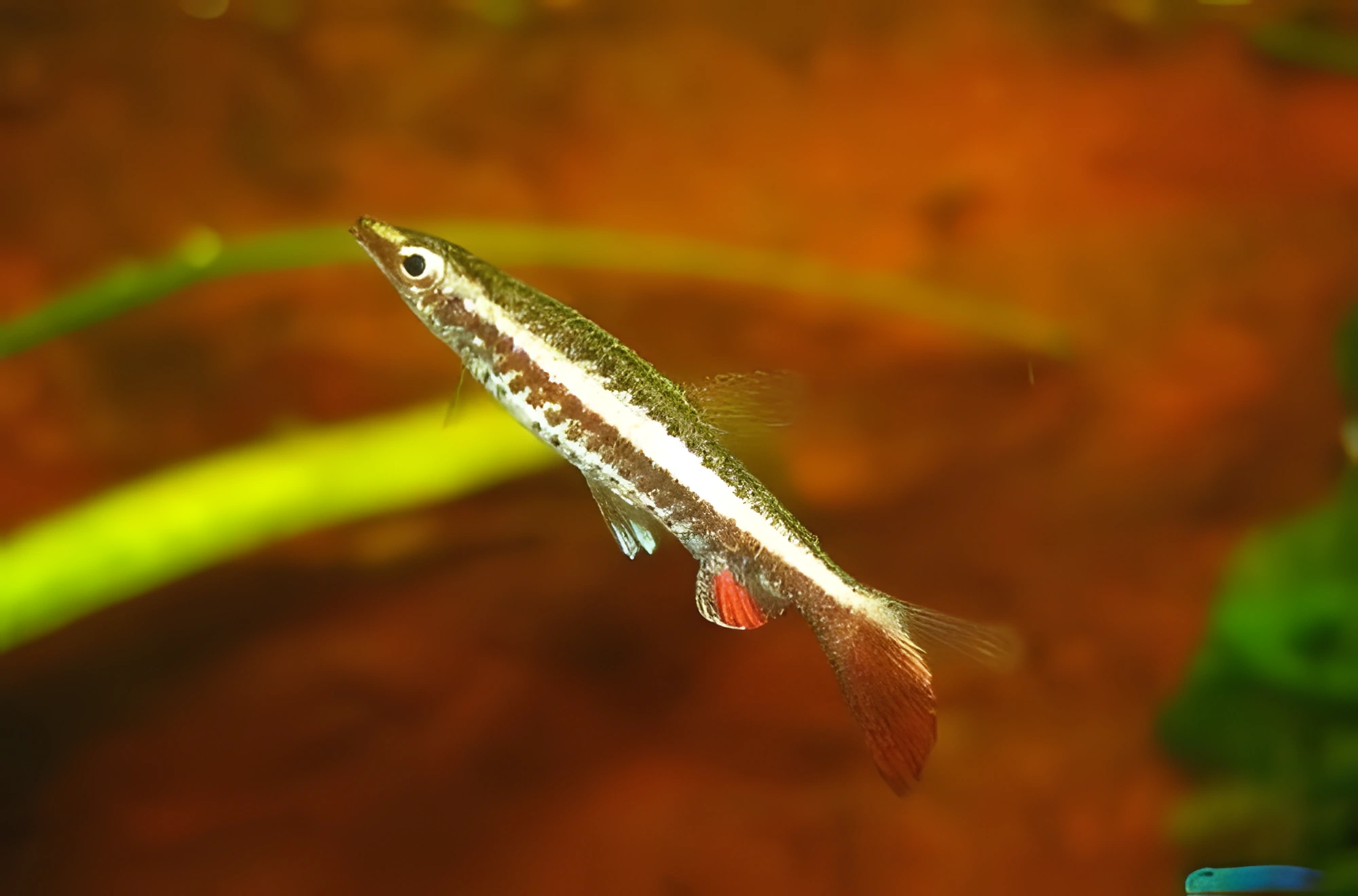
The Pencilfish (Nannostomus eques) is a member of the Lebiasinidae family, an exceptionally interesting aquarium fish to observe. It possesses an amazing ability to change its body pattern depending on the intensity of light, as well as a characteristic oblique swimming style. These fish adapt well to the conditions of most tropical aquariums, but their maintenance requires some experience, so this species is not recommended for beginner aquarists.
- Required aquarium volume
- 60 L
- Size in aquarium
- 5 cm
- Temperature
- 24 – 28 °C
- Temperament
- Peaceful (regular)
Parameters
Water pHSlightly acidic (5) – Slightly acidic (6)
Water dHSoft (5) – Hard (12)
Water salinityno salt (freshwater)
Size in aquarium5 cm
Lifespan4 years
TemperamentPeaceful (regular)
Toward small fishnot a predator
Required aquarium volume60 L
Lightingdimmed
Substrateany, but dark
Water flownone or stagnant (no flow)
FeedingSmall / appropriate size / pieces
CareLarge group (10+ individuals)
Description
This fish has an elongated, shallow body with a characteristic pointed head and a small adipose fin. Males are usually slimmer than females. The body coloration varies from gray to brownish with a distinct dark longitudinal stripe running along the lower part. In the dark, the Pencilfish's coloration transforms: the longitudinal stripe disappears, giving way to several dark stripes running diagonally. The anal fin has a bright red hue.
Habitat
This species is widespread in the upper Amazon River, particularly in the region where the borders of Brazil, Peru, and Colombia converge. Pencilfish choose small rivers and their tributaries with weak water flow as their home, as well as flooded forest areas where dense vegetation and many fallen leaves prevail.
Behavior and Compatibility
This is a peaceful schooling fish that is recommended to be kept in groups of at least 10 individuals. Due to their modest size, only small and calm fish species are suitable as tank mates. Co-habitation with any large or, even more so, aggressive fish is completely unacceptable.
Care and Maintenance
A modest-sized aquarium is sufficient for keeping Pencilfish, decorated with areas of dense vegetation and several groups of floating plants. Snags, intertwined roots, or tree branches can serve as shelters. A dark substrate with the addition of several dry tree leaves is recommended. Leaves help give the water a characteristic brownish tint, close to their natural habitat, and should be replaced weekly. The fish are very sensitive to water quality and chemical composition, requiring a soft, slightly acidic environment. To maintain optimal pH and dH parameters during weekly 20–25% water changes, it is convenient to use special reagents and water testing kits (e.g., litmus paper), which are sold in pet stores or online. Regular siphoning of the substrate to remove waste and unwanted debris is performed once a week, coinciding with water changes. An important piece of equipment is the filtration system; choose the most powerful filter with a peat filler, which will not only clean the water but also help maintain the pH level below 7.0. In addition to the filter, a heater, lighting system, and aerator are necessary.
Diet
The diet of Pencilfish can include any small food. Both dry, packaged food in the form of flakes or granules, and live food, such as bloodworms, daphnia, or nauplii, are acceptable. The key requirement is that the particle size of the food must be small. When using dry food, it is important to ensure that its composition is enriched with protein supplements.
Breeding and Reproduction
Breeding Pencilfish in a home aquarium is not very difficult. Eggs are laid on the inner surface of the leaves of rooted plants, such as Dwarf Anubias or Echinodorus schlueteri. The fish do not show parental care for their offspring, which makes the eggs vulnerable to being eaten by both conspecifics and the parents themselves. Therefore, it is recommended to provide a separate, so-called breeding tank, where plants with laid eggs will be transferred. Water parameters in the breeding tank must exactly match those of the main tank. No special conditions are required to stimulate spawning, but an additional stimulus can be the inclusion of live food in the daily diet. When the female becomes noticeably larger and her belly rounds, this indicates the approaching spawning. Since the spawning process itself may go unnoticed, the leaves of plants should be checked daily for eggs to timely move them to a separate tank. Fry hatch after 24–36 hours and begin free-swimming on day 5–6. They should be fed micro-food or dry flakes/granules, finely ground into dust.
Diseases
Pencilfish are sensitive to water quality and prone to diseases if keeping conditions are violated, especially under stress or solitary keeping. The main signs of distress are loss of appetite, pale coloration, and lethargy. Like other members of the family, they are susceptible to infections arising from high nitrate levels or sharp fluctuations in water parameters. For prevention, it is necessary to maintain a stable environment, avoid overpopulation, and ensure regular water changes, as the fish tolerate organic accumulation poorly.
How to choose
When selecting individuals, attention should be paid to their activity: healthy fish should swim in a school, maintaining their characteristic body tilt at an angle to the surface. Avoid specimens with damaged fins, film on the body, sunken bellies, or signs of apathy. In the store, fish may look pale due to stress, but their coloration should quickly recover in calm conditions. It is recommended to purchase a group of 8–10 individuals, as single fish in the store are often under severe stress, which negatively affects their future immunity.
Frequently asked questions
The essentials: size, tank volume, water parameters and care
How big does Pencilfish get?
An adult reaches 5 cm in length. Plan the tank around the maximum size: the fish quickly outgrows a cramped setup.
What size aquarium does Pencilfish need?
The minimum recommended volume is 60 L. A smaller tank speeds up nitrate build-up and raises stress levels.
What water parameters does Pencilfish need?
Temperature 24–28 °C, pH 5–6, hardness 5–12 dGH. Stability matters more than exact values: sudden swings are harder on the fish than a small deviation from the ideal.
How long does Pencilfish live?
Around 4 years when kept properly. Lifespan depends directly on tank volume, water quality and a varied diet.
Is Pencilfish aggressive?
Temperament: peaceful (regular). Keep this in mind when choosing tank mates.
How many Pencilfish should be kept together?
Recommended setup: large group (10+ individuals). Ignoring this is a common cause of stress and disease.
What does Pencilfish eat?
Diet type: small / appropriate size / pieces. Feed small portions that are finished within a couple of minutes — overfeeding does more harm than underfeeding.
What is the scientific name of Pencilfish?
The scientific name of the species is Nannostomus eques, family Lebiasinidae. It also appears in the literature as: Nannobrycon eques, Poecilobrycon auratus, Poecilobrycon eques.