Temperature20 – 28 °C
Natural range
- Mexico area
- Guatemala area
- Honduras area
- Central America area
LivebearersConservation status: Data deficient DD
Other scientific names: Platypoecilus aurata, Platypoecilus cyanellus, Platypoecilus maculatus, Platypoecilus nigra, Platypoecilus pulchra, Platypoecilus rubra
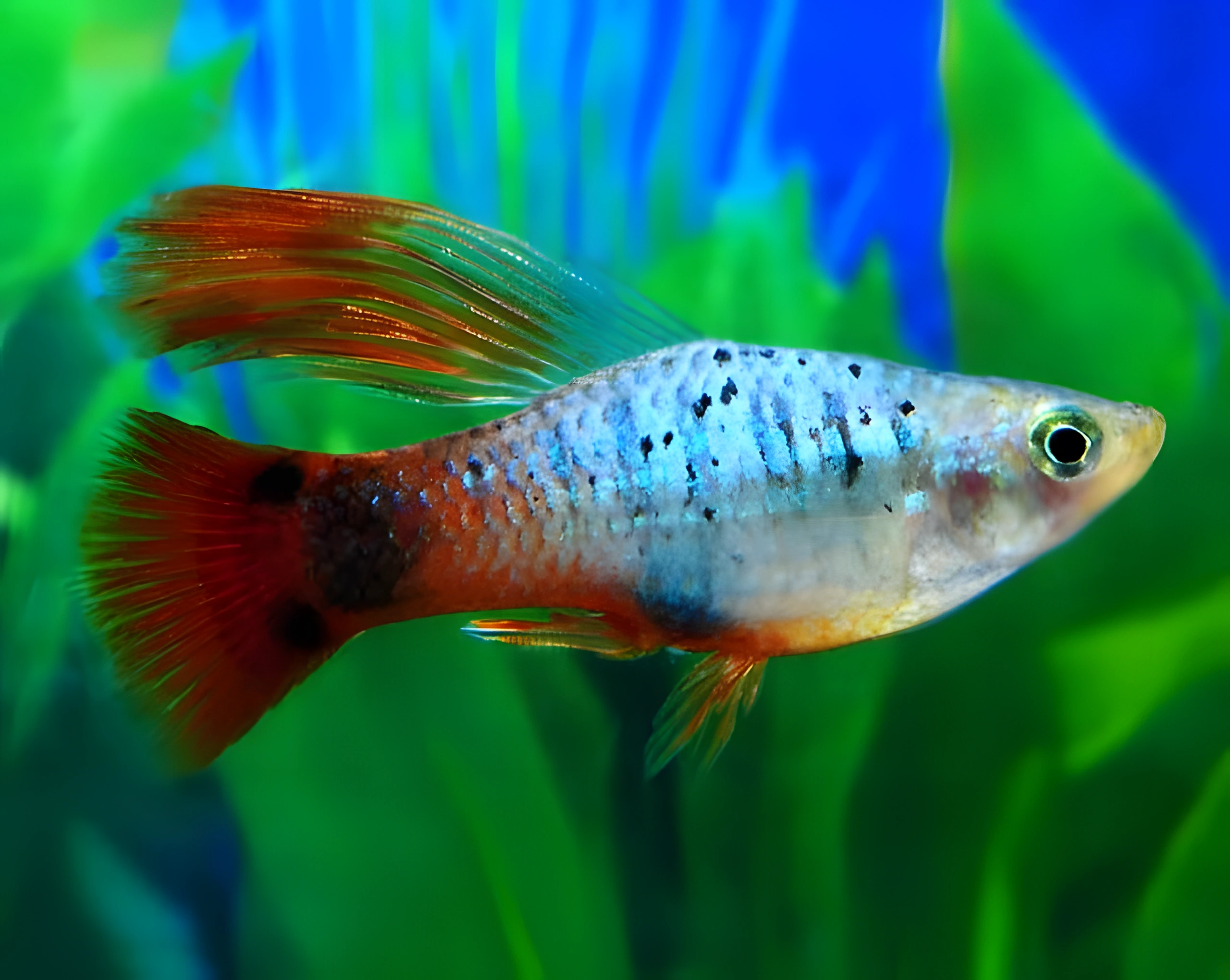
The Hi-Fin Platy, often referred to as such in English-speaking countries, represents a group of hybrids. This name combines individuals obtained by crossing the common Platy and the Variatus Platy with the Flagtail Swordtail. A characteristic feature of these fish is their elongated, "high" dorsal fin.
- Required aquarium volume
- 60 L
- Size in aquarium
- 5 – 7 cm
- Temperature
- 20 – 28 °C
- Temperament
- Peaceful (regular)
Parameters
Water pHNeutral (7) – Slightly alkaline (8.2)
Water dHMedium hardness (9) – Very hard (20)
Water salinityincreased (10–15 g/L)
Size in aquarium5 – 7 cm
Lifespan3 years
TemperamentPeaceful (regular)
Toward small fishnot a predator
Required aquarium volume60 L
Lightingweak (low)
Substrateany (no restrictions)
Water flowweak or moderate
FeedingFloating (protein)
CareMixed (solitary / pair / group)
Description
The Hi-Fin Platy is a selective breeding form, distinguished from the original species by the elongated rays of its dorsal fin, which, when spread, resembles a sail. The fish's body is rhomboid, flattened laterally, with a relatively small head. Various color variations are found in aquariums: from bright red and golden to black and marbled. Sexual dimorphism is clearly expressed: males possess a gonopodium—a modified, tube-shaped anal fin used for fertilization—and usually have a more slender body than females. Adult individuals reach a size of 5–7 cm.
Habitat
In nature, the original platy species inhabit fresh and brackish waters of Mexico, Guatemala, and Honduras, preferring areas with dense vegetation and slow currents. The Hi-Fin form is a result of selective breeding and does not occur in natural conditions. For comfortable existence in an aquarium, the fish require stable water parameters with an alkaline reaction, which corresponds to their natural preference for hard and mineralized water.
Behavior and Compatibility
These are active, peaceful fish that prefer to stay in the middle and upper layers of the water. They are well-suited for a community tank with other calm species, such as gouramis, tetras, or small catfish. Intraspecific hierarchy is weakly expressed, but males may show increased interest in females. To reduce stress and disperse the males' attention, it is recommended to keep the fish in small groups where the number of females exceeds the number of males.
Care and Maintenance
These fish are rightly considered one of the least demanding aquarium inhabitants, easily adapting to various conditions. They possess a high tolerance for fluctuations in basic water parameters such as pH and GH, and they do not have strict requirements for aquarium decor. However, for optimal keeping of the Hi-Fin Platy, it is desirable to maintain water temperature within 22–24°C, preferring neutral or slightly alkaline pH values. Creating numerous hiding places, for example, from dense thickets of aquatic plants, will contribute to their comfort. Peaceful species of similar size make excellent companions, among which other livebearers that prefer a similar habitat are often found. Regarding feeding, these fish readily accept most types of food, whether dry, frozen, or live. It is important to include vegetable supplements in their daily diet; otherwise, they may start to damage delicate aquarium plants. Aqvium flake food, popular on Ozon with a rating of 4.9, is suitable for feeding. It is developed according to new EU 2018/848 standards, enriched with vitamins A, C, D3, E, and Omega 3-6 fatty acids. Breeding these fish presents no difficulties even for beginner aquarists. Under favorable conditions, females are capable of producing offspring monthly. Fry are born fully formed and are immediately ready for independent feeding. They can be fed specialized products for aquarium fish fry, such as powders or suspensions, or finely crushed dry flakes.
Diet
Platies are omnivores and in nature feed on insects, their larvae, and algae. In the aquarium, their diet should be varied and include both high-quality dry foods and vegetable supplements, which are necessary for proper digestion. It is recommended to alternate specialized foods for livebearers with frozen or live foods. It is important to avoid overfeeding, as this negatively affects water quality and fish health.
Breeding and Reproduction
Breeding platies is simple because they are livebearing fish. Fertilization occurs inside the female's body, after which she carries the fry for about 4–5 weeks. For the survival of offspring in a community tank, dense plant thickets are necessary, where the fry can hide. Adult fish tend to eat their offspring, so if the goal is to obtain the maximum number of fry, the pregnant female should be moved to a separate breeding tank. Fry are born fully formed and are immediately capable of feeding on Artemia nauplii or specialized starter foods.
Diseases
The fish have strong immunity when kept under proper conditions, but they are sensitive to the accumulation of nitrogenous compounds. The main causes of diseases are poor filtration, sudden changes in water parameters, and overpopulation. Characteristic signs of illness may include clamped fins, lethargy, or refusal to eat. Prevention involves regular water changes, maintaining a stable temperature, and using high-quality, balanced nutrition.
How to choose
When choosing fish, pay attention to their activity and the cleanliness of their skin. Healthy individuals should have bright coloration, tightly pressed fins, and no white spots, ulcers, or damage on their bodies. Avoid purchasing fish that stay at the water's surface, breathe rapidly, or have an unnaturally bloated abdomen. It is recommended to acquire specimens from aquariums with good filtration and no signs of other inhabitants dying.
Frequently asked questions
The essentials: size, tank volume, water parameters and care
How big does Hi-Fin Platy get?
An adult reaches 5–7 cm in length. Plan the tank around the maximum size: the fish quickly outgrows a cramped setup.
What size aquarium does Hi-Fin Platy need?
The minimum recommended volume is 60 L. A smaller tank speeds up nitrate build-up and raises stress levels.
What water parameters does Hi-Fin Platy need?
Temperature 20–28 °C, pH 7–8.2, hardness 9–20 dGH. Stability matters more than exact values: sudden swings are harder on the fish than a small deviation from the ideal.
How long does Hi-Fin Platy live?
Around 3 years when kept properly. Lifespan depends directly on tank volume, water quality and a varied diet.
Is Hi-Fin Platy aggressive?
Temperament: peaceful (regular). Keep this in mind when choosing tank mates.
How many Hi-Fin Platy should be kept together?
Recommended setup: mixed (solitary / pair / group). Ignoring this is a common cause of stress and disease.
What does Hi-Fin Platy eat?
Diet type: floating (protein). Feed small portions that are finished within a couple of minutes — overfeeding does more harm than underfeeding.
What is the scientific name of Hi-Fin Platy?
The scientific name of the species is Xiphophorus maculatus, family Poeciliidae. It also appears in the literature as: Platypoecilus aurata, Platypoecilus cyanellus, Platypoecilus maculatus.