Temperature20 – 28 °C
LivebearersConservation status: Data deficient DD
Other scientific names: Platypoecilus aurata, Platypoecilus cyanellus, Platypoecilus maculatus, Platypoecilus nigra, Platypoecilus pulchra, Platypoecilus rubra
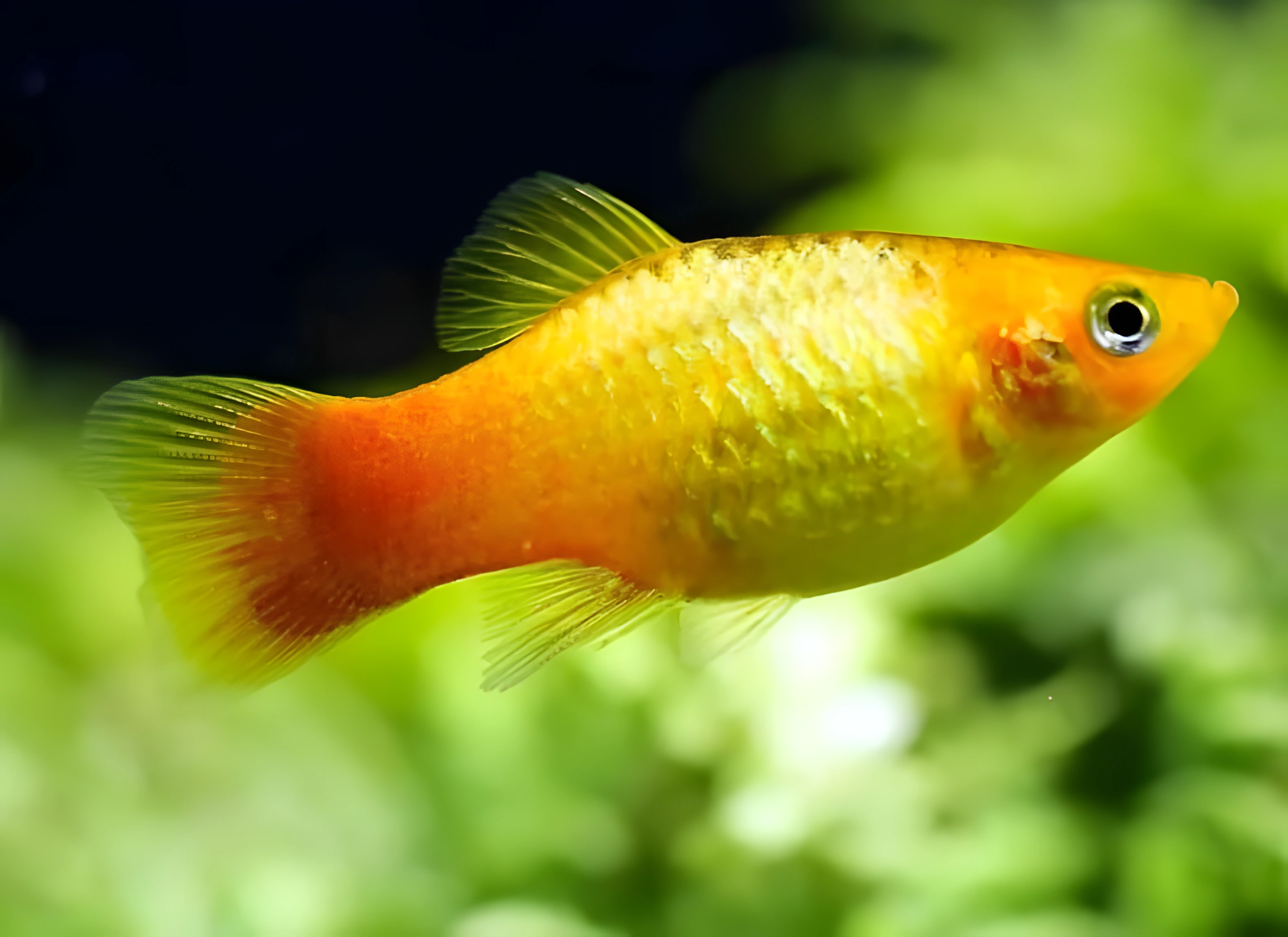
The Sunset Platy, also known as the Sun Platy, got its English trade name "Sunset" due to a characteristic feature of its coloration: its body displays a gradient transition from bright yellow to red. Sometimes, black specks can be observed on the body.
- Required aquarium volume
- 60 L
- Size in aquarium
- 5 – 7 cm
- Temperature
- 20 – 28 °C
- Temperament
- Peaceful (regular)
Parameters
Water pHNeutral (7) – Slightly alkaline (8.2)
Water dHMedium hardness (9) – Very hard (20)
Water salinityincreased (10–15 g/L)
Size in aquarium5 – 7 cm
Lifespan3 years
TemperamentPeaceful (regular)
Toward small fishnot a predator
Required aquarium volume60 L
Lightingweak (low)
Substrateany (no restrictions)
Water flowweak or moderate
FeedingFloating (protein)
CareMixed (solitary / pair / group)
Description
The Sunset Platy is a selective color form of the spotted platy, artificially bred. Its appearance is characterized by a smooth color gradient: the main body color varies from yellow to orange, transitioning into rich red tones towards the caudal fin. The fish's body is rhomboid, flattened laterally, and adult specimens reach 5–7 cm in size. Sexual dimorphism is clearly expressed: in males, the anal fin is transformed into a copulatory organ – a gonopodium, which looks like an elongated tube.
Habitat
This form is not found in the wild, as it is a product of selective breeding, obtained by crossing various color variations of platies and swordtails. In the aquarium, these fish prefer stable water parameters: temperature 20–28°C, hardness 10–25 dGH, and an alkaline environment with pH 7.0–8.2. The species is adapted to freshwater life, but can also be kept in slightly brackish water (5–10 g of salt per liter).
Behavior and Compatibility
These are peaceful and active fish that are well-suited for community tanks. They are schooling fish, so it is recommended to keep them in groups. They are compatible with most peaceful species, such as gouramis, tetras, danios, and small catfish. Avoid keeping them with aggressive, large fish that might perceive platies as prey.
Care and Maintenance
This fish is considered undemanding and relatively easy to care for. Optimal conditions for its keeping can be created even in a relatively small aquarium of 50–60 liters. It is important to provide hiding places, using dense plant thickets or other natural/artificial decorative elements. The Sun Platy adapts well to a wide range of temperatures, as well as pH and GH values. Maintaining water quality largely depends on the effective operation of the filtration system and moderate feeding. A common mistake among beginner aquarists is often overfeeding, as uneaten food remains contribute to water pollution. To avoid this, it is recommended to offer food in such quantities that it is consumed within five minutes. The choice of food matters: specialized foods from many manufacturers, developed specifically for Platies, will provide balanced nutrition and meet the fish's need for plant supplements. Additionally, the diet can be enriched with live or frozen artemia, bloodworms, daphnia, and other small invertebrates. Aqvium flake food for aquarium fish, available on Ozon, has proven to be a bestseller with a rating of 4.9. It is suitable for most aquarium fish, made from raw materials that comply with new European Union standards (EU 2018/848), and contains vitamins A, C, D3, E, as well as Omega 3-6. You can purchase it on Ozon.
Diet
Sunset Platies are omnivores. Their diet should include both high-quality dry foods (flakes or granules) and products with an essential content of plant components for normal digestion. It is recommended to supplement their diet with live or frozen foods such as artemia, daphnia, or bloodworms. Feeding should be done 1–2 times a day with portions that the fish consume within a few minutes.
Breeding and Reproduction
Under favorable conditions, these fish are capable of regular reproduction. The Sunset Platy does not lay eggs but gives birth to fully formed fry. It should be noted that the fish do not show any parental care and may well eat their own offspring. In an aquarium with dense thickets of aquatic plants, the fry will be able to find reliable hiding places, and many of them will survive to adulthood. However, if the goal is to save the entire brood, the fry will need to be moved to a separate tank.
Diseases
The species is hardy but sensitive to sharp fluctuations in water parameters and high levels of nitrogenous compounds. The main causes of diseases are poor sanitary conditions in the aquarium, leading to bacterial infections or parasitic infestations. Prevention includes regular water changes (up to 25–30% weekly), effective filtration, and monitoring nitrate and phosphate levels.
How to choose
When purchasing, choose active fish with clean fins and scales without visible damage, spots, or film. It is important to avoid individuals that stay at the water surface, appear apathetic, or have an unnaturally bloated abdomen, which may indicate illness. It is recommended to purchase fish from reputable sources, paying attention to the conditions in the store.
Frequently asked questions
The essentials: size, tank volume, water parameters and care
How big does Sunset Platy get?
An adult reaches 5–7 cm in length. Plan the tank around the maximum size: the fish quickly outgrows a cramped setup.
What size aquarium does Sunset Platy need?
The minimum recommended volume is 60 L. A smaller tank speeds up nitrate build-up and raises stress levels.
What water parameters does Sunset Platy need?
Temperature 20–28 °C, pH 7–8.2, hardness 9–20 dGH. Stability matters more than exact values: sudden swings are harder on the fish than a small deviation from the ideal.
How long does Sunset Platy live?
Around 3 years when kept properly. Lifespan depends directly on tank volume, water quality and a varied diet.
Is Sunset Platy aggressive?
Temperament: peaceful (regular). Keep this in mind when choosing tank mates.
How many Sunset Platy should be kept together?
Recommended setup: mixed (solitary / pair / group). Ignoring this is a common cause of stress and disease.
What does Sunset Platy eat?
Diet type: floating (protein). Feed small portions that are finished within a couple of minutes — overfeeding does more harm than underfeeding.
What is the scientific name of Sunset Platy?
The scientific name of the species is Xiphophorus maculatus, family Poeciliidae. It also appears in the literature as: Platypoecilus aurata, Platypoecilus cyanellus, Platypoecilus maculatus.