Temperature20 – 28 °C
Natural range
- Mexico area
- Guatemala area
- Central America area
LivebearersConservation status: Data deficient DD
Other scientific names: Platypoecilus aurata, Platypoecilus cyanellus, Platypoecilus maculatus, Platypoecilus nigra, Platypoecilus pulchra, Platypoecilus rubra
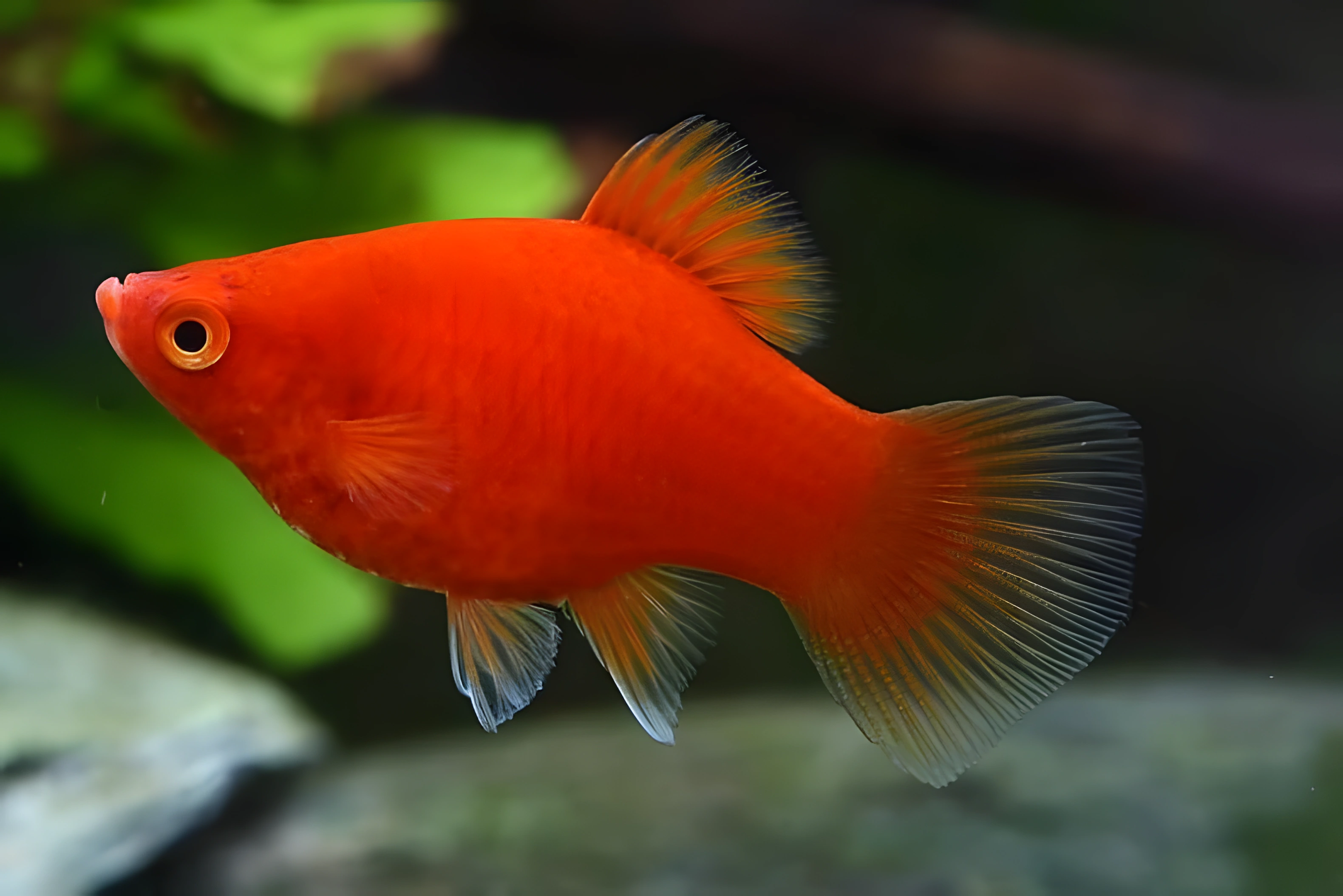
This ornamental variety of the common Platy (Xiphophorus maculatus) is known by the English trade name Red Platy Fish, and in America, the synonym Coral Platy is also encountered.
- Required aquarium volume
- 60 L
- Size in aquarium
- 5 – 7 cm
- Temperature
- 20 – 28 °C
- Temperament
- Peaceful (regular)
Parameters
Water pHNeutral (7) – Slightly alkaline (8.2)
Water dHMedium hardness (9) – Very hard (20)
Water salinityincreased (10–15 g/L)
Size in aquarium5 – 7 cm
Lifespan4 years
TemperamentPeaceful (regular)
Toward small fishnot a predator
Required aquarium volume60 L
Lightingweak (low)
Substrateany (no restrictions)
Water flowweak or moderate
FeedingAny (universal)
CareMixed (solitary / pair / group)
Description
The Red Platy is a selectively bred form, distinguished by its rich, solid body coloration. The fish have a dense, moderately elongated body, compressed laterally. Adult males reach 3.5–4 cm, while females are larger, up to 6–7 cm. Through selective breeding, varieties with different fin shapes have been developed, including veil-tailed and pointed-tailed options. Sexual dimorphism is evident in size and the structure of the anal fin: in males, it is transformed into a copulatory organ – the gonopodium.
Habitat
In the wild, Xiphophorus maculatus inhabits water bodies in Central America, from Mexico to Guatemala. The fish prefer areas with slow currents, dense aquatic vegetation, and silty or sandy bottoms. The natural habitat is characterized by stable water parameters; however, due to high adaptability, the species successfully tolerates a wide range of conditions in aquarium culture.
Behavior and Compatibility
These are peaceful and active fish, suitable for keeping in community tanks with similarly sized tankmates. Intraspecific behavior is hierarchical: males can be persistent towards females, so it is recommended to keep them in groups with a predominance of females in a ratio of 1:2 or 1:3. The species coexists well with other livebearers and non-aggressive fish.
Care and Maintenance
For keeping 3–4 fish, an aquarium of 60–70 liters is considered optimal. It is important to provide a sufficient number of shelters in the aquascape. These can be lush thickets of aquatic plants, as well as driftwood or other natural and artificial decorative elements. To maintain comfortable conditions, warm, slightly alkaline water with medium to high hardness (GH) is necessary. It should be noted that the Red Platy tolerates soft water poorly. As for feeding, any common foods can form the basis of their daily diet, be it dry, frozen, or live. In addition, a number of manufacturers offer specialized foods developed specifically for Platies. For example, Aqvium flake food for aquarium fish, which has gained popularity on Ozon with a rating of 4.9, is suitable for most aquarium inhabitants. Its raw materials comply with new European Union standards (EU 2018/848) and contain essential vitamins A, C, D3, E, as well as Omega 3-6. It can be purchased on Ozon. In terms of behavior, the Red Platy is a peaceful and friendly fish. It coexists perfectly with many freshwater species of similar size. The fish reach sexual maturity at 3–4 months. Females give birth every 4–6 weeks, producing 20 to 40 fully formed fry. However, their parental instincts are not developed, so to prevent the young from being eaten, it is necessary to timely transfer the fry to a separate aquarium.
Diet
Platies are omnivores. Their diet should include both high-quality dry foods and live or frozen products such as bloodworms, daphnia, or brine shrimp. An important feature is the need for vegetable supplementation, so it is recommended to offer them specialized foods containing algae or finely chopped vegetables. Regular feeding with diverse components helps maintain vibrant coloration.
Breeding and Reproduction
The species is a livebearer, and breeding occurs easily in a community tank without special stimulation. Fertilization is internal, after which the female carries the fry for up to 4 weeks. Before giving birth, the female's abdomen becomes rounded, and a dark spot appears near the anal fin. To ensure the survival of the offspring, dense plant thickets or a breeding box are recommended, as adult fish may eat the fry.
Diseases
Platies have a strong immune system but are sensitive to water quality and keeping conditions. A common problem is melanosis — a pathology associated with excessive melanin production, manifesting as dark spots on the body. Prevention includes maintaining cleanliness, regular water changes, and eliminating stress factors that can weaken the body's protective functions.
How to choose
When choosing, pay attention to the fish's activity, the cleanliness of its skin, and the absence of unnatural spots or fin damage. A healthy specimen should have a robust body without signs of emaciation or spinal curvature. It is recommended to avoid purchasing fish from tanks where signs of disease are observed in other inhabitants, and to quarantine new fish before introducing them into the main tank.
Frequently asked questions
The essentials: size, tank volume, water parameters and care
How big does Red Platy get?
An adult reaches 5–7 cm in length. Plan the tank around the maximum size: the fish quickly outgrows a cramped setup.
What size aquarium does Red Platy need?
The minimum recommended volume is 60 L. A smaller tank speeds up nitrate build-up and raises stress levels.
What water parameters does Red Platy need?
Temperature 20–28 °C, pH 7–8.2, hardness 9–20 dGH. Stability matters more than exact values: sudden swings are harder on the fish than a small deviation from the ideal.
How long does Red Platy live?
Around 4 years when kept properly. Lifespan depends directly on tank volume, water quality and a varied diet.
Is Red Platy aggressive?
Temperament: peaceful (regular). Keep this in mind when choosing tank mates.
How many Red Platy should be kept together?
Recommended setup: mixed (solitary / pair / group). Ignoring this is a common cause of stress and disease.
What does Red Platy eat?
Diet type: any (universal). Feed small portions that are finished within a couple of minutes — overfeeding does more harm than underfeeding.
What is the scientific name of Red Platy?
The scientific name of the species is Xiphophorus maculatus, family Poeciliidae. It also appears in the literature as: Platypoecilus aurata, Platypoecilus cyanellus, Platypoecilus maculatus.