Temperature20 – 28 °C
LivebearersConservation status: Data deficient DD
Other scientific names: Platypoecilus aurata, Platypoecilus cyanellus, Platypoecilus maculatus, Platypoecilus nigra, Platypoecilus pulchra, Platypoecilus rubra
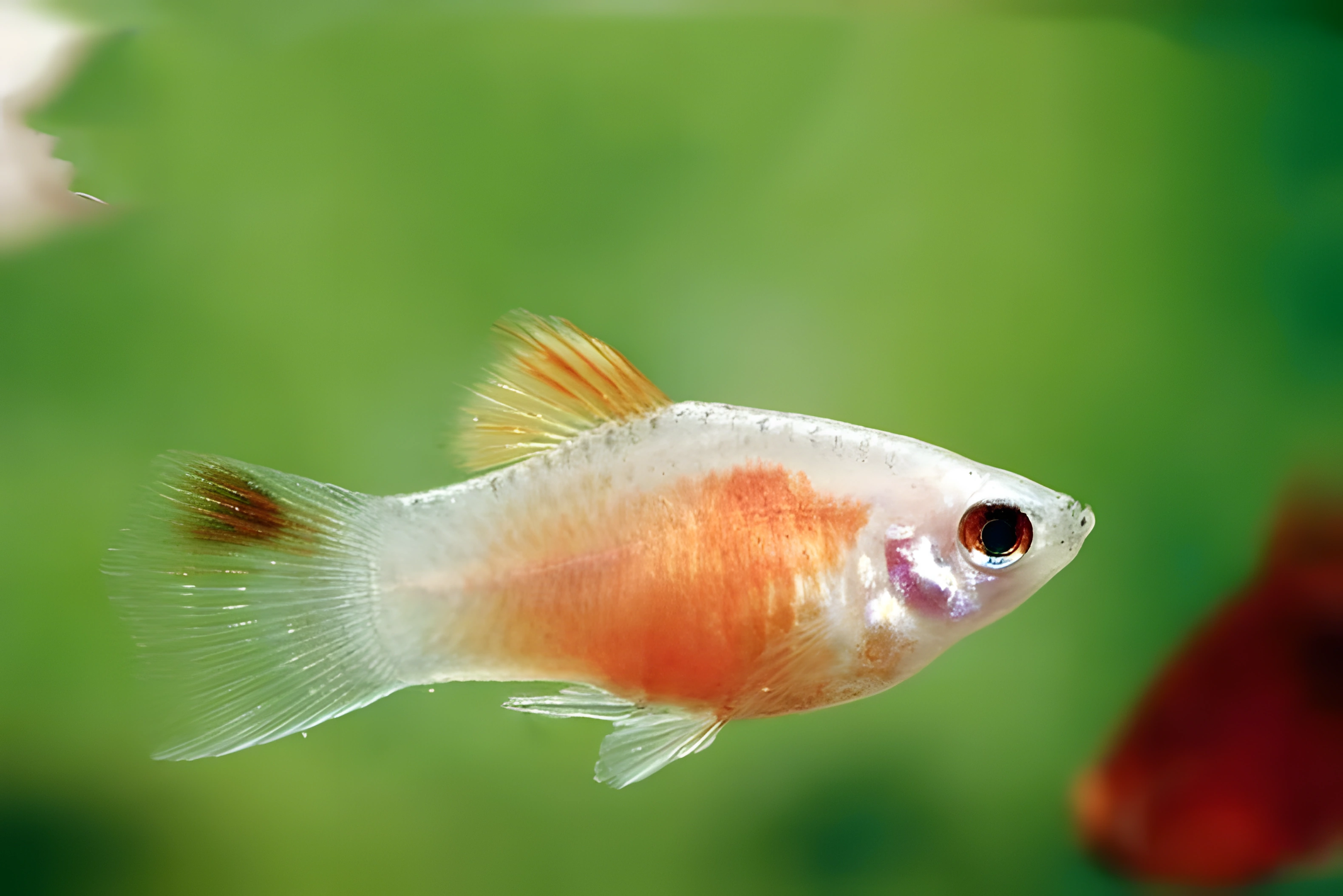
The Coral Platy, also known as the Red and White Platy, is referred to as Platy Coral in the English-speaking market. This fish is a result of selective breeding, showcasing a unique color variation of the common Platy that is not found in nature. Adult specimens are characterized by a combination of milky light shades with orange or red colors. Initially, fry are born with a uniform red coloration, but after several weeks, some of them develop white spots, forming an individual pattern. The remaining fry may either retain their red or orange coloration or become completely white.
- Required aquarium volume
- 60 L
- Size in aquarium
- 5 – 7 cm
- Temperature
- 20 – 28 °C
- Temperament
- Peaceful (regular)
Parameters
Water pHNeutral (7) – Slightly alkaline (8.2)
Water dHMedium hardness (10) – Very hard (30)
Water salinityincreased (10–15 g/L)
Size in aquarium5 – 7 cm
Lifespan4 years
TemperamentPeaceful (regular)
Toward small fishnot a predator
Required aquarium volume60 L
Lightingweak (low)
Substrateany (no restrictions)
Water flowweak or moderate
FeedingFloating (protein)
CareMixed (solitary / pair / group)
Description
The Coral Platy is a selectively bred form of the species Xiphophorus maculatus. These fish have an elongated body, moderately compressed laterally, and a striking red-orange coloration, which is how they got their name. Adult specimens reach 5–7 cm in length. Sexual dimorphism is pronounced: females are noticeably larger and more robust than males, whose anal fin is transformed into a copulatory organ — the gonopodium.
Habitat
This species does not exist in the natural environment, as it is a result of artificial selection. The wild ancestors of platies inhabit waters in Southern Mexico and Guatemala, preferring still or slow-moving waters: swamps, lagoons, and overgrown ponds with dense vegetation. In nature, they are adapted to a wide range of water parameters, including hard and slightly alkaline environments.
Behavior and Compatibility
This species is characterized by a peaceful and friendly nature, allowing it to coexist well with other aquarium fish of similar size and temperament. Within the species itself, competition can be observed among males for dominance and female attention. In small aquariums, males may sometimes show increased activity, so the presence of shelters becomes especially important.
Care and Maintenance
Keeping these fish is no different from the requirements for other subspecies and selectively bred forms of Platies. For a group of 3–4 individuals, an aquarium of 50–60 L will be needed. The water in it should be warm, clean, with pH levels close to neutral, and high general hardness. It is desirable to provide an abundance of aquatic plants in the aquarium, which will serve as a refuge for females, subdominant males, and growing fry. Regular aquarium maintenance, in addition to its technical equipment and the number of inhabitants, includes mandatory weekly procedures: partial water changes with fresh water and timely removal of organic waste, such as leftover food and excrement.
Diet
Beginner aquarists are recommended to choose specialized Platy foods offered by many manufacturers. Such products are enriched with all necessary nutrients, including plant components, which are extremely important for maintaining the health and growth of fish. It is important to promptly remove uneaten food to avoid deterioration of water quality in the aquarium. Aqvium flake food for aquarium fish Check out our new product, a bestseller on Ozon with a rating of 4.9. Flake food is suitable for most aquarium fish. Raw materials are manufactured according to new European Union standards (EU 2018/848). Contains vitamins A, C, D3, E, and Omega 3-6 Buy on Ozon
Breeding and Reproduction
When suitable conditions are provided, the Red and White Platy regularly reproduces. At a water temperature of 22–26°C, the incubation period lasts from 26 to 30 days. Fry are born fully formed and ready for independent feeding. For their feeding, it is preferable to use live foods, such as Artemia nauplii or infusoria, as well as dry powders or suspensions. It is advisable to transfer the fry to a separate tank to protect them from predation by adult fish and ensure more effective feeding.
Diseases
Platies are hardy, but if keeping conditions are violated, especially with sudden temperature fluctuations or poor filtration, they become susceptible to bacterial infections and fungal lesions. Common problems include ich (Ichthyophthirius multifiliis) and fin rot. An important preventative factor is maintaining a stable water temperature (optimally 23–25°C) and regular partial water changes. When kept below 20°C, fish are prone to colds, and if exceeding 25°C, they may lose reproductive function.
How to choose
When purchasing, choose active fish with clean fins, without visible spots, sores, or film on the scales. A healthy platy should show interest in food and have no signs of emaciation or a bloated abdomen. It is recommended to avoid individuals that stay at the water surface, breathe heavily, or display apathetic behavior. It is advisable to acquire fish from aquariums where the correct sex ratio is maintained: there should be two to three females for every male to reduce intraspecific stress.
Frequently asked questions
The essentials: size, tank volume, water parameters and care
How big does Coral Platy get?
An adult reaches 5–7 cm in length. Plan the tank around the maximum size: the fish quickly outgrows a cramped setup.
What size aquarium does Coral Platy need?
The minimum recommended volume is 60 L. A smaller tank speeds up nitrate build-up and raises stress levels.
What water parameters does Coral Platy need?
Temperature 20–28 °C, pH 7–8.2, hardness 10–30 dGH. Stability matters more than exact values: sudden swings are harder on the fish than a small deviation from the ideal.
How long does Coral Platy live?
Around 4 years when kept properly. Lifespan depends directly on tank volume, water quality and a varied diet.
Is Coral Platy aggressive?
Temperament: peaceful (regular). Keep this in mind when choosing tank mates.
How many Coral Platy should be kept together?
Recommended setup: mixed (solitary / pair / group). Ignoring this is a common cause of stress and disease.
What does Coral Platy eat?
Diet type: floating (protein). Feed small portions that are finished within a couple of minutes — overfeeding does more harm than underfeeding.
What is the scientific name of Coral Platy?
The scientific name of the species is Xiphophorus maculatus, family Poeciliidae. It also appears in the literature as: Platypoecilus aurata, Platypoecilus cyanellus, Platypoecilus maculatus.