Temperature20 – 28 °C
Natural range
- Mexico area
- Gulf Coastal Plain area
LivebearersConservation status: Least concern LC
Other scientific names: Platypoecilus variatus
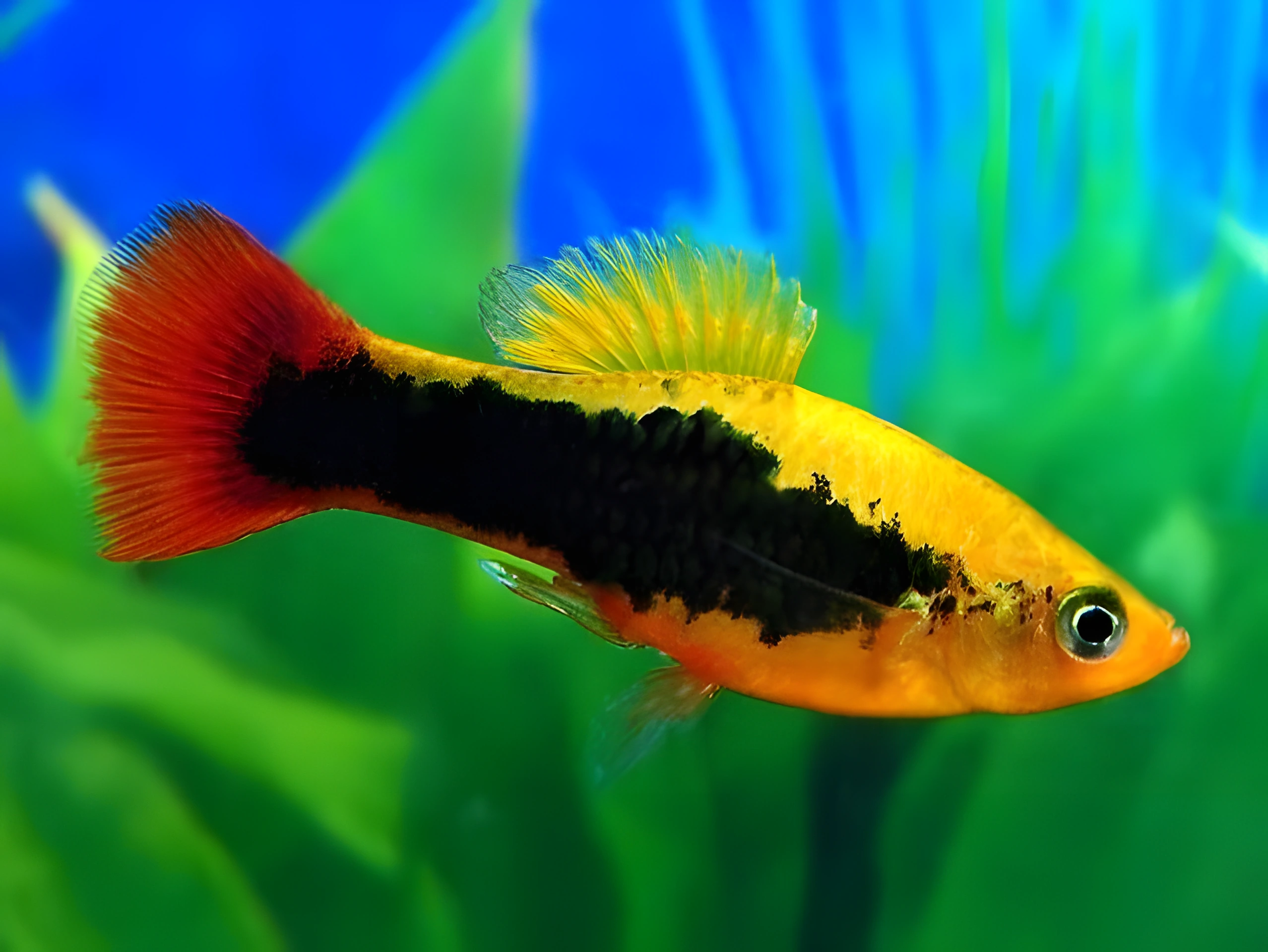
The Hawaii Platy, known in the English-speaking world as the Hawaii Platy, is one of many color variations of Xiphophorus variatus. Its history began in 1962 when this species first appeared at the University of Hawaii at Manoa, which served as the basis for its name. This fish has a very remarkable coloration: its tail is bright red, and its body combines black and yellow hues. Its fins can be either yellow or completely transparent, colorless.
- Required aquarium volume
- 60 L
- Size in aquarium
- 5 – 7 cm
- Temperature
- 20 – 28 °C
- Temperament
- Peaceful (regular)
Parameters
Water pHNeutral (7) – Slightly alkaline (8.2)
Water dHMedium hardness (9) – Very hard (25)
Water salinityincreased (10–15 g/L)
Size in aquarium5 – 7 cm
Lifespan4 years
TemperamentPeaceful (regular)
Toward small fishnot a predator
Required aquarium volume60 L
Lightingweak (low)
Substrateany (no restrictions)
Water flowweak or moderate
FeedingFloating (protein)
CareMixed (solitary / pair / group)
Description
The Hawaii Platy is a selectively bred color morph of the species Xiphophorus variatus. The fish has a characteristic bright coloration, including a red tail and a combination of yellow and black tones on its body. The fins can be transparent or have a yellowish tint. Adult specimens reach a size of 5–7 cm. Sexual dimorphism is typical for livebearers: males have a gonopodium (a modified anal fin) and usually have a more slender body, while females are larger and rounder.
Habitat
The wild species Xiphophorus variatus inhabits waters in Mexico, primarily in river systems. In nature, the fish prefer areas with moderate currents and dense vegetation. In aquarium conditions, this species demonstrates high adaptability, successfully developing in water with medium to high hardness (10–30 dGH) and slightly alkaline reaction (pH 7.0–8.2).
Behavior and Compatibility
This is a peaceful and active species, suitable for keeping in a community tank with similarly sized, calm fish. Platies can be kept individually or in groups. Intraspecific aggression is weak, but males may exhibit territorial behavior if overcrowded or lacking space. The fish prefer the middle and upper layers of the water.
Care and Maintenance
For a group of 3–4 individuals of this species, an aquarium of at least 50–60 liters is recommended. Various aquarium decorations are acceptable, but creating hiding places, for example, from dense thickets of aquatic plants, is welcome. Optimal conditions for the Hawaii Platy are warm and slightly alkaline water with high general hardness. Nevertheless, it demonstrates the ability to adapt to less hard water with a lower pH level. Due to its unpretentiousness, this species is considered a good option for beginner aquarists. Regarding nutrition, it is an omnivorous species that readily accepts a variety of popular dry foods, such as flakes and granules, of appropriate size. Live or frozen invertebrates, such as Artemia, bloodworms, Daphnia, or mosquito larvae, can also be included in the diet. It is important to note that the daily diet should contain vegetable supplements; otherwise, the fish may start to nibble on the soft parts of aquarium plants. Aqvium flake food for aquarium fish, which has become a bestseller on Ozon with a rating of 4.9, is recommended. It is suitable for most aquarium fish, and its raw materials are produced according to new European Union standards (EU 2018/848). It contains essential vitamins A, C, D3, E, and Omega 3-6. It can be purchased on Ozon. In terms of behavior and compatibility, the Hawaii Platy gets along well with almost all similarly sized aquarium fish with a comparable temperament.
Diet
The species is omnivorous. The diet should include both high-quality dry foods (flakes, granules) and live or frozen invertebrates, such as Artemia, Daphnia, or bloodworms. An essential condition is the presence of plant components in the daily menu, without which the fish may damage the soft parts of aquarium plants.
Breeding and Reproduction
Like all livebearing fish, Platies are born fully formed, bypassing the egg stage in the usual sense. Although eggs are present, their development occurs directly inside the female's body. Under favorable environmental conditions, new offspring can appear almost every month. The average incubation period is 26 to 30 days at a water temperature range of 22–26°C. Crossbreeding with other varieties of Platies is also possible. Occasionally, hybrid offspring with the closely related Swordtail may occur, but this phenomenon is extremely rare in a home aquarium.
Diseases
Platies have strong immunity if kept under proper conditions. The most common problems include bacterial infections and parasitic diseases, which arise from poor water quality or sharp parameter fluctuations. Prevention involves regular water changes of up to 25% of the volume weekly, ensuring effective filtration, and maintaining a stable temperature.
How to choose
When choosing specimens, attention should be paid to clean skin, absence of spots, ulcers, and plaque. A healthy fish should be active, with clean fins and a normal appetite. Avoid purchasing fish that stay at the water surface, look emaciated, or have clamped fins, as this may be a sign of chronic stress or illness.
Frequently asked questions
The essentials: size, tank volume, water parameters and care
How big does Hawaii Platy get?
An adult reaches 5–7 cm in length. Plan the tank around the maximum size: the fish quickly outgrows a cramped setup.
What size aquarium does Hawaii Platy need?
The minimum recommended volume is 60 L. A smaller tank speeds up nitrate build-up and raises stress levels.
What water parameters does Hawaii Platy need?
Temperature 20–28 °C, pH 7–8.2, hardness 9–25 dGH. Stability matters more than exact values: sudden swings are harder on the fish than a small deviation from the ideal.
How long does Hawaii Platy live?
Around 4 years when kept properly. Lifespan depends directly on tank volume, water quality and a varied diet.
Is Hawaii Platy aggressive?
Temperament: peaceful (regular). Keep this in mind when choosing tank mates.
How many Hawaii Platy should be kept together?
Recommended setup: mixed (solitary / pair / group). Ignoring this is a common cause of stress and disease.
What does Hawaii Platy eat?
Diet type: floating (protein). Feed small portions that are finished within a couple of minutes — overfeeding does more harm than underfeeding.
What is the scientific name of Hawaii Platy?
The scientific name of the species is Xiphophorus variatus, family Poeciliidae. It also appears in the literature as: Platypoecilus variatus.