Temperature20 – 28 °C
Natural range
- Mexico area
- Guatemala area
- Belize area
- Nicaragua area
LivebearersConservation status: Data deficient DD
Other scientific names: Platypoecilus aurata, Platypoecilus cyanellus, Platypoecilus maculatus, Platypoecilus nigra, Platypoecilus pulchra, Platypoecilus rubra
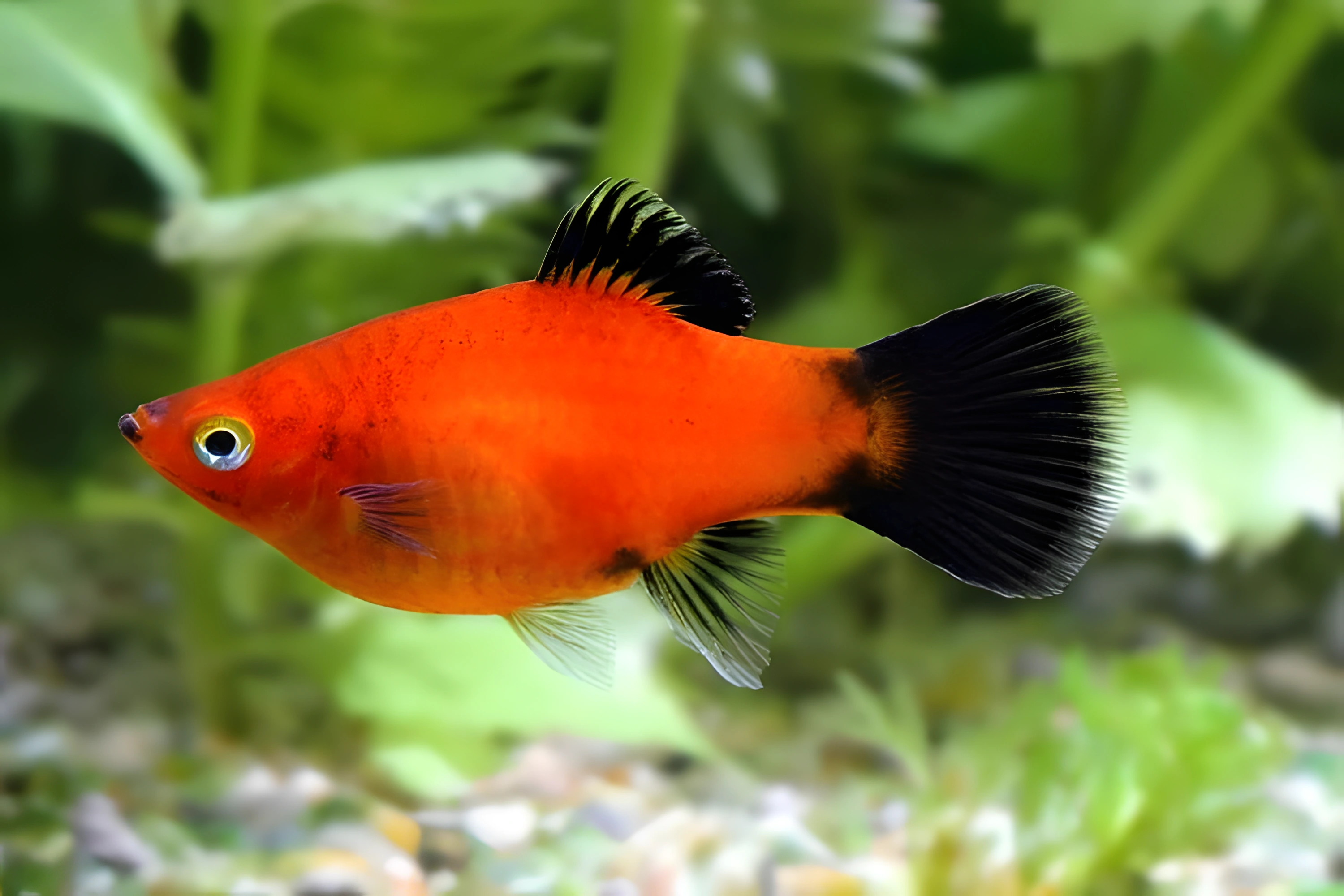
The Wagtail Platy, often considered a benchmark or even a classic example among platies, is the fish usually associated with this entire group of attractive fish. Its body can be red, orange, or golden, which contrasts strikingly with its intensely black fins and tail. Due to its primary coloration, it is also often called the Red or Yellow (Golden) Platy, although formally these names refer to separate, though related, varieties.
- Required aquarium volume
- 60 L
- Size in aquarium
- 5 – 7 cm
- Temperature
- 20 – 28 °C
- Temperament
- Peaceful (regular)
Parameters
Water pHNeutral (7) – Slightly alkaline (8.2)
Water dHMedium hardness (9) – Very hard (19)
Water salinityincreased (10–15 g/L)
Size in aquarium5 – 7 cm
Lifespan4 years
TemperamentPeaceful (regular)
Toward small fishnot a predator
Required aquarium volume60 L
Lightingweak (low)
Substrateany (no restrictions)
Water flowweak or moderate
FeedingAny (universal)
CareMixed (solitary / pair / group)
Description
The history of the Wagtail Platy began in the 1940s in the New York laboratory of biologist Dr. Myron Gordon. During one of his expeditions to the tropical regions of Mexico, he discovered a small fish from the genus Xiphophorus, characterized by black fin and tail edges. It was subsequently named the “Comet” Platy. A detailed article was published in “Aquarium” magazine in August 1940, where Dr. Gordon recalled: “When we first discovered this fish in Mexico, our first thought was that it was just another specimen among the amazing genetic diversity of Platies. At that time, it was of interest to me solely as an object for genetic study. The aquarium fish dealers accompanying our expedition did not see it as a promising commercial species.” Upon returning to New York, Myron Gordon did not isolate the “Comet” Platy in his laboratory but placed it in a community tank with other Platy varieties. A month later, the result was unexpectedly diverse: the fry had not only black fins but also a contrasting pattern of speckles all over their bodies and heads. This new variety was named the Wagtail Platy. The final appearance of this variety was shaped on commercial fish farms. Through selective breeding, the speckles were eliminated from the body, and cross-breeding with Red and Golden Platies gave the body reddish and yellow hues, respectively, while the black fins were retained.
Habitat
In nature, the species inhabits fresh and brackish waters of Central America, including territories from Mexico to Nicaragua. The fish populate shallow areas of rivers, lakes, swamps, and flooded pastures. They prefer zones with dense aquatic vegetation and weak currents. Water parameters in their natural habitat range from 20–28 °C, pH 7.0–8.2, and medium to high hardness.
Behavior and Compatibility
Platies are peaceful and active fish that prefer to stay in the middle water column. They get along well with other non-aggressive species of comparable size, such as swordtails, guppies, and mollies. Intraspecific relationships are characterized by tolerance, but it is recommended to keep a group where the number of females exceeds the number of males to reduce stress levels in the females.
Care and Maintenance
This small, lively fish impresses with its peaceful nature and amazing ability to adapt to various conditions, making it an excellent tank mate for many other species. It prefers warm, slightly alkaline water with moderate to high GH values. For a group of 3–4 individuals, an aquarium of 60–70 L will be required. Regular maintenance and an efficient filtration system are crucial. Brief information: Feeding. The fish readily accepts most common foods — whether dry flakes, frozen, or live foods. Specialized foods from many manufacturers, developed specifically for platies, will be an excellent choice. It is recommended to feed the fish 2–3 times a day, offering a portion they can consume within 5 minutes. This rule is extremely important, as platies are prone to overeating, and uneaten food quickly pollutes the water. There is an unwritten rule: it's better to give a little less than too much. Aqvium flake food for aquarium fish, which has received high ratings on Ozon (4.9), will be an excellent choice for most of your aquarium pets. Its raw materials comply with new EU standards (EU 2018/848), and its composition is enriched with vitamins A, C, D3, E, and Omega 3-6 fatty acids. You can purchase it on Ozon. Breeding / Reproduction. The appearance of fry will be a regular event if mature male and female are present. The incubation period usually takes approximately 4–6 weeks, and new fry can be expected with the same frequency. It is important to remember that these fish can interbreed with other varieties, leading to hybrid offspring.
Diet
The species is omnivorous. In the aquarium, fish readily accept all types of food: high-quality dry flakes, granules, as well as frozen and live foods such as bloodworms, daphnia, or brine shrimp. To maintain health and prevent digestive problems, vegetable supplements must be included in the diet. It is recommended to feed the fish 1–2 times a day in portions that are consumed within a few minutes.
Breeding and Reproduction
Platies are livebearing fish, so breeding does not require special conditions. Sexual maturity occurs at 3–5 months. The female carries the fry for 28–35 days, after which fully formed individuals are born. To preserve the offspring, it is recommended to move the female to a separate aquarium with dense vegetation before birth, as adult fish may eat the fry. Brine shrimp nauplii, cyclops, or specialized dry foods serve as initial food for the young.
Diseases
When stable keeping conditions are maintained, the fish have strong immunity. The main risks are associated with overpopulation, sudden changes in water parameters, and poor aquarium hygiene. The most characteristic diseases include ichthyophthiriasis, fin rot, and bacterial infections. Prevention includes regular water changes, quarantining new individuals, and maintaining substrate cleanliness.
How to choose
When choosing, preference should be given to active and mobile individuals with clean fins and no visible damage, spots, or film on the body. It is important to assess the condition of the aquarium in the store: the water should be clear, and neighboring fish should look healthy. Avoid purchasing individuals that stay near the surface, appear sluggish, or have unnaturally clamped fins.
Frequently asked questions
The essentials: size, tank volume, water parameters and care
How big does Wagtail Platy get?
An adult reaches 5–7 cm in length. Plan the tank around the maximum size: the fish quickly outgrows a cramped setup.
What size aquarium does Wagtail Platy need?
The minimum recommended volume is 60 L. A smaller tank speeds up nitrate build-up and raises stress levels.
What water parameters does Wagtail Platy need?
Temperature 20–28 °C, pH 7–8.2, hardness 9–19 dGH. Stability matters more than exact values: sudden swings are harder on the fish than a small deviation from the ideal.
How long does Wagtail Platy live?
Around 4 years when kept properly. Lifespan depends directly on tank volume, water quality and a varied diet.
Is Wagtail Platy aggressive?
Temperament: peaceful (regular). Keep this in mind when choosing tank mates.
How many Wagtail Platy should be kept together?
Recommended setup: mixed (solitary / pair / group). Ignoring this is a common cause of stress and disease.
What does Wagtail Platy eat?
Diet type: any (universal). Feed small portions that are finished within a couple of minutes — overfeeding does more harm than underfeeding.
What is the scientific name of Wagtail Platy?
The scientific name of the species is Xiphophorus maculatus, family Poeciliidae. It also appears in the literature as: Platypoecilus aurata, Platypoecilus cyanellus, Platypoecilus maculatus.