Temperature20 – 28 °C
LivebearersConservation status: Least concern LC
Other scientific names: Gambusia modesta, Gambusia plumbea, Lembesseia parvianalis, Mollienesia altissima, Mollienesia macrura, Mollienesia pallida
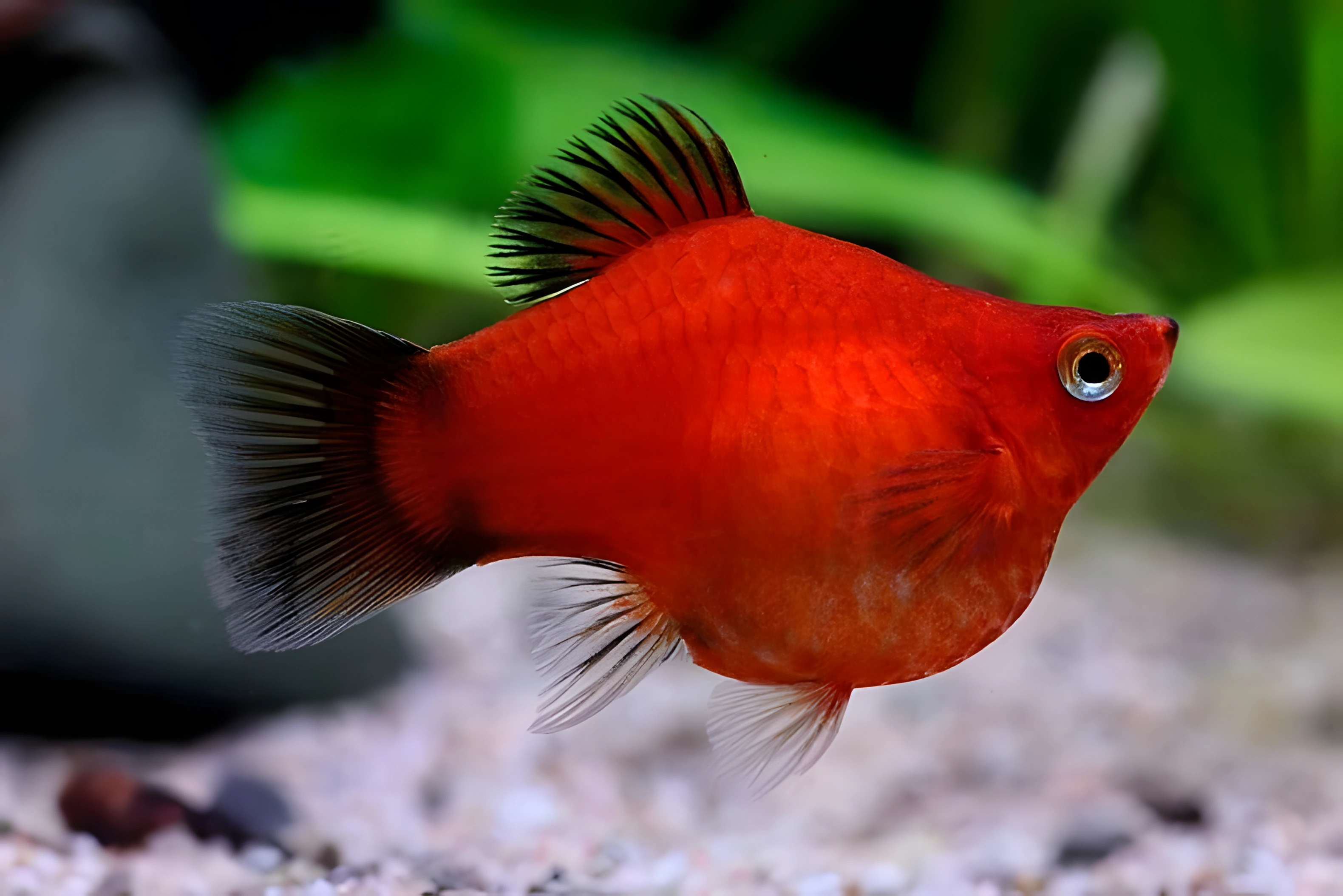
The Balloon Platy, also known as the Disc Platy, is known in the English-speaking commercial world as the Balloon Platy. A distinctive feature of this fish is its peculiar appearance: it has a strongly arched, hunched back and a noticeably inflated belly, characteristic of both males and females. Variations in coloration and body pattern can be very diverse.
- Required aquarium volume
- 60 L
- Size in aquarium
- 5 – 7 cm
- Temperature
- 20 – 28 °C
- Temperament
- Peaceful (regular)
Parameters
Water pHNeutral (7) – Slightly alkaline (8.2)
Water dHMedium hardness (10) – Very hard (25)
Water salinityincreased (10–15 g/L)
Size in aquarium5 – 7 cm
Lifespan4 years
TemperamentPeaceful (regular)
Toward small fishnot a predator
Required aquarium volume60 L
Lightingweak (low)
Substrateany (no restrictions)
Water flowweak or moderate
FeedingFloating (protein)
CareMixed (solitary / pair / group)
Description
The Balloon Platy is a selective breeding form characterized by a deformed spine, which gives the fish a shortened, bloated body shape and a greatly enlarged belly. Outwardly, this manifests as a hunched back and a rounded abdomen. Coloration and pattern vary depending on the specific breeding line. Sexual dimorphism is typical for livebearers: males have a pointed anal fin, transformed into a gonopodium, while in females it has a rounded shape.
Habitat
In nature, the species Poecilia sphenops inhabits fresh and brackish waters of Central and South America, from Mexico to Colombia. However, the balloon form is exclusively the result of artificial selection, obtained in fish farms, mainly in Asian countries. This morphological mutation is not found in its natural habitat.
Behavior and Compatibility
These are peaceful and calm fish suitable for community tanks with non-aggressive tankmates. Due to their anatomical body structure and the associated swimming difficulties, they require calm tankmates, as overly active fish can create competition for food. It is recommended to keep them in a group with fewer males than females.
Care and Maintenance
The requirements for keeping these fish are largely similar to the conditions necessary for other platy varieties. They require warm, slightly alkaline water, preferably with high hardness levels. It is also important to provide hiding places, such as dense plant thickets. However, unlike their relatives, which can withstand short-term deterioration in water quality, the Disc Platy shows less endurance and is more susceptible to diseases. For this reason, aquarium care where it is kept must be particularly thorough. It is worth noting that fry show the same sensitivity to diseases. As for nutrition, it is extremely important to provide a balanced diet, including both protein and plant components. Live or frozen invertebrates such as Artemia, bloodworms, Daphnia, and mosquito larvae will be an excellent addition to the main feed. An example of a suitable product: Aqvium flake food for aquarium fish. Our new product has successfully proven itself on Ozon, receiving a 4.9 rating and becoming a bestseller. This flake food is designed for most aquarium fish. Its raw materials comply with new European Union standards (EU 2018/848) and are enriched with vitamins A, C, D3, E, as well as Omega 3-6. You can purchase it on Ozon. Regarding behavior and compatibility: this is a peaceful and calm fish. Given the peculiarities of its structure and the associated swimming problems, it is preferable to choose species with similar slowness as tankmates. Overly active fish will create an unfavorable environment for it. Breeding is possible, however, as mentioned earlier, most fry will often be sickly, which significantly reduces their survival rate. In addition, a significant part of the brood, and in some cases the entire brood, may have a normal body shape, since the characteristic trait for this variety, although heritable, is not dominant. It may only appear after one or even several generations.
Diet
These fish are omnivorous and undemanding in terms of diet. The diet should be balanced and must include plant components, such as specialized foods with algae, blanched vegetables, or scalded lettuce. Additionally, high-quality dry, frozen, or live foods, such as Artemia or Daphnia, can be used. It is important not to overfeed individuals, as they are prone to gluttony.
Breeding and Reproduction
Breeding occurs in the same way as with other livebearing fish, but it is associated with a number of difficulties. Fry are often born weak, and survival rates may be lower than with normal forms. The characteristic balloon body shape is not a dominant trait, so some offspring may have a normal spinal structure. Selective breeding is required to maintain the form.
Diseases
Due to spinal curvature, these fish are prone to anatomical problems that affect their internal organs and swimming ability. They are more sensitive to water quality and keeping conditions than the original species. In the aquarium, it is important to maintain cleanliness, regularly change water, and ensure good aeration, as stress and environmental pollution quickly provoke the development of infectious diseases.
How to choose
When purchasing, choose active fish with clean skin and no visible fin damage. It is important to avoid individuals that constantly lie on the bottom or show signs of emaciation. Given the inherent anatomical defects of the balloon form, it is worth carefully examining the fish for the absence of ulcers, unnatural plaque, or signs of curvature beyond the breed standard.
Frequently asked questions
The essentials: size, tank volume, water parameters and care
How big does Balloon Platy get?
An adult reaches 5–7 cm in length. Plan the tank around the maximum size: the fish quickly outgrows a cramped setup.
What size aquarium does Balloon Platy need?
The minimum recommended volume is 60 L. A smaller tank speeds up nitrate build-up and raises stress levels.
What water parameters does Balloon Platy need?
Temperature 20–28 °C, pH 7–8.2, hardness 10–25 dGH. Stability matters more than exact values: sudden swings are harder on the fish than a small deviation from the ideal.
How long does Balloon Platy live?
Around 4 years when kept properly. Lifespan depends directly on tank volume, water quality and a varied diet.
Is Balloon Platy aggressive?
Temperament: peaceful (regular). Keep this in mind when choosing tank mates.
How many Balloon Platy should be kept together?
Recommended setup: mixed (solitary / pair / group). Ignoring this is a common cause of stress and disease.
What does Balloon Platy eat?
Diet type: floating (protein). Feed small portions that are finished within a couple of minutes — overfeeding does more harm than underfeeding.
What is the scientific name of Balloon Platy?
The scientific name of the species is Poecilia sphenops, family Poeciliidae. It also appears in the literature as: Gambusia modesta, Gambusia plumbea, Lembesseia parvianalis.