Temperature22 – 28 °C
Natural range
- West Kalimantan area
- Borneo area
Labyrinth fishConservation status: Critically endangered CR
The Ornate Licorice Gourami, also known as Parosphromenus ornaticauda, belongs to the family Osphronemidae. These fish are available for purchase, but their keeping is associated with a number of difficulties, so they are not a suitable choice for inexperienced aquarists.
- Required aquarium volume
- 30 L
- Size in aquarium
- 2.5 – 4 cm
- Temperature
- 22 – 28 °C
- Temperament
- Peaceful (regular)
Parameters
Water pHAcidic (3) – Neutral (6.5)
Water dHVery soft (1) – Soft (5)
Water salinityno salt (freshwater)
Size in aquarium2.5 – 4 cm
Lifespan4 years
TemperamentPeaceful (regular)
Toward small fishnot a predator
Required aquarium volume30 L
Lightingdimmed
Substrateany, but dark
Water flownone or stagnant (no flow)
FeedingHigh protein (predominantly meat)
CareSchooling (usually from 5–6 individuals and more)
Description
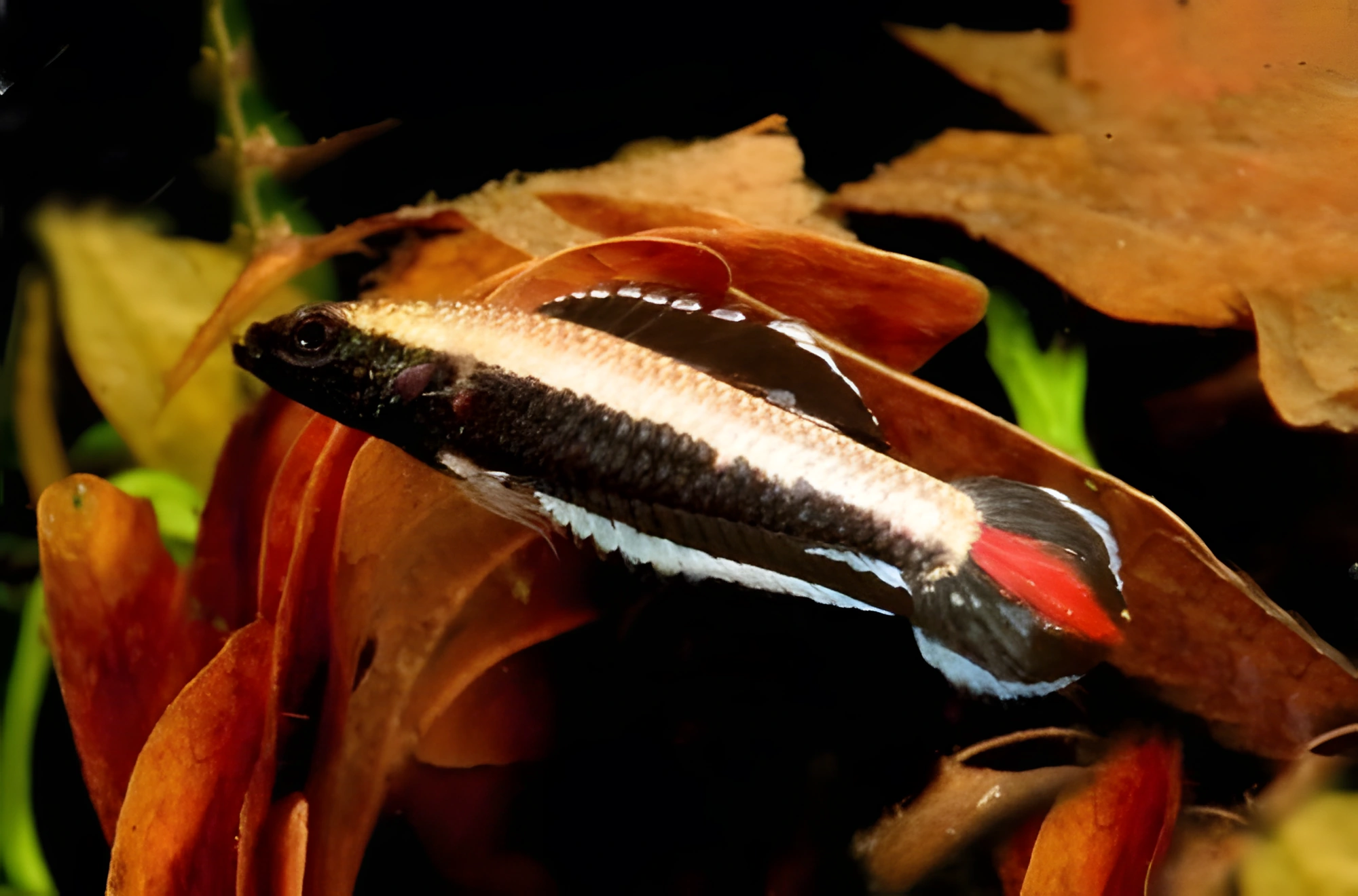
These fish reach a length of no more than 3 cm. Their name "ornate" is fully justified by the contrasting pattern on their body and fins. The lower part of their body is colored in brownish-black tones, while the upper part has a lighter shade. Interestingly, during spawning, the light areas darken, almost matching the color of the lower part. The caudal fin stands out with a bluish-white edge, followed by a black inner part with a wide red stripe. The other fins are dark, with a noticeable light edging. Distinguishing males and females by coloration is almost impossible, as it is identical in both.
Habitat
The natural habitat of this fish is the Indonesian part of Borneo island, specifically the West Kalimantan province in Southeast Asia. Here it is found in the peat swamps of the Kapuas and Pawan river basins. A typical biotope for Parosphromenus ornaticauda is a shallow body of water located under the canopy of a dense tropical forest, where only faint sunlight penetrates. The bottom of such bodies of water is covered with a thick layer of organic debris, the decomposition of which leads to the release of humic acids and other tannins, giving the water a characteristic rich brown hue.
Behavior and Compatibility
Among males, there is competition for the attention of females, which intensifies during the breeding season. However, this rivalry rarely goes beyond displays of strength, which allows several males to be kept in one aquarium. These fish are peaceful and get along well with other non-aggressive species of comparable size.
Care and Maintenance
For one or two fish, the optimal aquarium volume starts from 20–30 liters. When decorating, it is recommended to create many shelters, using, for example, a combination of driftwood and thickets of live plants, including floating ones. Lighting should be subdued, so it is better to choose shade-loving plant species for the aquarium. Any dark substrate will be suitable as a bottom material. Often, a layer of pre-soaked dried leaves of certain trees is placed on the substrate so that they do not float. Leaves not only complement the natural decor but also help to give the water a chemical composition close to the natural habitat conditions of these fish. You can learn more about this in the article "Which tree leaves can be used in an aquarium". However, the decoration can be quite free. Some aquarists even refuse to use substrate to facilitate maintenance, and use PVC pipe fragments, inverted ceramic pots, and other decorative elements as shelters. The long-term well-being of Parosphromenus ornaticauda depends on maintaining a stable aquatic environment within acceptable temperature and hydrochemical parameters. The latter can be challenging for beginners, as achieving low pH and dGH values may require a reverse osmosis system or the use of traditional methods for obtaining soft water. It is important to ensure delicate filtration, avoiding strong currents. A simple air-driven sponge filter often works well for this.
Diet
Preference is given to live or frozen foods. Their diet consists mainly of small invertebrates such as brine shrimp, daphnia, bloodworms, and mosquito larvae. It has been observed that dry granulated foods are generally not accepted by them.
Breeding and Reproduction
Spawning of Ornate Licorice Gouramis successfully occurs under suitable environmental conditions and a balanced diet. During the breeding period, males, as already mentioned, acquire a uniform dark shade. They choose an area on the bottom, in the center of which there is some kind of shelter, and begin to court the females. Sometimes a nest of air bubbles is built in the shelter beforehand. When the female accepts the courtship, spawning begins. The fish press tightly against each other, taking an almost vertical head-down position. At a certain moment, a portion of eggs is released, which are immediately fertilized. The parents carefully place all the eggs in the shelter. After spawning is complete, the female swims away, leaving the male to guard the clutch. He stays with the offspring until the hatched fry begin to swim freely. This entire process takes about a week, after which the male loses interest in them. The fry can stay with the parents in safety, as there is no risk of being eaten. However, if other fish species are present in the aquarium, avoiding cases of predation will likely not be possible. In such a case, the young are best moved to a separate tank.
Diseases
Maintaining a stable biological system, providing a balanced diet, and eliminating stress factors (e.g., harassment by aggressive tank mates) are the best guarantees for preserving fish health. If the first signs of illness appear, the first thing to pay attention to is precisely these three aspects, as deviations have likely occurred in one of them. As a rule, eliminating the problem leads to self-recovery. However, if the immune system proves to be insufficiently strong, medicinal treatment may be required. More detailed information on symptoms and treatment methods can be found in the "Diseases of Aquarium Fish" section.
How to choose
When purchasing, caution should be exercised, as this species often goes on sale in a weakened state after transport and is extremely sensitive to bacterial infections. A healthy individual should actively react to external stimuli, have no visible fin damage, ulcers, or film on the body. Avoid purchasing fish with signs of emaciation, sunken bellies, or those that constantly stay at the water surface, unless this is caused by stress from relocation. Given the secretive lifestyle of the species, fish in the store often look pale, but with proper care, their coloration quickly recovers. It is recommended to clarify with the seller the keeping conditions and the adaptation period of the individuals in the aquarium, as abrupt changes in water parameters can be detrimental to this species.
Frequently asked questions
The essentials: size, tank volume, water parameters and care
How big does Ornate Licorice Gourami get?
An adult reaches 2.5–4 cm in length. Plan the tank around the maximum size: the fish quickly outgrows a cramped setup.
What size aquarium does Ornate Licorice Gourami need?
The minimum recommended volume is 30 L. A smaller tank speeds up nitrate build-up and raises stress levels.
What water parameters does Ornate Licorice Gourami need?
Temperature 22–28 °C, pH 3–6.5, hardness 1–5 dGH. Stability matters more than exact values: sudden swings are harder on the fish than a small deviation from the ideal.
How long does Ornate Licorice Gourami live?
Around 4 years when kept properly. Lifespan depends directly on tank volume, water quality and a varied diet.
Is Ornate Licorice Gourami aggressive?
Temperament: peaceful (regular). Keep this in mind when choosing tank mates.
How many Ornate Licorice Gourami should be kept together?
Recommended setup: schooling (usually from 5–6 individuals and more). Ignoring this is a common cause of stress and disease.
What does Ornate Licorice Gourami eat?
Diet type: high protein (predominantly meat). Feed small portions that are finished within a couple of minutes — overfeeding does more harm than underfeeding.
What is the scientific name of Ornate Licorice Gourami?
The scientific name of the species is Parosphromenus ornaticauda, family Osphronemidae.