Temperature22 – 28 °C
Natural range
- Johor area
- Malay Peninsula area
Labyrinth fish
The fish Parosphromenus tweediei, also known as Tweedie's Licorice Gourami, is a member of the Osphronemoides family. Its name was given in honor of ichthyologist Michael Tweedie, who made a significant contribution to the discovery of a number of riverine species in Malaysia. Keeping this species in an aquarium is considered quite challenging for beginners, as it requires maintaining very low pH and dGH values.
- Required aquarium volume
- 30 L
- Size in aquarium
- 3 – 3.5 cm
- Temperature
- 22 – 28 °C
- Temperament
- Peaceful (regular)
Parameters
Water pHAcidic (3) – Neutral (6.5)
Water dHVery soft (1) – Soft (5)
Water salinityno salt (freshwater)
Size in aquarium3 – 3.5 cm
Lifespan3 years
TemperamentPeaceful (regular)
Toward small fishnot a predator
Required aquarium volume30 L
Lightingdimmed
Substrateany, but dark
Water flownone or stagnant (no flow)
FeedingHigh protein (predominantly meat)
CareSchooling (usually from 5–6 individuals and more)
Description
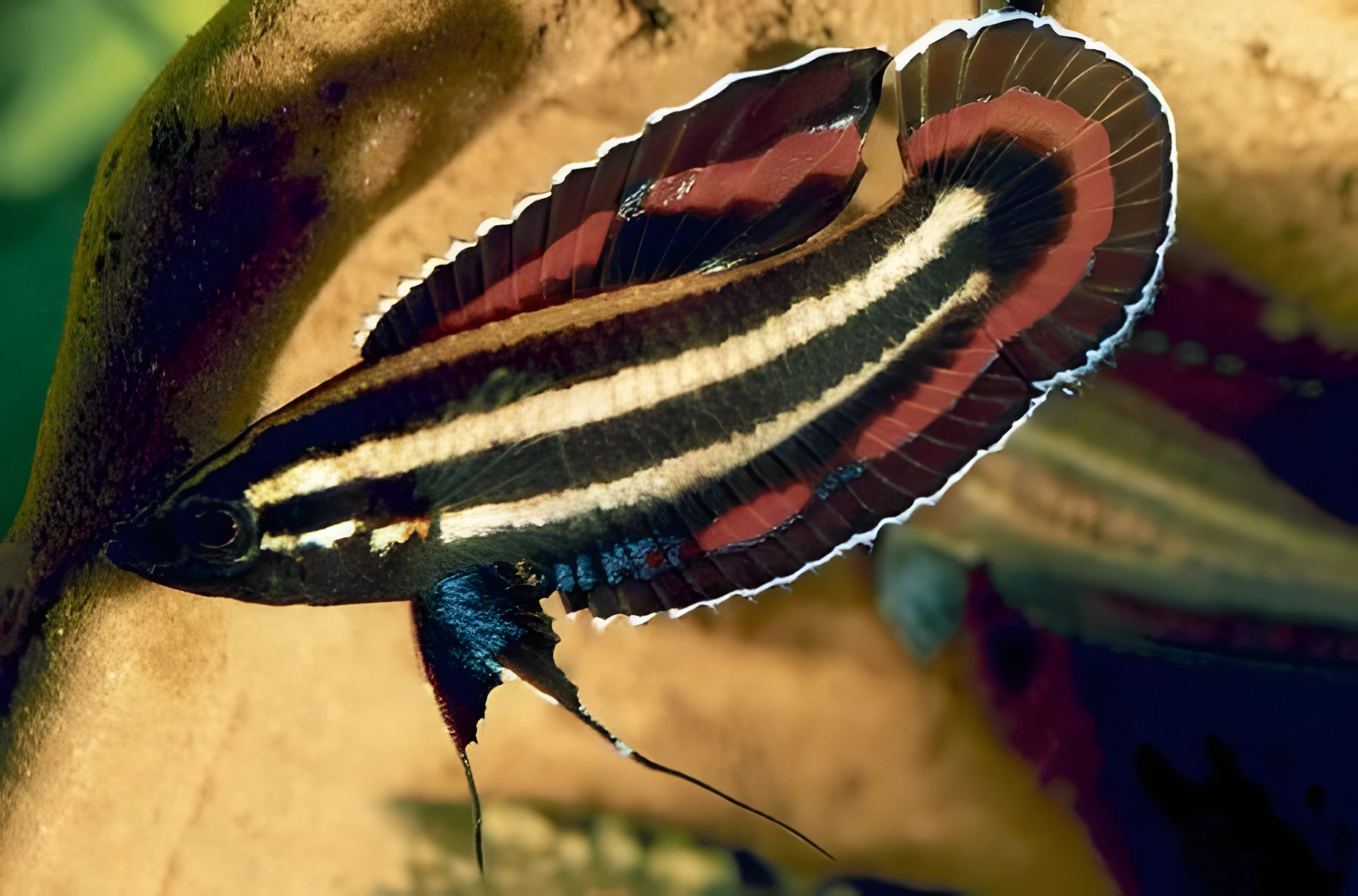
Adults usually exceed 3 cm in length. The fish's body displays a characteristic striped pattern formed by alternating horizontal black and yellow bands. Males stand out with brighter fin coloration. The dorsal and anal fins, as well as the caudal fin, feature a red stripe, which is bordered on both sides by wider black stripes, and the edges are outlined with a delicate blue line. It should be noted that in the anal fin, the red stripe is sometimes divided by blue pigment. During the breeding season, their coloration becomes noticeably more intense. Unlike males, adult females do not possess red and blue stripes, and their overall coloring appears somewhat duller, tending towards gray hues.
Habitat
The natural habitat of this species is in Southeast Asia, specifically on the Malay Peninsula, and largely coincides with the territory of the Malaysian state of Johor. The fish inhabit tropical peat swamps hidden deep within tropical forests. These biotopes are characterized by shallow bodies of water, the bottom of which is traditionally covered with an impressive layer of fallen natural materials — leaves, branches, and tree roots. The water in such places has a cloudy, dark hue, which is explained by the high content of humic acids and other tannins released during the decomposition of organic matter. Nowadays, this species is becoming rare in the wild, suffering from the rapid reduction of forest areas and the pollution of remaining water bodies.
Behavior and Compatibility
Males compete for females and territories during spawning. However, if there are enough shelters, keeping several males in one aquarium is not difficult, and their rivalry is usually limited to displays of strength. Females are generally calmer. Parosphromenus tweediei show good compatibility with other miniature fish species that can live in similar conditions. In their natural environment, their neighbors can be rasboras, some peaceful Betta species, and barbs.
Care and Maintenance
For one or two fish, an aquarium of 20 to 30 liters will be optimal. When decorating the aquarium, it is important to think about a system of shelters where the fish can hide. If only natural decor is used, snags, thickets of shade-loving plants, and a layer of fallen leaves from various trees can help solve this problem. If aesthetics are not a priority, any aquarium decorations, ceramic pots or vessels laid on their side, or fragments of PVC pipes can serve as shelters. Lighting should be subdued, and additional shading can be created with floating plants. Ultimately, the choice of decorative elements is up to the aquarist. Long-term keeping of Parosphromenus tweediei is only possible with strictly low water hydrochemistry parameters. Water preparation may require the installation of a reverse osmosis system or the use of traditional softening methods. Tree leaves will have a positive effect on the chemical composition of the water, not only serving as a decorative element but also releasing tannins, recreating a natural habitat. The stability of the aquarium ecosystem depends on the uninterrupted operation of equipment, primarily filters, as well as the regular performance of mandatory procedures: weekly water changes of 10–15% with fresh water and timely removal of organic waste – food debris and excrement. When choosing a filtration system, preference should be given to models that do not create excessive water movement, as Parosphromenus, accustomed to natural stagnant swamps, tolerate strong currents poorly.
Diet
In their natural habitat, these fish feed on small invertebrates. In a home aquarium, their diet should be appropriate and include live or frozen foods such as Artemia, bloodworms, Daphnia, Drosophila flies, and mosquito larvae. Dry foods are usually accepted reluctantly and, as a rule, cannot serve as a complete basis for their diet.
Breeding and Reproduction
The likelihood of spawning directly depends on the quality of the fish's habitat and the food provided. In favorable conditions, reproduction occurs regularly. At the beginning of the breeding season, the male occupies a certain area at the bottom of the aquarium around some shelter, which will become the place for the future clutch. Sometimes he may build a bubble nest inside this shelter. After the location is determined, courtship begins. The male tries to attract one of the females to his nest, and if she responds to his advances, spawning begins. The pair forms for only one breeding season, and the partners may well change next time. Females usually do not participate in caring for the offspring, leaving the clutch immediately after laying all the eggs. The male, on the contrary, remains nearby until the hatched fry begin to swim freely, after which his parental instincts gradually fade. This process takes approximately one week. The fry can grow up alongside their parents without fear of being eaten. However, if other fish are present in the aquarium, cases of predation cannot be avoided.
Diseases
Maintaining a stable biological system, providing a balanced diet, and eliminating stress factors (e.g., harassment by aggressive tank mates) are the best guarantees for preserving fish health. If the first signs of illness appear, the first thing to pay attention to is precisely these three aspects, as deviations have likely occurred in one of them. As a rule, eliminating the problem leads to self-recovery. However, if the immune system proves to be insufficiently strong, medicinal treatment may be required. More detailed information on symptoms and treatment methods can be found in the "Diseases of Aquarium Fish" section.
How to choose
When purchasing Parosphromenus tweediei, it should be noted that the species is extremely rare in trade and is often mistakenly identified as other members of the genus. A healthy fish should be active, without visible fin damage, ulcers, or signs of emaciation. Avoid individuals with signs of apathy, sunken bellies, or unnaturally bloated abdomens, which may indicate parasitic diseases or problems with internal organs. Given the high sensitivity of the species to water quality, it is important to assess the conditions in the store: the aquarium should be clean, with subdued lighting and the presence of shelters, as fish quickly lose color and immunity under stressful conditions.
Frequently asked questions
The essentials: size, tank volume, water parameters and care
How big does Parosphromenus tweediei get?
An adult reaches 3–3.5 cm in length. Plan the tank around the maximum size: the fish quickly outgrows a cramped setup.
What size aquarium does Parosphromenus tweediei need?
The minimum recommended volume is 30 L. A smaller tank speeds up nitrate build-up and raises stress levels.
What water parameters does Parosphromenus tweediei need?
Temperature 22–28 °C, pH 3–6.5, hardness 1–5 dGH. Stability matters more than exact values: sudden swings are harder on the fish than a small deviation from the ideal.
How long does Parosphromenus tweediei live?
Around 3 years when kept properly. Lifespan depends directly on tank volume, water quality and a varied diet.
Is Parosphromenus tweediei aggressive?
Temperament: peaceful (regular). Keep this in mind when choosing tank mates.
How many Parosphromenus tweediei should be kept together?
Recommended setup: schooling (usually from 5–6 individuals and more). Ignoring this is a common cause of stress and disease.
What does Parosphromenus tweediei eat?
Diet type: high protein (predominantly meat). Feed small portions that are finished within a couple of minutes — overfeeding does more harm than underfeeding.
What is the scientific name of Parosphromenus tweediei?
The scientific name of the species is Parosphromenus tweediei, family Osphromenus.