Temperature22 – 28 °C
Natural range
- Peninsular Malaysia area
- East Coast Peninsular Malaysia area
Labyrinth fishConservation status: Vulnerable VU
The Licorice Gourami, also known as Parosphromenus nagyi, belongs to the family Osphronemidae. Despite their small size, these fish possess a distinctive character, and males display very bright coloration during active periods, sometimes rivaling larger and more famous species, which, unfortunately, cannot be said for the females. Successful keeping and, especially, breeding of this species requires specific water conditions, which can be somewhat challenging for beginner aquarists.
- Required aquarium volume
- 40 L
- Size in aquarium
- 4 cm
- Temperature
- 22 – 28 °C
- Temperament
- Semi-peaceful (including aggression during spawning / intraspecific conflicts)
Parameters
Water pHAcidic (3) – Neutral (6.5)
Water dHVery soft (1) – Soft (4)
Water salinityno salt (freshwater)
Size in aquarium4 cm
Lifespan4 years
TemperamentSemi-peaceful (including aggression during spawning / intraspecific conflicts)
Toward small fishnot a predator
Required aquarium volume40 L
Lightingdimmed
Substratesoft silted
Water flownone or stagnant (no flow)
FeedingMeat / protein (live, frozen, fresh)
CareHarem (1 male and several females)
Description
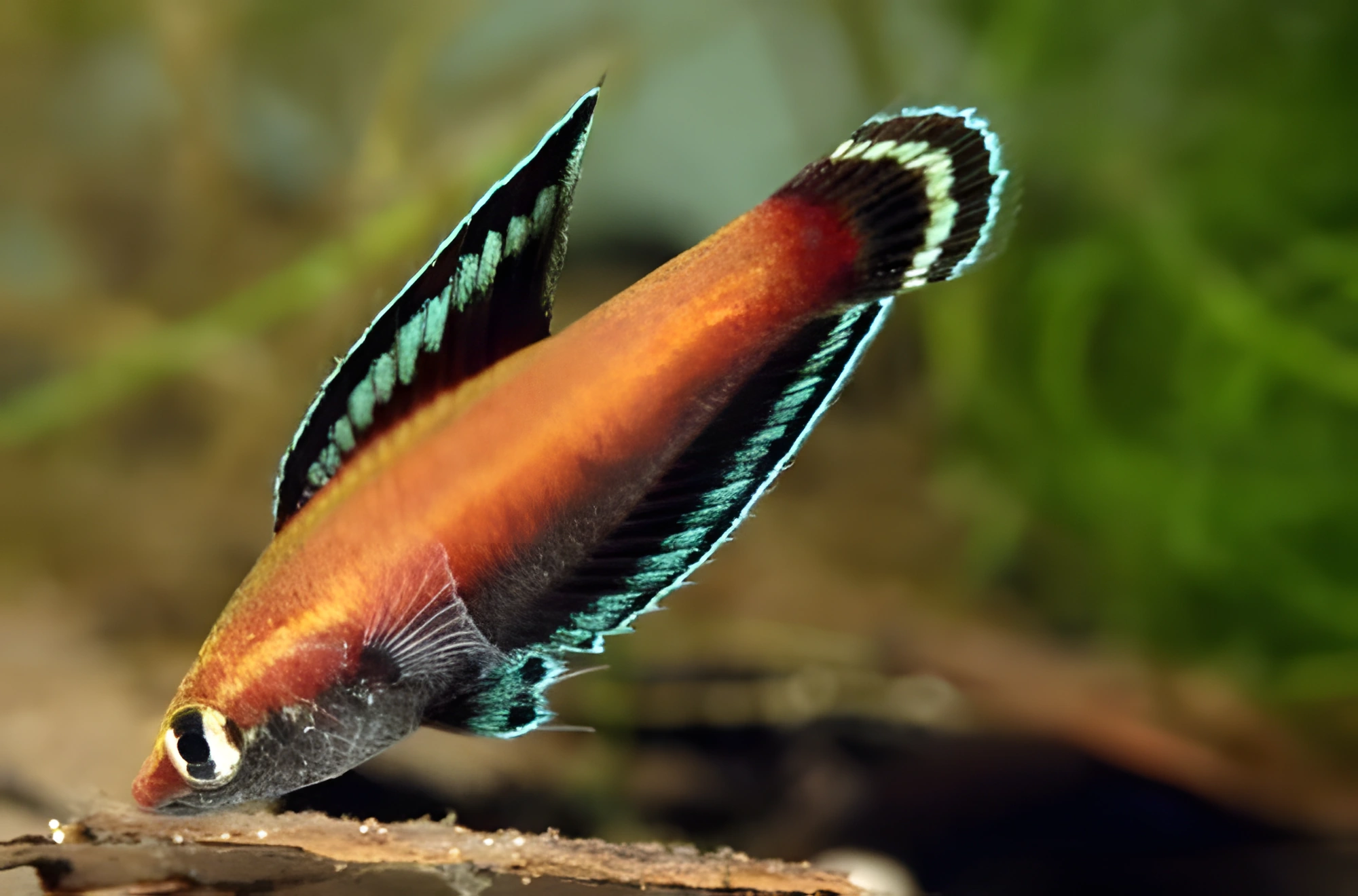
Adults do not exceed 4 centimeters in length. The main body color is brownish, complemented by two horizontal stripes. During spawning or when displaying aggression, males undergo significant changes in coloration: their body becomes intensely orange, and their fins turn black with bright blue stripes. Females, however, retain their usual appearance.
Habitat
The natural habitat of this species is limited to the eastern coast of peninsular Malaysia, located in Southeast Asia. Here, the Licorice Gourami inhabits peat swamps and small rivers that flow from them. These bodies of water are characterized by abundant aquatic vegetation, rather dim lighting due to the dense canopy of the tropical forest, and a high concentration of humic acids. These acids are formed by the decomposition of organic materials—such as leaves, branches, and fruits—and give the water a characteristic brownish tint.
Behavior and Compatibility
Male Licorice Gouramis show aggression towards each other, actively defending their territory from rivals. However, in a spacious aquarium equipped with a sufficient number of shelters placed at some distance, it is possible to keep two or more males, distributing them into separate territories. Females, on the other hand, have a more peaceful disposition and do not engage in conflicts. They are also tolerant of other species and can successfully coexist with fish of similar size belonging to the carp or characin families.
Care and Maintenance
For keeping a single pair of these fish, an aquarium of at least 40 liters is recommended. The aquascape should favor dense plant thickets, a dark substrate, and numerous shelters, which can be created using driftwood, decorative elements (imitations of sunken ships, castles), or ceramic pots laid on their side. The water should be acidic (low pH) and have low carbonate hardness. To recreate the conditions of their natural habitat, a filtration system with peat as a filter medium can be used, and fallen leaves and alder cones can be added to the bottom. These components, as they decompose, color the water a light brown and enrich it with humic acids. Before placing leaves and cones in the aquarium, they should be dried and then soaked until they sink completely. Equipment should also be selected with the fish's needs in mind: lighting should be subdued, and internal currents should be absent. An essential element is a tight aquarium lid, which will prevent the fish from jumping out and create a warm, humid air layer above the surface, which is critically important for the respiration of labyrinth fish. Aquarium care includes regular cleaning of the substrate from organic waste (excrement, food remains), weekly partial water changes (10–15% of the total volume) with fresh water, and replacement of leaves and cones every one to two weeks.
Diet
The diet of these fish should primarily consist of live or frozen foods, such as bloodworms, Daphnia, and Artemia. Dry and freeze-dried foods can be used as a supplement, although some experienced aquarists have successfully adapted the fish to a constant intake of such products. Before purchasing, it is important to ask the pet store seller what the Parosphromenus are currently being fed.
Breeding and Reproduction
Spawning in these fish usually occurs in small caves (ceramic shelters will be useful here) or among fallen leaves. With the onset of the breeding season, the male chooses a spot and actively invites the female there, while simultaneously chasing away all competitors. He performs special ritual dances, swimming almost vertically head-down around the female and maximally fanning his fins. Once the female is ready, they swim into the shelter, where they lay up to 40 eggs, after which the female leaves the clutch. The male remains to protect the future offspring until the fry emerge from the shelter and begin to swim freely. If other fish species are present in the aquarium, the fry should be removed, as in such conditions, parental protection cannot be relied upon.
Diseases
Most diseases are caused by unsuitable keeping conditions and poor-quality food. Upon detecting the first signs of illness, it is necessary to immediately check the water parameters (such as pH and dGH) and ensure the absence of high concentrations of dangerous substances (ammonia, nitrites, nitrates, etc.). The parameters should be brought back to normal only after this before proceeding with treatment. More detailed information on symptoms and treatment methods can be found in the section “Diseases of Aquarium Fish.”
How to choose
When purchasing, choose active individuals that display natural behavior. It is recommended to avoid fish with signs of emaciation, fin damage, or white film on the body. Since many species of the genus are externally very similar, it is important to ensure correct species identification, as fish with unclear status or hybrids are often found in trade. It is advisable to acquire specimens from private breeders, as wild-caught individuals may be weakened by transport and require complex adaptation to aquarium conditions.
Frequently asked questions
The essentials: size, tank volume, water parameters and care
How big does Licorice Gourami get?
An adult reaches 4 cm in length. Plan the tank around the maximum size: the fish quickly outgrows a cramped setup.
What size aquarium does Licorice Gourami need?
The minimum recommended volume is 40 L. A smaller tank speeds up nitrate build-up and raises stress levels.
What water parameters does Licorice Gourami need?
Temperature 22–28 °C, pH 3–6.5, hardness 1–4 dGH. Stability matters more than exact values: sudden swings are harder on the fish than a small deviation from the ideal.
How long does Licorice Gourami live?
Around 4 years when kept properly. Lifespan depends directly on tank volume, water quality and a varied diet.
Is Licorice Gourami aggressive?
Temperament: semi-peaceful (including aggression during spawning / intraspecific conflicts). Keep this in mind when choosing tank mates.
How many Licorice Gourami should be kept together?
Recommended setup: harem (1 male and several females). Ignoring this is a common cause of stress and disease.
What does Licorice Gourami eat?
Diet type: meat / protein (live, frozen, fresh). Feed small portions that are finished within a couple of minutes — overfeeding does more harm than underfeeding.
What is the scientific name of Licorice Gourami?
The scientific name of the species is Parosphromenus nagyi, family Osphronemidae.