Temperature22 – 28 °C
Natural range
- West Kalimantan area
- Borneo area
Labyrinth fishConservation status: Endangered EN
Inhabiting waters near the city of Anjungan, Parosphromenus anjunganensis, or Anjungan Licorice Gourami, belongs to the family Osphronemidae, receiving its scientific name from this locality. Keeping this fish is considered quite challenging due to its elevated water quality requirements, and the small size of adult specimens limits the choice of suitable tank mates.
- Required aquarium volume
- 30 L
- Size in aquarium
- 2.5 – 3.5 cm
- Temperature
- 22 – 28 °C
- Temperament
- Peaceful (regular)
Parameters
Water pHAcidic (3) – Neutral (6.5)
Water dHVery soft (1) – Soft (5)
Water salinityno salt (freshwater)
Size in aquarium2.5 – 3.5 cm
Lifespan2 years
TemperamentPeaceful (regular)
Toward small fishnot a predator
Required aquarium volume30 L
Lightingdimmed
Substrateany, but dark
Water flownone or stagnant (no flow)
FeedingHigh protein (predominantly meat)
CareSchooling (usually from 5–6 individuals and more)
Description
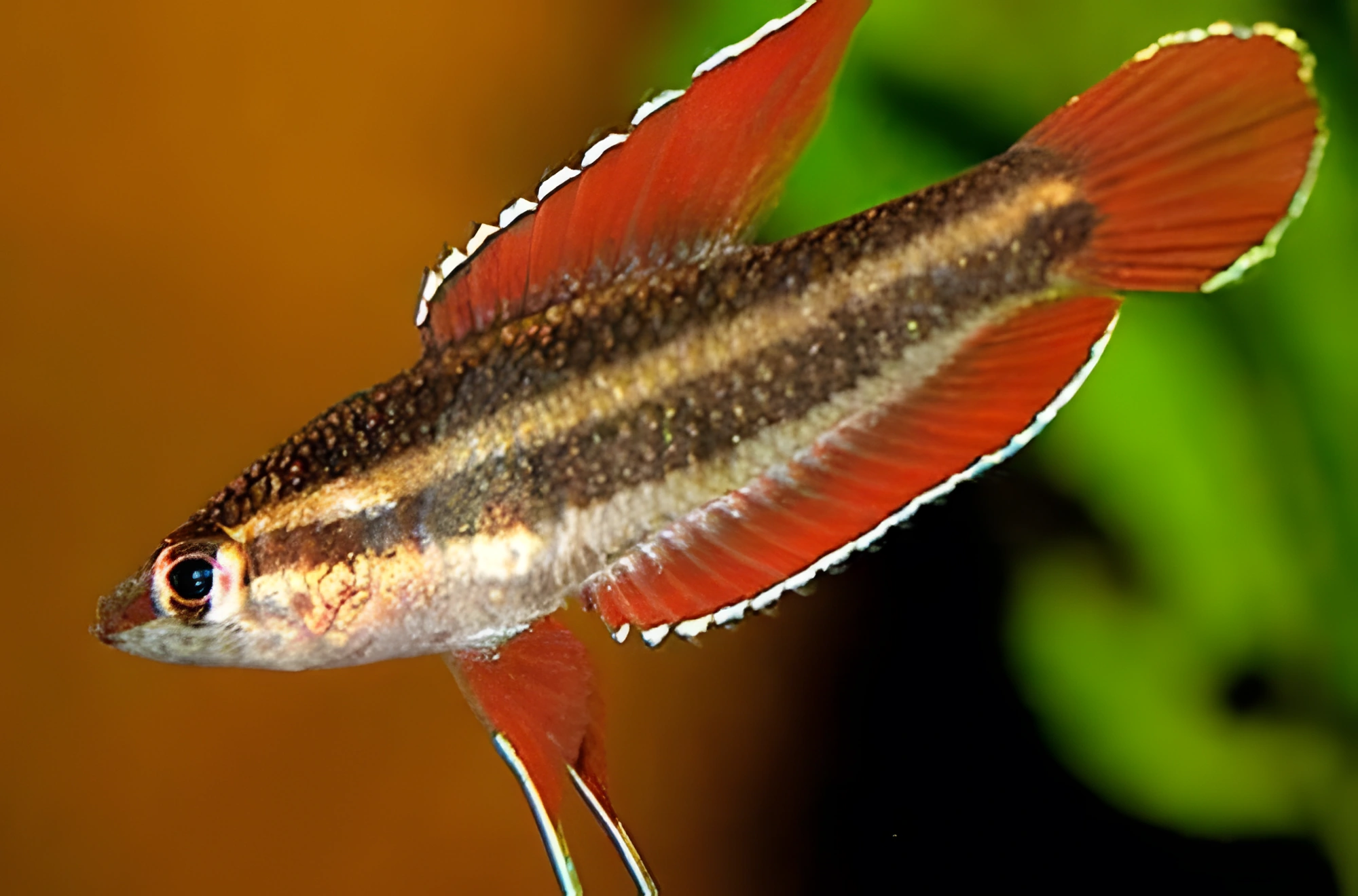
Adults of this species reach approximately 3 cm in length. Pronounced sexual dimorphism is observed. Males typically appear brighter, their coloration significantly more intense compared to females. The male's body is adorned with a striped pattern consisting of alternating dark and light horizontal bands. Their dorsal, anal, and caudal fins are reddish-brown with a thin bluish edging. Females, while having a similar body pattern, are less colorful and lack the reddish fins.
Habitat
This species originates from Southeast Asia, specifically the Indonesian part of Borneo. Its natural distribution roughly coincides with the borders of West Kalimantan province. The fish inhabits peat swamps and associated rivers located in humid tropical rainforests. A typical habitat is a shaded body of water with dense vegetation growing along its banks. The bottom of the water body is covered with a thick layer of fallen leaves, branches, and numerous roots. The water here acquires a rich brown hue due to the high concentration of humic acids and other tannins released during the decomposition of organic plant matter.
Behavior and Compatibility
This fish is distinguished by its peaceful and calm nature. It coexists well with its congeners and other species of comparable size that can thrive in similar conditions, such as rasboras or some small barbs. Avoid keeping them with any large tank mates.
Care and Maintenance
For one or two fish, aquariums from 20 to 30 liters are optimal. When decorating, it is recommended to recreate elements of their natural habitat: provide subdued lighting, plenty of hiding places made of snags, and thickets of shade-loving plants, mosses, and ferns. On a dark substrate, it is desirable to place a layer of leaf litter. The leaves of some trees not only serve as part of the natural decor but also affect the chemical composition of the water, releasing tannins during decomposition, which gives the water its characteristic brown tint. More detailed information can be found in the article “What tree leaves can be used in an aquarium”. When keeping Parosphromenus anjunganensis, it is critically important to maintain very low pH and dGH values. It may be necessary to use a reverse osmosis system or other methods to obtain soft water; this is discussed in a separate article. The stability of the aquatic environment depends on the uninterrupted operation of equipment and the regularity of essential aquarium maintenance procedures: weekly replacement of 5–10% of the water volume with fresh water, as well as timely removal of organic waste. The filtration system should not be too powerful; sometimes a simple air-driven filter is sufficient. Filtration is the main cause of internal current, and these fish are poorly adapted to strong water movement, which should always be taken into account.
Diet
This species is carnivorous. Their diet should primarily consist of live or frozen foods, such as bloodworms, Artemia, and Daphnia. Dry foods are generally not recommended, as the fish often ignore such nutrition.
Breeding and Reproduction
Under favorable conditions, successful breeding is quite possible. With the onset of the breeding season, the male selects an area on the aquarium bottom, in the center of which there is some kind of shelter, and begins courtship. When the female accepts his advances, the pair proceeds to spawn, accompanied by peculiar “mating dances” during which the fish turn upside down and press against each other. Each portion of fertilized eggs is picked up by the parents and transferred to the shelter, attaching them to the roof of the cave. The female then leaves the spawning site, and the male remains to guard the clutch. The incubation period lasts 24–36 hours. After another 4–6 days, the fry begin to swim freely. Gradually, parental instincts weaken, and soon the male stops paying attention to his offspring.
Diseases
Maintaining a stable biological system, providing a balanced diet, and eliminating stress factors (e.g., harassment by aggressive tank mates) are the best guarantees for preserving fish health. If the first signs of illness appear, the first thing to pay attention to is precisely these three aspects, as deviations have likely occurred in one of them. As a rule, eliminating the problem leads to self-recovery. However, if the immune system proves to be insufficiently strong, medicinal treatment may be required. More detailed information on symptoms and treatment methods can be found in the "Diseases of Aquarium Fish" section.
How to choose
When choosing Parosphromenus anjunganensis, it is important to pay attention to the fish's activity and the condition of their fins. Healthy individuals should show curiosity, no visible damage, ulcers, or white film on the body. Avoid purchasing fish that appear emaciated, have clamped fins, or constantly stay near the water surface, which may indicate breathing problems or difficulty adapting to aquarium conditions.
Since the species is rare and often supplied from the wild, it is recommended to ask the seller about the fish's adaptation period in the store when purchasing. It is advisable to acquire individuals that have already started accepting offered food. Given the territorial nature of the species, it is better to choose fish for group or pair keeping, avoiding individuals with signs of severe mechanical damage obtained from intraspecific conflicts when kept in overcrowded commercial tanks.
Frequently asked questions
The essentials: size, tank volume, water parameters and care
How big does Parosphromenus anjunganensis get?
An adult reaches 2.5–3.5 cm in length. Plan the tank around the maximum size: the fish quickly outgrows a cramped setup.
What size aquarium does Parosphromenus anjunganensis need?
The minimum recommended volume is 30 L. A smaller tank speeds up nitrate build-up and raises stress levels.
What water parameters does Parosphromenus anjunganensis need?
Temperature 22–28 °C, pH 3–6.5, hardness 1–5 dGH. Stability matters more than exact values: sudden swings are harder on the fish than a small deviation from the ideal.
How long does Parosphromenus anjunganensis live?
Around 2 years when kept properly. Lifespan depends directly on tank volume, water quality and a varied diet.
Is Parosphromenus anjunganensis aggressive?
Temperament: peaceful (regular). Keep this in mind when choosing tank mates.
How many Parosphromenus anjunganensis should be kept together?
Recommended setup: schooling (usually from 5–6 individuals and more). Ignoring this is a common cause of stress and disease.
What does Parosphromenus anjunganensis eat?
Diet type: high protein (predominantly meat). Feed small portions that are finished within a couple of minutes — overfeeding does more harm than underfeeding.
What is the scientific name of Parosphromenus anjunganensis?
The scientific name of the species is Parosphromenus anjunganensis, family Osphronemidae.