Temperature22 – 28 °C
Natural range
- Johor area
- Singapore area
Labyrinth fishConservation status: Critically endangered CR
Parosphromenus alfredi, also known as Alfred's Licorice Gourami, belongs to the family Osphronemidae. This species was named in honor of Eric Alfred, former director of the National Museum of Singapore, whose significant contributions to the study of Malayan fish were highly valued. These miniature but vibrant fish – although the latter characteristic is more often applicable only to males – require careful attention and have difficulty coexisting with most larger species. Their keeping is not recommended for beginner aquarists due to their specific requirements.
- Required aquarium volume
- 30 L
- Size in aquarium
- 2.5 – 2.6 cm
- Temperature
- 22 – 28 °C
- Temperament
- Peaceful (regular)
Parameters
Water pHAcidic (3) – Neutral (6.5)
Water dHVery soft (1) – Soft (5)
Water salinityno salt (freshwater)
Size in aquarium2.5 – 2.6 cm
Lifespan3 years
TemperamentPeaceful (regular)
Toward small fishnot a predator
Required aquarium volume30 L
Lightingdimmed
Substrateany, but dark
Water flownone or stagnant (no flow)
FeedingHigh protein (predominantly meat)
CareSchooling (usually from 5–6 individuals and more)
Description
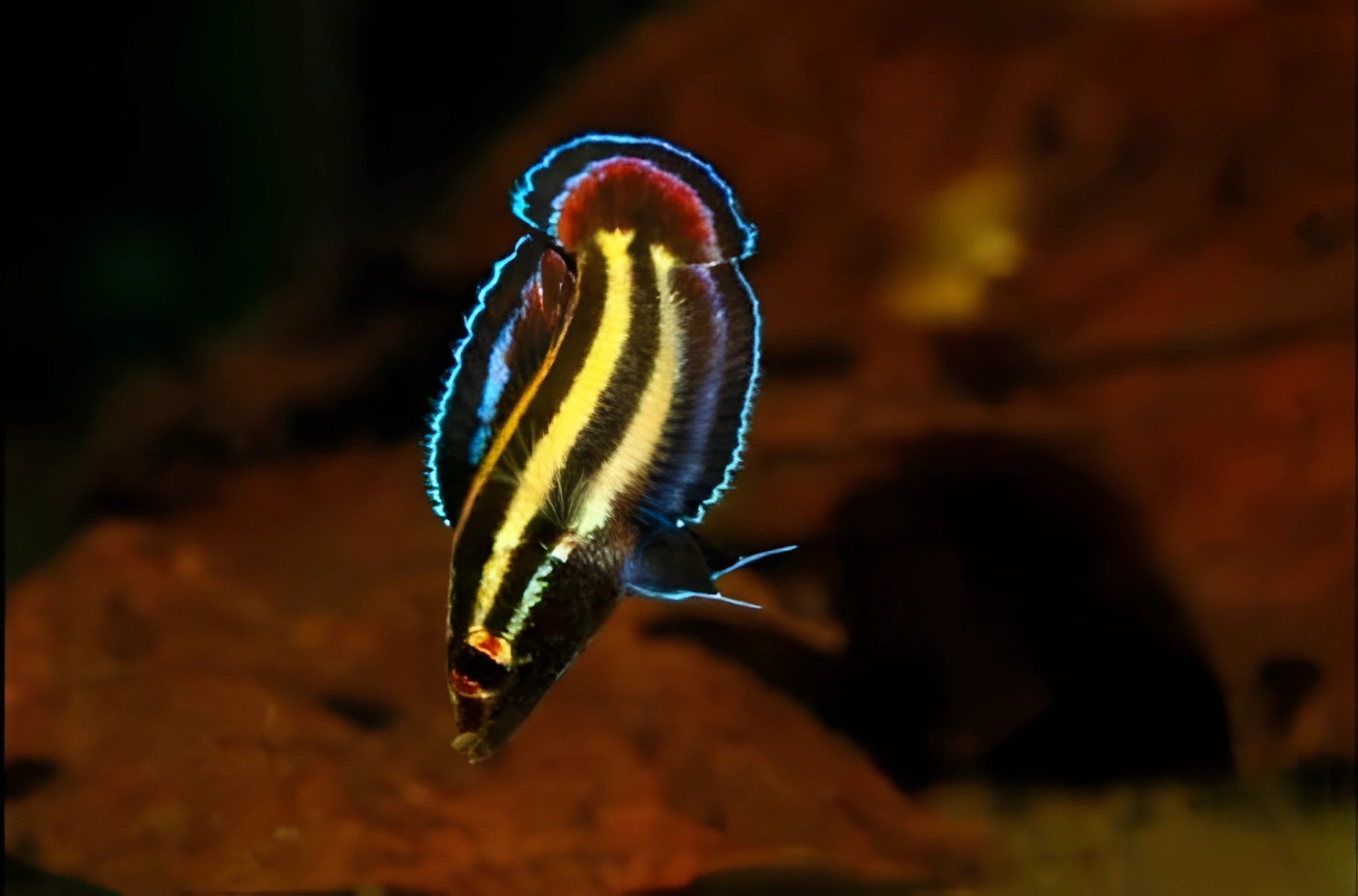
Adults reach no more than 3 cm in length. This species exhibits distinct sexual dimorphism. Males have significantly brighter and more varied coloration. Their bodies are adorned with a pattern of alternating horizontal yellow and black stripes. The fins show a blue edging and a black stripe framed on both sides by bluish-iridescent stripes, sometimes with internal reddish hues. Females appear less vibrant; their body pattern is similar to that of males but has a paler appearance. The fins of females are transparent and gray.
Habitat
The natural habitat of this species is in Southeast Asia, extending from the southern tip of the Malay Peninsula, including the territory of the Malaysian state of Johor, to the city-state of Singapore. A significant portion of these natural habitats has undergone serious changes due to human economic activity. Deforestation in the region has led to the degradation of aquatic ecosystems and the disappearance of a number of local animal species. Originally, the fish inhabited tropical peat swamps located deep within rainforests. Such biotopes typically featured shallow bodies of water, the bottom of which was covered with a thick layer of fallen leaves, branches, and other plant debris. The water in these swamps acquired a rich brown hue, due to the high concentration of humic acids and other tannins.
Behavior and Compatibility
This peaceful fish does not exhibit intraspecific conflicts. However, it should not be kept with related species to avoid hybrid offspring. Only fish of comparable size are suitable for cohabitation. Among them, small cyprinids, such as rasboras and danios, can be considered.
Care and Maintenance
The optimal aquarium volume for keeping one or two fish starts from 20–30 L. When decorating, it is recommended to create conditions as close as possible to the natural environment. For aquarium decoration, it is advisable to use many natural snags, as well as shade-loving plants, mosses, and ferns, which will serve as shelters and potential spawning sites. A layer of dried and pre-soaked tree leaves should be placed on dark substrate. Such an addition of leaf litter will not only give the decor a natural look but also be a source of tannins, coloring the water in the dark shade characteristic of natural bodies of water. Moreover, leaves can become a place for the development of a colony of beneficial microorganisms, such as paramecia, which are a valuable food source for fry in the first days of their lives. Successful keeping of Alfred's Licorice Gourami is only possible in a stable aquatic environment with an acceptable range of hydrochemical parameters and temperatures. Maintaining biological balance directly depends on the regularity of mandatory aquarium care procedures: weekly water changes of 10–15% with fresh water, as well as systematic removal of organic waste, such as food residues and excrement. If the number of fish is small and they are not overfed, a filtration system may not be necessary. A simple air-lift filter with a sponge will be a good choice. The water conditioning process can cause some difficulties for a beginner aquarist. The fish require a very low dGH value, so it may be necessary to install a reverse osmosis system or use "folk methods" to reduce water hardness. More details on this can be found in a separate article.
Diet
This carnivorous species feeds on small aquatic invertebrates in nature. In aquarium conditions, their diet should include a variety of small live foods, such as Artemia, Daphnia, and small bloodworms. Frozen foods can also serve as a suitable alternative to live ones. Dry flakes and granulated foods are generally ignored.
Breeding and Reproduction
During the breeding season, the male and female form a temporary pair, spawning in small shelters, such as caves or under a layer of leaves. This is preceded by a prolonged courtship process. The male pre-selects a suitable spawning site, occupying an area on the aquarium bottom and guarding it from other males. He then tries to attract a female. If she agrees, the fish begin their mating dance: they turn almost vertically upside down and press closely against each other. During these embraces, the eggs are fertilized. The parents carefully pick up the eggs, place them in the cave, and attach them to the ceiling. Sometimes males build a foam nest under the arch. After spawning, the female usually swims away, leaving the male to guard the clutch. The incubation period lasts no more than 36 hours, and then another 4–6 days are required for the hatched fry to start swimming independently. In the first days, specialized micro-food or the aforementioned paramecia must be provided.
Diseases
Most health problems in fish often arise from unsuitable keeping conditions. Maintaining a stable and comfortable habitat is a key factor for successful keeping. If symptoms of illness appear, the first step is to check the water quality. If deviations are found, it is important to take immediate measures to eliminate them. If the symptoms do not disappear or worsen, medicinal treatment may be required. More detailed information on symptoms and treatment methods can be found in the "Diseases of Aquarium Fish" section.
How to choose
When purchasing, special care should be taken, as the species is endangered in the wild and often suffers from the consequences of inbreeding in aquarium lines. Choose only active individuals with clean fins, free of damage or white film. Avoid fish with signs of emaciation, sunken bellies, or stunted individuals, as this species is prone to degeneration with improper breeding. If possible, ask the seller about the fish's origin and keeping conditions, as Parosphromenus are extremely sensitive to water quality and require specific parameters close to natural ones.
Frequently asked questions
The essentials: size, tank volume, water parameters and care
How big does Parosphromenus alfredi get?
An adult reaches 2.5–2.6 cm in length. Plan the tank around the maximum size: the fish quickly outgrows a cramped setup.
What size aquarium does Parosphromenus alfredi need?
The minimum recommended volume is 30 L. A smaller tank speeds up nitrate build-up and raises stress levels.
What water parameters does Parosphromenus alfredi need?
Temperature 22–28 °C, pH 3–6.5, hardness 1–5 dGH. Stability matters more than exact values: sudden swings are harder on the fish than a small deviation from the ideal.
How long does Parosphromenus alfredi live?
Around 3 years when kept properly. Lifespan depends directly on tank volume, water quality and a varied diet.
Is Parosphromenus alfredi aggressive?
Temperament: peaceful (regular). Keep this in mind when choosing tank mates.
How many Parosphromenus alfredi should be kept together?
Recommended setup: schooling (usually from 5–6 individuals and more). Ignoring this is a common cause of stress and disease.
What does Parosphromenus alfredi eat?
Diet type: high protein (predominantly meat). Feed small portions that are finished within a couple of minutes — overfeeding does more harm than underfeeding.
What is the scientific name of Parosphromenus alfredi?
The scientific name of the species is Parosphromenus alfredi, family Osphronemidae.