Temperature22 – 28 °C
Natural range
- Sarawak area
- Borneo area
Labyrinth fishConservation status: Vulnerable VU
Other scientific names: Parosphromenus alleni
Parosphromenus allani, known as Allan's Licorice Gourami or Allan's Betta, belongs to the family Osphronemidae. It was named in honor of German biologist Allan Brown, who participated in the description of many fish species from the Malay Peninsula. Due to its demanding nature regarding conditions, this species is not recommended for beginner aquarists.
- Required aquarium volume
- 30 L
- Size in aquarium
- 3 – 3.5 cm
- Temperature
- 22 – 28 °C
- Temperament
- Peaceful (regular)
Parameters
Water pHAcidic (3) – Neutral (6.5)
Water dHVery soft (1) – Soft (5)
Water salinityno salt (freshwater)
Size in aquarium3 – 3.5 cm
Lifespan5 years
TemperamentPeaceful (regular)
Toward small fishnot a predator
Required aquarium volume30 L
Lightingdimmed
Substrateany, but dark
Water flownone or stagnant (no flow)
FeedingHigh protein (predominantly meat)
CareSchooling (usually from 5–6 individuals and more)
Description
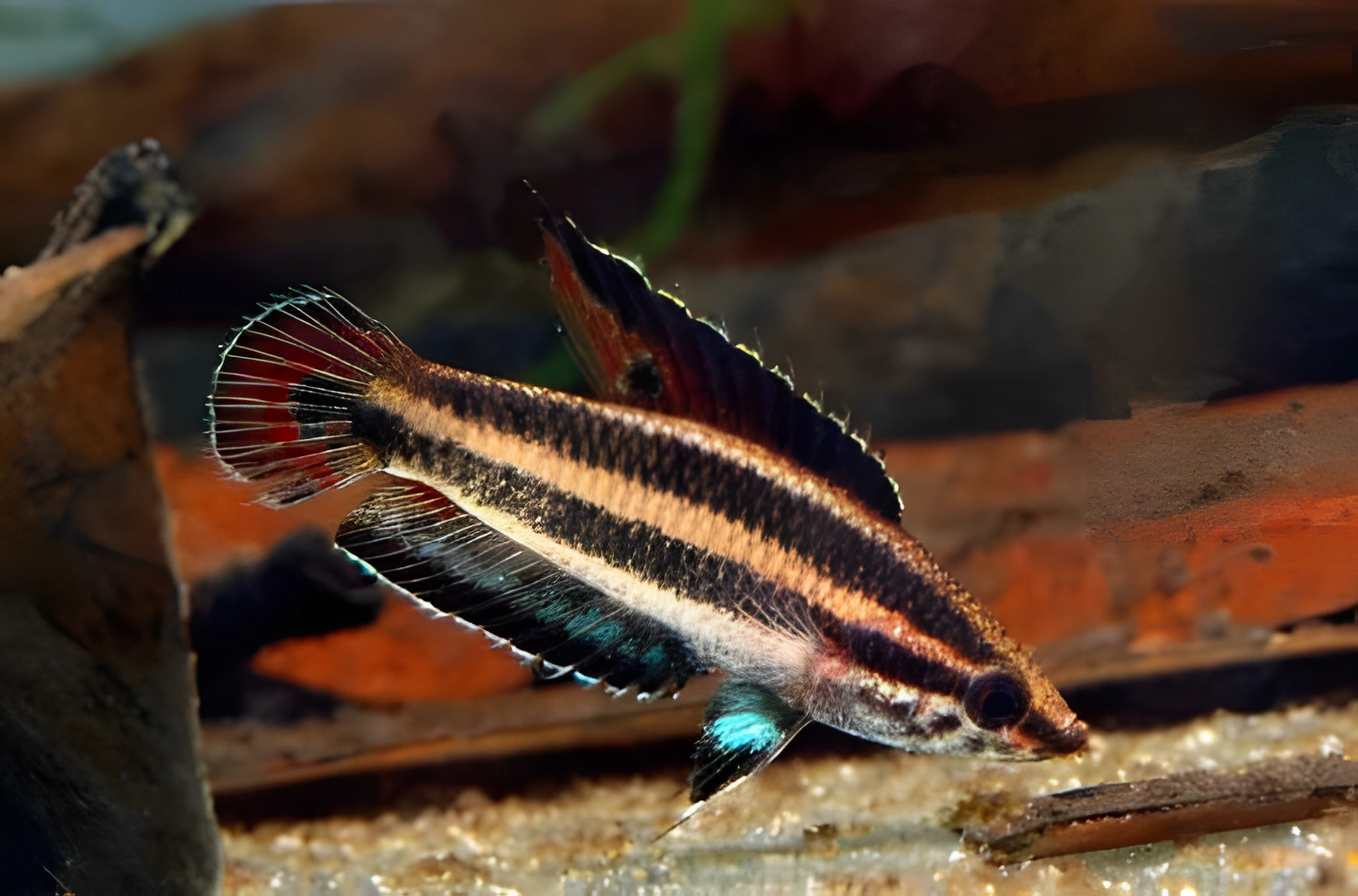
Adults grow to just over 3 centimeters. Males are distinguished by their bright and rich coloration: their bodies are adorned with alternating dark and light horizontal stripes. The fins of males are colored in black and red tones, with a turquoise pigment sometimes present along the edges. It is important to note that some populations lack red hues. A characteristic feature of the species is an irregularly shaped black spot located on the dorsal and caudal fins. Females, however, appear much more modest: their body pattern is similar to males, but their fins are plain, translucent, and gray.
Habitat
The natural habitat of this species is in Southeast Asia, on the Malaysian part of Borneo, primarily in the state of Sarawak. They prefer shallow peat swamps, as well as associated streams and small rivers where the banks are densely overgrown. The bottom of such bodies of water is usually covered with a thick layer of fallen plant debris — branches, leaves, and grass. During their decomposition, a significant amount of humic acids and tannins are released, giving the water a rich brown tint. In conditions where humans develop wild nature and natural habitats degrade, fish may be found in agricultural irrigation canals and even in roadside ditches.
Behavior and Compatibility
Their peaceful nature, small size, and specific habitat significantly limit the choice of compatible species. Good tankmates can be small cyprinids, such as rasboras and danios. The selection of other Parosphromenus species should be approached with caution, as many of them are prone to hybridization.
Care and Maintenance
For one or two fish, the optimal aquarium volume starts from 20–30 liters. The natural aquarium setup should include natural snags, dark soft substrate, shade-loving plant species, some of which can be floating, as well as dried leaves from certain trees. Hiding places should be formed from snags and vegetation; this is especially important for breeding. If decorative elements are not essential, any other aquarium decorations from a pet store or online store will suffice as shelters. For long-term keeping of Parosphromenus allani, the hydrochemical composition of the water plays a key role. The fish require very acidic and soft pH and dGH values. Beginner aquarists may face difficulties both in water preparation and in maintaining stable water parameters. To do this, a series of mandatory care procedures must be regularly performed: weekly water changes of 10–15% of the volume with fresh water, systematic removal of organic waste (food remnants, excrement), and cleaning of decorative elements. Since the fish inhabit swampy waters, they tolerate current poorly, the main source of which in an aquarium is the filtration system. For a small group of fish and no risk of overfeeding, a simple air-driven sponge filter is quite sufficient.
Diet
The diet of these fish should primarily consist of live or frozen foods, such as Artemia, Daphnia, and bloodworms. Fish generally refuse dry foods, so they are not recommended.
Breeding and Reproduction
The breeding strategy of this species is as follows: a male and female Allan's Licorice Gourami form a temporary pair. Spawning usually occurs in bottom shelters, such as caves, fallen leaves, or other hiding places. The male takes on the protection of the clutch and subsequent offspring. As the breeding season approaches, he selects a suitable spawning site and begins to actively guard it from rivals, while simultaneously initiating courtship. After the female accepts his attention, spawning begins, accompanied by mating dances, during which the fish press closely against each other, swimming almost vertically, head down. Each batch of eggs is picked up and transported to the shelter, where they are attached to the roof of the cave or placed in a pre-prepared foam nest by the male. Upon completion of spawning, the female departs, and the male remains to guard the clutch. The incubation period is up to 36 hours. Another 4–6 days will pass before the fry begin free-swimming. At this point, parental instincts weaken, and the adults lose interest in the offspring. Although the juveniles can safely stay near the parents, there is no guarantee that other fish will not try to eat them; therefore, it is recommended to transfer the fry to a separate aquarium with similar water conditions.
Diseases
Maintaining a stable biological system, providing a balanced diet, and eliminating stress factors (e.g., harassment by aggressive tank mates) are the best guarantees for preserving fish health. If the first signs of illness appear, the first thing to pay attention to is precisely these three aspects, as deviations have likely occurred in one of them. As a rule, eliminating the problem leads to self-recovery. However, if the immune system proves to be insufficiently strong, medicinal treatment may be required. More detailed information on symptoms and treatment methods can be found in the "Diseases of Aquarium Fish" section.
How to choose
The species is practically absent in wide commercial sale and is distributed mainly through private aquarists. When purchasing, it is important to ensure that the fish are active, have no visible fin damage, ulcers, or signs of emaciation. Due to their high sensitivity to water quality and propensity for stress during transport, the condition of the individuals in the seller's aquarium should be carefully assessed. It is recommended to acquire only established pairs, as sex determination in young or stressed fish is difficult, and keeping mixed-sex groups in one aquarium can lead to conflicts.
Frequently asked questions
The essentials: size, tank volume, water parameters and care
How big does Parosphromenus allani get?
An adult reaches 3–3.5 cm in length. Plan the tank around the maximum size: the fish quickly outgrows a cramped setup.
What size aquarium does Parosphromenus allani need?
The minimum recommended volume is 30 L. A smaller tank speeds up nitrate build-up and raises stress levels.
What water parameters does Parosphromenus allani need?
Temperature 22–28 °C, pH 3–6.5, hardness 1–5 dGH. Stability matters more than exact values: sudden swings are harder on the fish than a small deviation from the ideal.
How long does Parosphromenus allani live?
Around 5 years when kept properly. Lifespan depends directly on tank volume, water quality and a varied diet.
Is Parosphromenus allani aggressive?
Temperament: peaceful (regular). Keep this in mind when choosing tank mates.
How many Parosphromenus allani should be kept together?
Recommended setup: schooling (usually from 5–6 individuals and more). Ignoring this is a common cause of stress and disease.
What does Parosphromenus allani eat?
Diet type: high protein (predominantly meat). Feed small portions that are finished within a couple of minutes — overfeeding does more harm than underfeeding.
What is the scientific name of Parosphromenus allani?
The scientific name of the species is Parosphromenus allani, family Osphronemidae. It also appears in the literature as: Parosphromenus alleni.