Temperature18 – 24 °C
Natural range
- Seychelles area
- Mahé Island area
KillifishConservation status: Data deficient DD
Other scientific names: Haplochilus playfairii, Panchax playfairii
Pachypanchax playfairii, or Playfair's Panchax, belongs to the family Aplocheilidae. This tropical killifish, native to the Seychelles, is quite large among members of the Killifish genus. It exhibits a high degree of unpretentiousness, which greatly simplifies its keeping and subsequent breeding.
- Required aquarium volume
- 120 L
- Size in aquarium
- 10 cm
- Temperature
- 18 – 24 °C
- Temperament
- Territorial (often aggressive)
Parameters
Water pHSlightly acidic (6) – Slightly alkaline (8)
Water dHSoft (5) – Very hard (18)
Water salinityno salt (freshwater)
Size in aquarium10 cm
Lifespan3 years
TemperamentTerritorial (often aggressive)
Toward small fishnot a predator
Required aquarium volume120 L
Lightingdimmed or moderate
Substraterocky (rock formations, boulders, etc.)
Water flowmoderate
FeedingHigh protein (predominantly meat)
CarePair (male/female)
Description
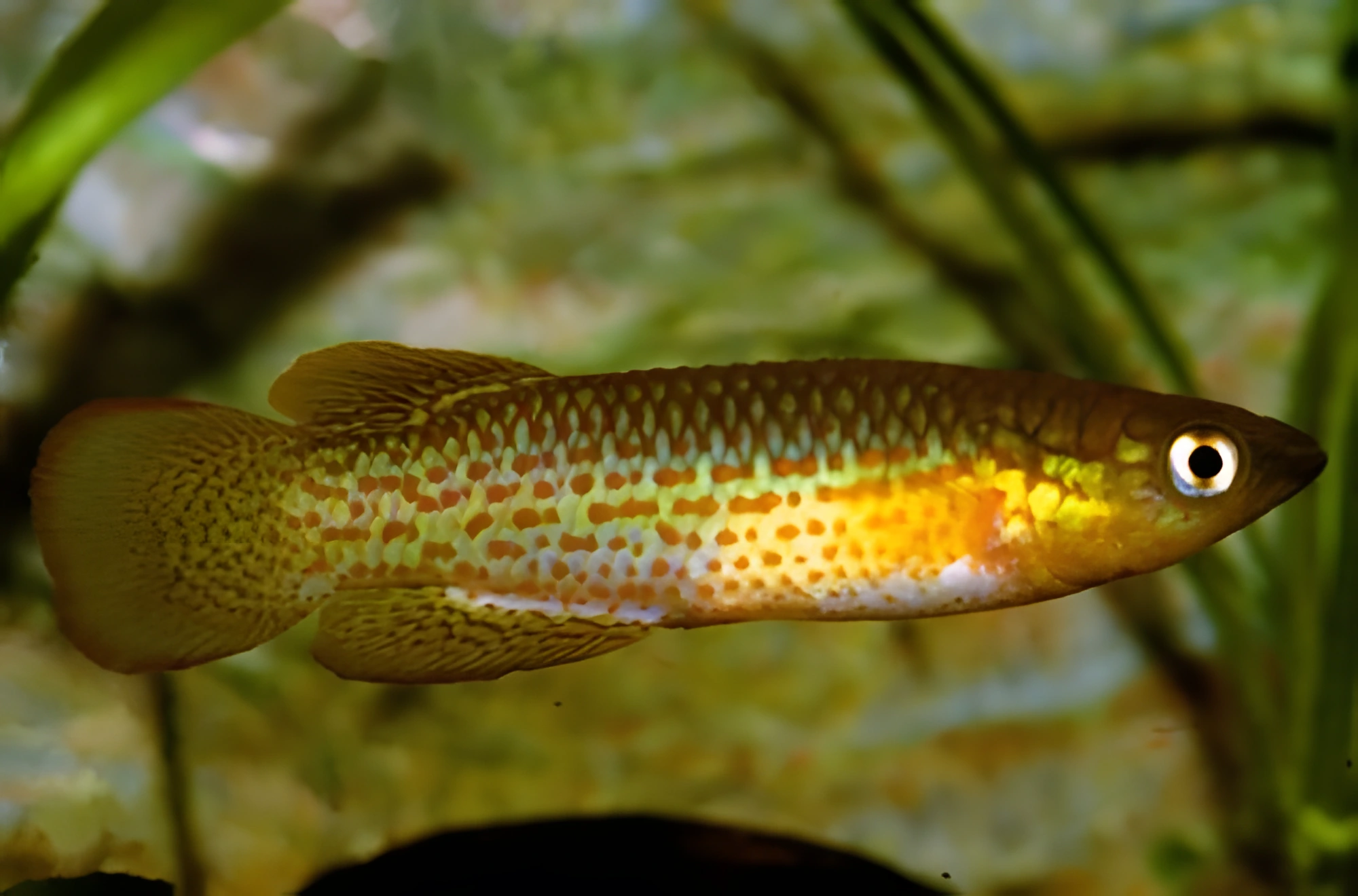
Adults can reach 10 cm in length, with males generally being larger than females and having more saturated, vibrant coloration. The fish's body is typically grayish, but shades of green and yellow may appear with changes in lighting conditions. Numerous red speckles are scattered across its entire pattern, from head to tail. The rounded fins are also adorned with a combination of dark and light green speckles.
Habitat
This species is endemic to the Seychelles islands, located off the east coast of the African continent, slightly north of Madagascar. Wild populations of this fish have been found on the islands of Mahé, Praslin, Silhouette, and La Digue. These islands are abundant in tropical rainforests, under the canopy of which numerous streams and small rivers flow — this is precisely where the Panchax Playfair prefers to live.
Behavior and Compatibility
In general, Playfair's Panchax exhibit a relatively peaceful disposition, but in certain situations, they may chase smaller fish. It is preferable to keep them either with members of their own species or with other peaceful fish of similar or slightly larger size. Intraspecific interactions are based on the dominance of an alpha male, who regularly engages in skirmishes with rivals to maintain his status. Although such clashes rarely result in serious injuries, it is still recommended to keep one male with several females.
Care and Maintenance
For a group of 3–4 individuals, an aquarium of at least 120 L will be required. The decor should include many hiding places created by intertwined roots and tree branches, which will mimic their natural habitat. Coarse sand or fine gravel with inclusions of rock will serve as a suitable substrate. Any vegetation can be used, the main thing is to arrange it in groups along the side and back walls to maintain a free central swimming area. Floating plants are also welcome, but complete overgrowth of the water surface should be avoided. Essential equipment should include a filter, lighting system, and heater. When choosing a filtration system, it is worth opting for the most productive models available within your means. This is because Playfair's Panchax are accustomed to clean, flowing waters and react poorly to high pollution. The water flow from the filter should be directed towards the glass or large decor elements to avoid strong internal currents. The permissible water parameters are quite broad: from slightly acidic to slightly alkaline, and hardness also falls within a wide range. This means that there will be no particular difficulties with water preparation; it is sufficient to let the water settle before adding it to the aquarium. More detailed information on pH and dGH parameters can be found in the “Water Hydrochemical Composition” section. Aquarium maintenance involves renewing 10–15% of the water volume weekly, as well as periodically cleaning the glass of plaque and the substrate of accumulating organic waste.
Diet
In its natural habitat, Playfair's Panchax is a carnivorous species, with its diet primarily consisting of small insects, crustaceans, and worms. When kept in a home aquarium, it is recommended to offer protein-rich foods. These can include dried or frozen bloodworms, daphnia, and insect larvae. Live food, including small worms, fruit flies, and mosquitoes, will also be beneficial.
Breeding and Reproduction
Panchax are not known for developed parental instincts towards their offspring and may often eat their own fry. For successful breeding, the spawning process should be conducted in a separate tank. Its setup should be similar to the main aquarium, with the exception of plants. The main plant cover should consist of various aquatic mosses, such as Java moss or Riccia, where the fish will lay their eggs. For equipment, a simple sponge filter, heating system, and lighting will suffice for the spawning tank. More detailed information on spawning and subsequent care for the offspring can be found in the “Fish Breeding” section.
Diseases
Well-chosen keeping conditions and a balanced diet directly affect the overall well-being of the fish. In a mature aquarium, where a stable biological system has already been established, health problems in inhabitants are extremely rare.
How to choose
When purchasing, choose active specimens with clean scales, free of visible damage, ulcers, or white film. Healthy fish should have spread fins, and their eyes should remain clear and transparent. Avoid specimens that stay at the bottom, appear apathetic, or show signs of emaciation, as this species can be prone to stress during transport. Observe their behavior in the store: healthy Panchax show territoriality and interest in surrounding objects, rather than constantly hiding in the corners of the aquarium. Given the territorial nature of the species, it is recommended to acquire individuals of approximately the same age and size to minimize the risk of aggression when introducing them into the community tank.
Frequently asked questions
The essentials: size, tank volume, water parameters and care
How big does Playfair's Panchax get?
An adult reaches 10 cm in length. Plan the tank around the maximum size: the fish quickly outgrows a cramped setup.
What size aquarium does Playfair's Panchax need?
The minimum recommended volume is 120 L. A smaller tank speeds up nitrate build-up and raises stress levels.
What water parameters does Playfair's Panchax need?
Temperature 18–24 °C, pH 6–8, hardness 5–18 dGH. Stability matters more than exact values: sudden swings are harder on the fish than a small deviation from the ideal.
How long does Playfair's Panchax live?
Around 3 years when kept properly. Lifespan depends directly on tank volume, water quality and a varied diet.
Is Playfair's Panchax aggressive?
Temperament: territorial (often aggressive). Keep this in mind when choosing tank mates.
How many Playfair's Panchax should be kept together?
Recommended setup: pair (male/female). Ignoring this is a common cause of stress and disease.
What does Playfair's Panchax eat?
Diet type: high protein (predominantly meat). Feed small portions that are finished within a couple of minutes — overfeeding does more harm than underfeeding.
What is the scientific name of Playfair's Panchax?
The scientific name of the species is Pachypanchax playfairii, family Aplocheilidae. It also appears in the literature as: Haplochilus playfairii, Panchax playfairii.