Temperature20 – 28 °C
Natural range
- Madagascar area
- Nosy Be area
Killifish
Other scientific names: Aplocheilus homalonotus, Aplocheilus omalonotus, Epiplatys homalonotus, Haplochilus andamanicus, Haplochilus homalonotus, Haplochilus nuchimaculatus
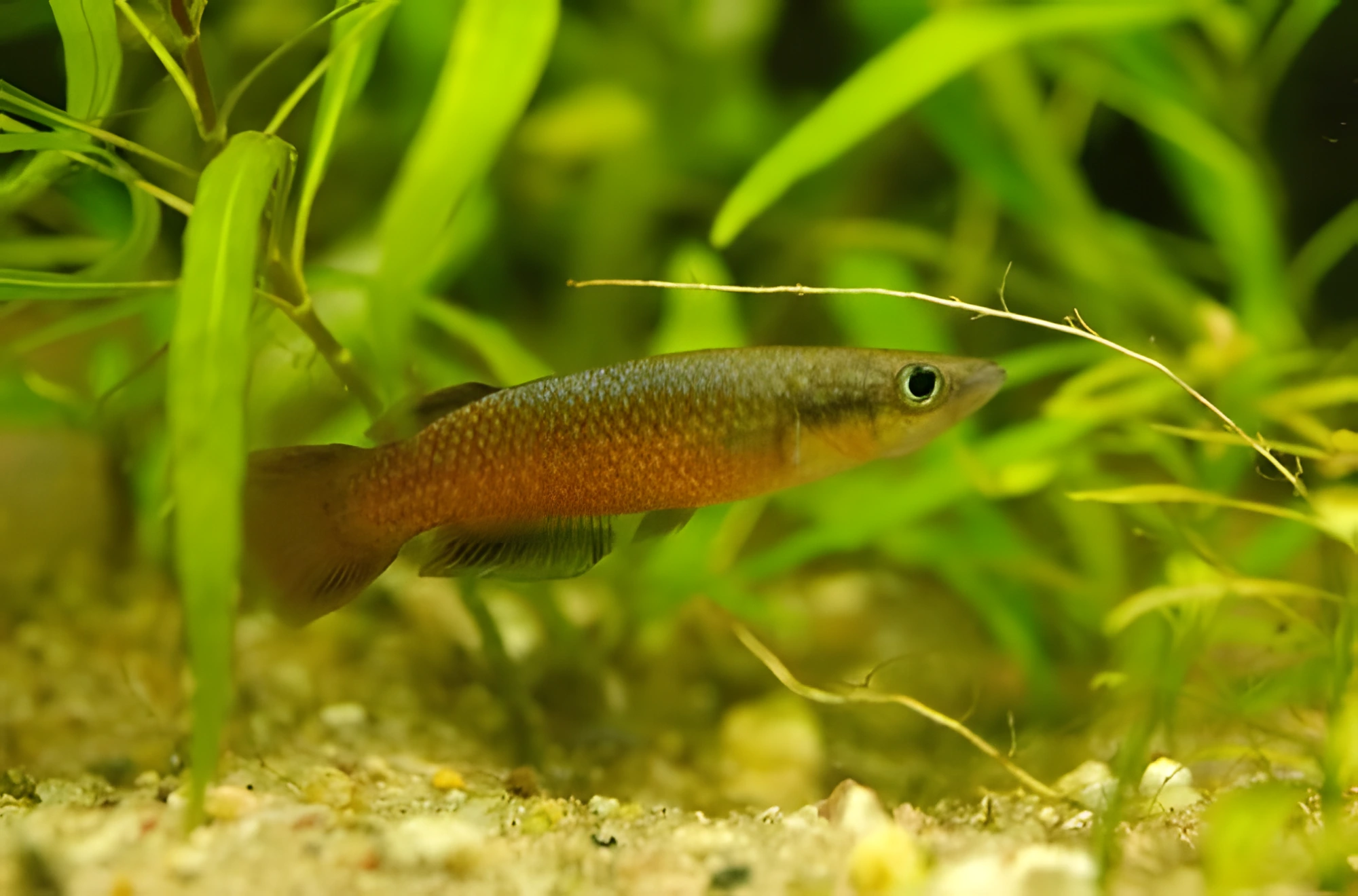
Pachypanchax omalonotus, or Omalonotus Panchax, belongs to the family Aplocheilidae. This species is well-known in aquaristics and is distinguished by a variety of colorations depending on geographic origin. Numerous intermediate forms resulting from crossbreeding are also common. For a long time, there was confusion with another species, Pachypanchax arnoldi, as both species were kept together, leading to hybrid offspring.
- Required aquarium volume
- 100 L
- Size in aquarium
- 9 cm
- Temperature
- 20 – 28 °C
- Temperament
- Semi-peaceful (including aggression during spawning / intraspecific conflicts)
Parameters
Water pHSlightly acidic (6) – Neutral (7.5)
Water dHVery soft (2) – Hard (15)
Water salinityno salt (freshwater)
Size in aquarium9 cm
Lifespan4 years
TemperamentSemi-peaceful (including aggression during spawning / intraspecific conflicts)
Toward small fishnot a predator
Required aquarium volume100 L
Lightingdimmed or moderate
Substraterocky (rock formations, boulders, etc.)
Water flowmoderate
FeedingMeat with plant additives (omnivores)
CarePair (male/female)
Description
This species is characterized by distinct sexual dimorphism. Males reach up to 9 cm in length, are noticeably larger than females, have larger fins, and are brightly colored. During the breeding season, males develop a dark stripe running from head to tail. Females are smaller and more modestly colored, in gray or silvery tones. Purebred Pachypanchax omalonotus specimens exhibit color variations correlating with their region of origin, where the coloration can be red, yellow, or blue. However, hybrid forms are more commonly available for sale, and their color range is quite limited, primarily to red hues.
Habitat
Its natural habitat is the river systems of Madagascar and Nosy Be, an island located slightly to the north. These fish prefer the upper or middle reaches of small rivers with sandy or rocky bottoms, flowing through forested areas. They can also be found in floodplain lakes near the coast. The population is quite numerous, and the habitat range is largely preserved, avoiding degradation due to human activity, which is a rare case for many other aquatic systems in Madagascar.
Behavior and Compatibility
Within the species, relationships are based on the principle of alpha male dominance; competing males will regularly engage in skirmishes, but serious physical damage is rare. It is recommended to form a community consisting of one male and several females. Pachypanchax omalonotus is tolerant of other species, but may chase smaller fish.
Care and Maintenance
For a group of 3–4 fish, an aquarium of at least 100 liters will be required. Its design should combine open swimming areas with densely planted sections that serve as hiding places. The substrate can be anything from sandy to rocky, with the choice primarily determined by the needs of the plants, rather than the fish themselves. The minimum equipment set includes filtration, heating, aeration, and lighting systems. No special preparation of water parameters is required, provided it is not hard (more detailed information on dGH parameters can be found in relevant sources). It is sufficient to let the water stand in an enameled container for 24 hours, after which it can be added to the aquarium. Regular aquarium maintenance dictates weekly replacement of 10–15% of the water volume with fresh water, as well as cleaning the glass and substrate of organic contaminants as needed. Overall, keeping Pachypanchax omalonotus is not particularly troublesome and is accessible even to a beginner aquarist.
Diet
In nature, their diet consists mainly of aquatic and terrestrial insects, as well as small crustaceans and other zooplankton. In a home aquarium, they readily accept most dry foods, such as flakes and pellets. For successful breeding, additions of live or frozen foods are particularly important: bloodworms, small worms, Daphnia, as well as insects and their larvae (e.g., mosquitoes, fruit flies). Feeding is recommended 2–3 times a day, giving an amount of food that the fish can consume in 5 minutes; any uneaten food should be removed promptly.
Breeding and Reproduction
Breeding these fish is quite simple and does not require special conditions, other than maintaining a proper diet including protein-rich foods. They can produce offspring year-round, without pronounced seasonality. The onset of the breeding period in males is accompanied by a change in coloration to a more saturated hue and the appearance of a dark horizontal stripe along the entire body. Spawning can occur in a community tank if there are no other fish species capable of eating the fry; otherwise, a separate breeding tank is recommended. The success of spawning largely depends on the preservation of the eggs. The best survival rate is achieved by using fine-leaved plants, ferns, and mosses, such as Riccia or Java moss, where the fry can hide initially and feed safely. Although parents usually do not show predatory interest in their offspring, there are exceptions.
Diseases
With a stable biological system in the aquarium and a balanced diet, health problems are usually not an issue for Pachypanchax, which is quite hardy. However, a disruption of this balance can lead to numerous problems. Unsuitable conditions or their significant deterioration are the main cause of most diseases. More information on symptoms and treatment methods can be found in the "Diseases of Aquarium Fish" section.
How to choose
When selecting individuals, it is important to pay attention to their activity and the condition of their skin. Healthy fish should show curiosity, have clean fins without signs of damage, growths, or spots. Avoid specimens with sunken bellies or apathetic behavior, as this may indicate emaciation or parasitic diseases.
- Inspect the aquarium in the store for dead fish, as this indicates an unhealthy condition of the entire batch.
- Check for the absence of visible scale damage and body ulcers, characteristic of stress during transportation.
- Ensure that the fish actively respond to food, which is a health indicator and readiness to adapt to new conditions.
Frequently asked questions
The essentials: size, tank volume, water parameters and care
How big does Pachypanchax omalonotus get?
An adult reaches 9 cm in length. Plan the tank around the maximum size: the fish quickly outgrows a cramped setup.
What size aquarium does Pachypanchax omalonotus need?
The minimum recommended volume is 100 L. A smaller tank speeds up nitrate build-up and raises stress levels.
What water parameters does Pachypanchax omalonotus need?
Temperature 20–28 °C, pH 6–7.5, hardness 2–15 dGH. Stability matters more than exact values: sudden swings are harder on the fish than a small deviation from the ideal.
How long does Pachypanchax omalonotus live?
Around 4 years when kept properly. Lifespan depends directly on tank volume, water quality and a varied diet.
Is Pachypanchax omalonotus aggressive?
Temperament: semi-peaceful (including aggression during spawning / intraspecific conflicts). Keep this in mind when choosing tank mates.
How many Pachypanchax omalonotus should be kept together?
Recommended setup: pair (male/female). Ignoring this is a common cause of stress and disease.
What does Pachypanchax omalonotus eat?
Diet type: meat with plant additives (omnivores). Feed small portions that are finished within a couple of minutes — overfeeding does more harm than underfeeding.
What is the scientific name of Pachypanchax omalonotus?
The scientific name of the species is Pachypanchax omalonotus, family Aplocheilidae. It also appears in the literature as: Aplocheilus homalonotus, Aplocheilus omalonotus, Epiplatys homalonotus.