Temperature22 – 25 °C
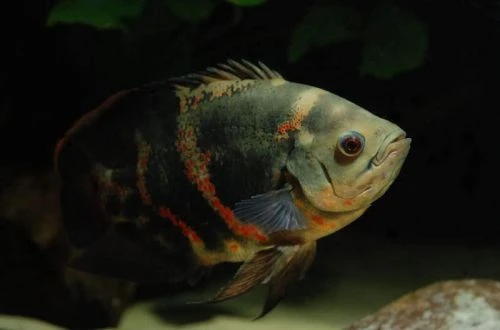
Other scientific names: Acara compressus, Acara hyposticta, Acara ocellatus, Astronotus orbiculatus, Cychla rubroocellata, Lobotes ocellatus
The Oscar cichlid, scientifically known as Astronotus ocellatus, belongs to the family Cichlidae. This popular aquarium fish comes in various color forms, as well as unique morphological variants with extended fins. Before acquiring one, it's important to consider the significant size and lifespan of this species.
The Oscar cichlid is a large, robust fish with a high body and rounded, dark-colored fins. Wild specimens typically exhibit a reddish-brick coloration with dark spots. However, selective breeding has produced numerous artificial forms, distinguished by a variety of colors and body patterns.
The natural habitat of the Oscar cichlid spans the Amazon River basin in South America, including its many tributaries. Additionally, this species has been introduced to the USA and Asian countries such as Singapore. The fish prefer shallow areas along riverbanks, small pools, and zones with submerged tree roots, which serve as natural shelters. It should be noted that the vast majority of specimens available on the market are commercially bred and have never been in the wild.
These fish can be kept either individually or in small groups, which is preferable. However, due to their size and feeding habits, the choice of suitable tank mates is limited. They should be sufficiently large and peaceful species. Oscar cichlids are quite intelligent creatures that can be tamed and even allow petting, but caution should be exercised when interacting with them. They have sharp, albeit small, teeth with which they can sometimes bite their owner.
A pair of adult fish will require an aquarium of approximately 500 liters; in this case, the principle of “the bigger, the better” is especially relevant. These fish enjoy digging in the substrate; given their size, this is undesirable in a confined aquarium space (unless the aquarium is very large). Therefore, large stones and boulders are recommended as substrate. Important decorative elements include tree roots and branches, as well as snags, which must be securely anchored to the bottom. Only artificial, large plants should be used, although it is advisable to do without them altogether, as live flora will be quickly destroyed. The Oscar cichlid, bred for many generations away from its natural habitat, has acquired an important adaptive feature – the ability to live in a wide range of acceptable water parameters. It thrives in both soft and medium-hard water, as well as in slightly alkaline and slightly acidic environments. More detailed information on water parameters and how to regulate them can be found in the “Hydrochemical composition of water” section. These fish produce a lot of waste, so 30–50% of the water should be changed weekly in 500-litre aquariums and 25% in larger tanks, remembering to regularly clean the substrate of waste products. An effective filtration system helps maintain water clarity. It is recommended to purchase external filters, as equipment damage by fish is quite common. The heater should be securely fastened to decorative elements or placed in an inaccessible location for the fish, while ensuring good water circulation to prevent localized overheating. Other necessary equipment includes lighting and aeration systems.
In their natural habitat, Oscar cichlids' diet includes anything they can catch: from small fish to fruits that have fallen into the water. In a home aquarium, they feed on all types of food: this can include dry commercial products (pellets, flakes, tablets), as well as frozen and live foods (small fish, earthworms, insects, and so on). A common misconception is that Oscar cichlids can be fed meat products like beef heart or liver. This practice is erroneous, as such a diet will likely lead to digestive problems, since animal fats cannot be properly assimilated by the fish's body. Another important aspect: avoid overfeeding; offer a portion of food that the fish can consume within 3–4 minutes.
Astronotus are bred on a large scale in fish farms, as their size and fecundity make home breeding in an aquarium highly impractical. Astronotus form permanent pairs, but not every individual can become a partner. Usually, 10 or more young fish are placed in one tank, and as they mature, they form pairs, which are then isolated. During spawning, the parents carefully select and clean a spot, after which they lay their eggs. One female can lay more than 2000 eggs, most of which develop successfully.
This species is highly resilient. In their natural environment, Astronotus play the role of unique “sanitizers” of water bodies, which has given them a strong immune system. As a rule, they do not experience health problems.
When purchasing an Astronotus, choose active individuals with clean fins and no visible damage or sores on their bodies. Avoid fish with sunken bellies, lethargic behavior, or cloudy eyes, as these may indicate chronic diseases or improper keeping conditions. In the store, the fish should show interest in food and display the species' typical curiosity. Given the territorial nature of the species, it is best to acquire juveniles from the same group to form a stable pair in the future, or a single healthy subadult for solitary keeping.
The essentials: size, tank volume, water parameters and care
An adult reaches 35 cm in length. Plan the tank around the maximum size: the fish quickly outgrows a cramped setup.
The recommended volume is 500 L. A smaller tank speeds up nitrate build-up and raises stress levels.
Temperature 22–25 °C, pH 6–8, hardness 5–19 dGH. Stability matters more than exact values: sudden swings are harder on the fish than a small deviation from the ideal.
Around 20 years when kept properly. Lifespan depends directly on tank volume, water quality and a varied diet.
Temperament: territorial (often aggressive). Keep this in mind when choosing tank mates.
Recommended setup: pair (male/female). Ignoring this is a common cause of stress and disease.
Diet type: any (universal). Feed small portions that are finished within a couple of minutes — overfeeding does more harm than underfeeding.
The scientific name of the species is Astronotus ocellatus, family Cichlids (Cichlidae). It also appears in the literature as: Acara compressus, Acara hyposticta, Acara ocellatus.
Matched by family, categories and overlapping keeping conditions
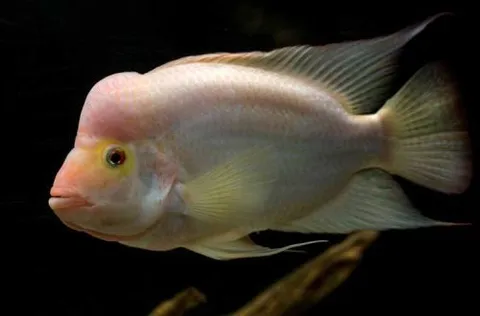
Amphilophus citrinellus
The Midas Cichlid, or Citron Cichlid, scientifically known as Amphilophus citrinellus, belongs to the Cichlidae family. Its name alludes to the myth of King Midas and his boundless greed. Observing the behavior of this…
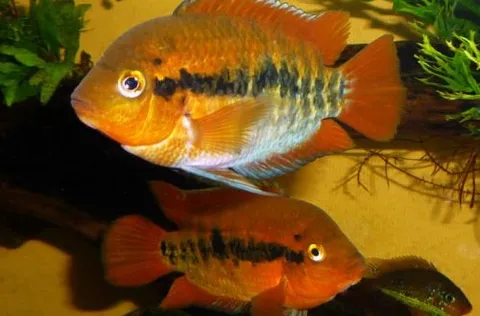
Herotilapia multispinosa
The Yellow Herotilapia, also known as the Rainbow Cichlid (scientific name Herotilapia multispinosa), belongs to the family Cichlidae. Previously, this species was named Archocentrus multispinosus. It is easy to keep…
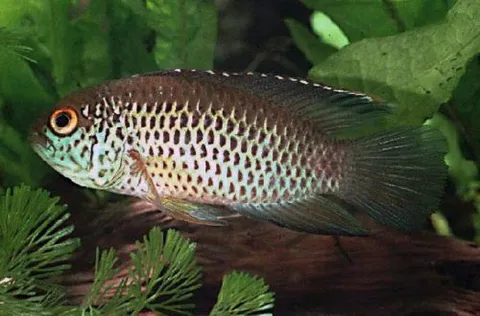
Nannacara anomala
Nannacara anomala, also known as the Yellow-Eyed Cichlid or Golden Dwarf Cichlid, belongs to the family Cichlidae. This fish attracts attention with its vibrant coloration, and its unpretentious and friendly nature…
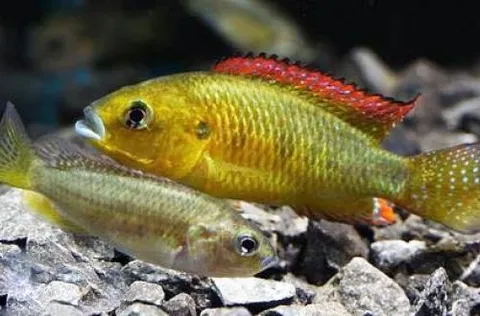
Pseudocrenilabrus philander
Haplochromis philander, known to scientists as Pseudocrenilabrus philander, belongs to the Cichlidae family. This fish is outwardly attractive but has a wayward character; males show belligerence towards each other and…