Temperature23 – 27 °C
Natural range
- Sri Lanka area
- South-Eastern Wet Zone area
CyprinidsConservation status: Endangered EN
Other scientific names: Rasbora vaterifloris
The Flame Rasbora, scientifically known as Rasboroides vaterifloris, belongs to the carp family (Cyprinidae). Despite its beauty, this fish is extremely rare. Its natural habitat is a small area of Sri Lanka, where natural predators are absent, and the aquatic environment remains remarkably stable throughout the year. When keeping these fish, special attention should be paid to maintaining high water quality and carefully selecting tank mates. Commercial breeding of this species is not widespread, making the acquisition of Flame Rasboras quite a challenge.
- Required aquarium volume
- 60 L
- Size in aquarium
- 4 cm
- Temperature
- 23 – 27 °C
- Temperament
- Peaceful, calm/shy/inactive
Parameters
Water pHSlightly acidic (5.5) – Neutral (7)
Water dHVery soft (1) – Medium hardness (10)
Water salinityno salt (freshwater)
Size in aquarium4 cm
Lifespan4 years
TemperamentPeaceful, calm/shy/inactive
Toward small fishnot a predator
Required aquarium volume60 L
Lightingdimmed
Substratesoft silted
Water flownone or stagnant (no flow)
FeedingHigh protein (predominantly meat)
CareLarge group (10+ individuals)
Description
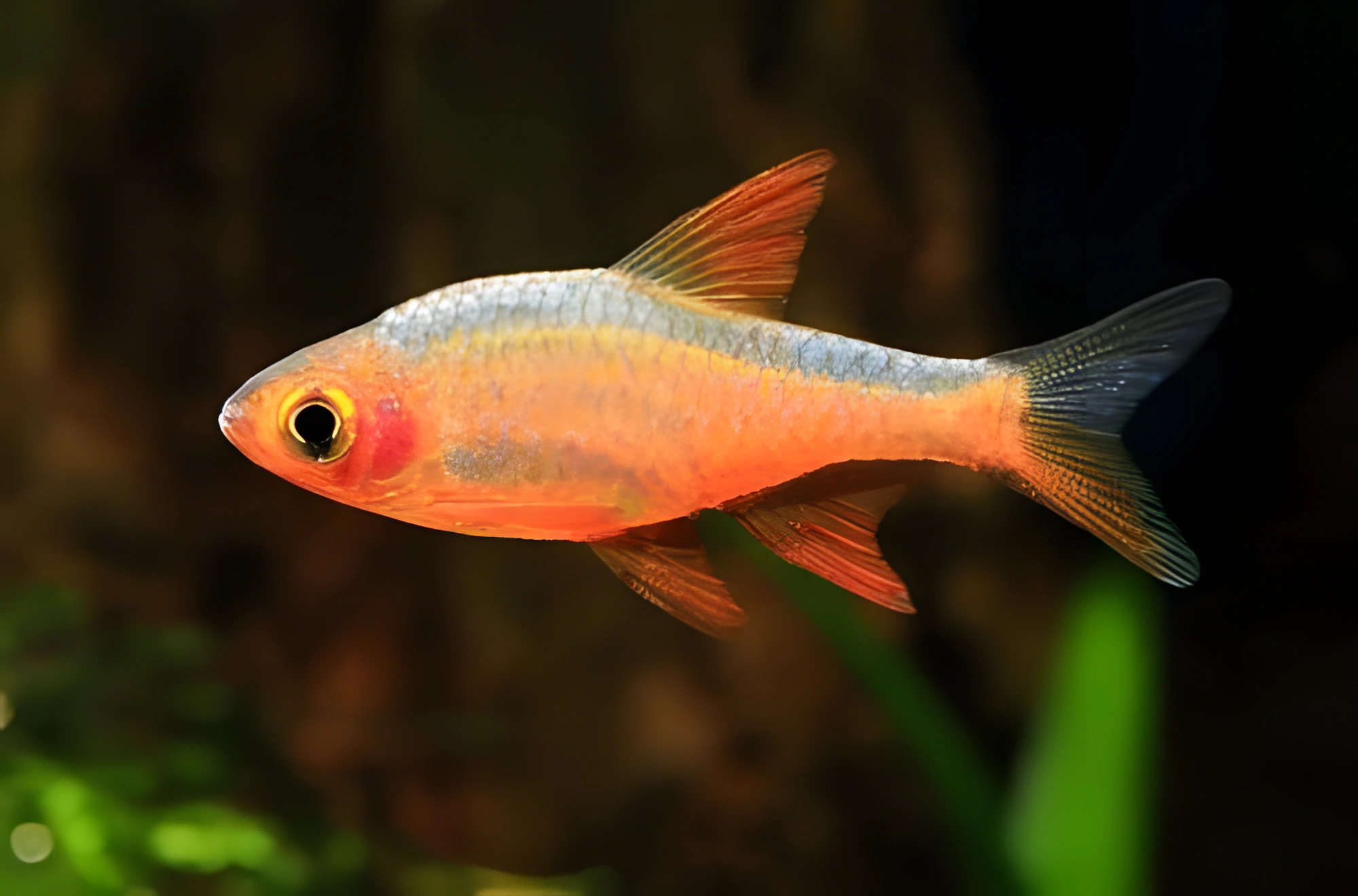
Adults of this species reach a modest 4 cm in length. Notably, females are usually larger than males, but their coloration is less intense than that of the males. Orange and red tones dominate the coloration, with the fins most often being red. The caudal fin is usually transparent, with minimal pigmentation.
Habitat
This species is endemic to the southeastern, so-called "wet zone" of Sri Lanka. Here, a significant amount of precipitation falls annually — from 2000 to 3000 mm, most of which occurs during the monsoon season from March to August. Thanks to constant high humidity and stable temperatures, lowland tropical forests thrive in this region. In the shade of these forests, in numerous streams and flowing ponds abundant with aquatic plants, the Flame Rasbora lives. The dense forest canopy practically prevents sunlight from reaching the lower tier, which ensures a relatively low water temperature. Unfortunately, by 2006, the original area of these forests had shrunk to a critical 4%, leading to the almost complete destruction of the species' natural habitat. The island's authorities are making efforts to preserve its unique nature, but the flora and fauna have already suffered significant and possibly irreparable damage.
Behavior and Compatibility
The Flame Rasbora is a peaceful and calm species that prefers to stay in schools of 6 to 10 individuals, which makes them less timid. In addition, in schooling conditions, males display more intense coloration, competing with each other for the attention of females. It is recommended to keep these fish in a species-specific tank, as finding suitable tank mates can be difficult. If cohabitation is planned, it is only possible with smaller fish of similar temperament, and the number of such tank mates should be less than the number of Rasboras.
Care and Maintenance
For a comfortable existence, a school of these fish will require an aquarium of at least 60 liters. The design of such a tank should include floating plants, a dark, soft substrate, and various shelters created from snags, roots, or tree branches. The addition of dried leaves, pre-soaked in water to ensure their sinking to the bottom, will give the aquarium a natural look. In addition, decomposing leaves gradually release tannins, which stain the water a light brown hue, corresponding to the natural habitat of the Flame Rasbora. Standard aquarium equipment includes a filtration and lighting system, a heater, and an aerator. When choosing and placing the filter, it is important to consider that the fish do not like strong water movement, so internal current should be minimized. Water parameters for keeping are characterized by a slightly acidic pH and a low concentration of dissolved calcium and magnesium salts (dGH parameter). This species is sensitive to changes in the chemical composition of water, so proper water preparation plays a key role. Regular aquarium maintenance includes weekly water changes of approximately 10% of the volume with fresh water, as well as cleaning the substrate from organic debris and the glass from film.
Diet
These fish readily accept all offered foods. However, to maintain vibrant coloration, the diet should primarily include meaty foods, served live or frozen. Dry foods can serve as a good supplement to the main diet. Feeding is recommended 2–3 times a day, offering portions that will be completely eaten within 5 minutes. It is important to promptly remove any uneaten leftovers to prevent contamination of the aquarium water.
Breeding and Reproduction
The Flame Rasbora is an egg-laying species: females scatter eggs in the water column, which are immediately fertilized by males. Parental instincts in these fish are poorly developed, and after spawning, adults may eat both their eggs and newly hatched fry. To ensure the survival of the offspring, it is recommended to breed them in a separate tank — a spawning aquarium. The setup of the spawning tank is quite simple; key attention is paid to the substrate: it should consist of sufficiently large particles that form many voids, for example, pebbles or decorative glass beads. When the eggs sink to the bottom, most of them fall into these voids, becoming inaccessible to adult fish. A similar effect is achieved by using a fine-mesh net fixed to the bottom. Another way to protect the eggs is to use low-growing, fine-leaved plants or mosses, such as Riccia fluitans and Java moss, which are planted over most of the substrate surface (in this case, the type of substrate is not critical). Dense plant thickets provide reliable shelter for the eggs as well as special substrate. The size of the spawning aquarium is usually 20 to 30 liters. Equipment includes an aerator, a heater, and a simple low-power sponge filter to prevent accidental suction of eggs and fry. Spawning occurs in dim light, so a light source is not required at the initial stage. The beginning of the breeding period can be determined by noticeably rounded females and the active attention of males to them. By this time, a separate tank should be prepared, filled with water from the main aquarium, then several females and the brightest males should be transferred there. Females lay eggs in portions, so the spawning process can last 4–5 days. The end of spawning is easily determined by the slimness of the females. After this, the fish should be returned to the main aquarium. Fry will hatch in 24–48 hours, and 3–4 days after that, they will begin to swim freely. Young fish should be fed specialized microscopic food for aquarium fish fry.
Diseases
Balanced nutrition and maintaining optimal living conditions are the best prevention of diseases in freshwater fish. If the first signs of an ailment appear, such as a change in coloration or behavior, it is first necessary to check the water parameters and quality, adjust them to normal if necessary, and only then proceed with treatment. More detailed information on symptoms and treatment methods is presented in the section “Diseases of Aquarium Fish”.
How to choose
When purchasing Flame Rasboras, their high sensitivity to transport conditions and stress resistance should be taken into account. Choose active individuals that stay in a school and do not show signs of lethargy or apathy. Carefully inspect the fish for external damage, white spots, ulcers, or unnatural film, as this species is prone to diseases if keeping conditions are violated. Avoid purchasing fish from aquariums where dead individuals or fish with signs of emaciation are observed.
- prefer individuals with bright, rich coloration, which indicates good care
- make sure the fish actively respond to feeding in the store
- ask the seller how long the fish has been in quarantine, as the species is extremely sensitive to sudden changes in water parameters
Frequently asked questions
The essentials: size, tank volume, water parameters and care
How big does Flame Rasbora get?
An adult reaches 4 cm in length. Plan the tank around the maximum size: the fish quickly outgrows a cramped setup.
What size aquarium does Flame Rasbora need?
The minimum recommended volume is 60 L. A smaller tank speeds up nitrate build-up and raises stress levels.
What water parameters does Flame Rasbora need?
Temperature 23–27 °C, pH 5.5–7, hardness 1–10 dGH. Stability matters more than exact values: sudden swings are harder on the fish than a small deviation from the ideal.
How long does Flame Rasbora live?
Around 4 years when kept properly. Lifespan depends directly on tank volume, water quality and a varied diet.
Is Flame Rasbora aggressive?
Temperament: peaceful, calm/shy/inactive. Keep this in mind when choosing tank mates.
How many Flame Rasbora should be kept together?
Recommended setup: large group (10+ individuals). Ignoring this is a common cause of stress and disease.
What does Flame Rasbora eat?
Diet type: high protein (predominantly meat). Feed small portions that are finished within a couple of minutes — overfeeding does more harm than underfeeding.
What is the scientific name of Flame Rasbora?
The scientific name of the species is Rasboroides vaterifloris, family Cyprinids (Cyprinidae). It also appears in the literature as: Rasbora vaterifloris.