Temperature18 – 27 °C
Natural range
- Mexico area
- Southern United States
LivebearersConservation status: Least concern LC
Other scientific names: Fundulus inurus, Gambusia gracilis, Gambusia humilis, Gambusia patruelis, Haplochilus melanops, Heterandria affinis
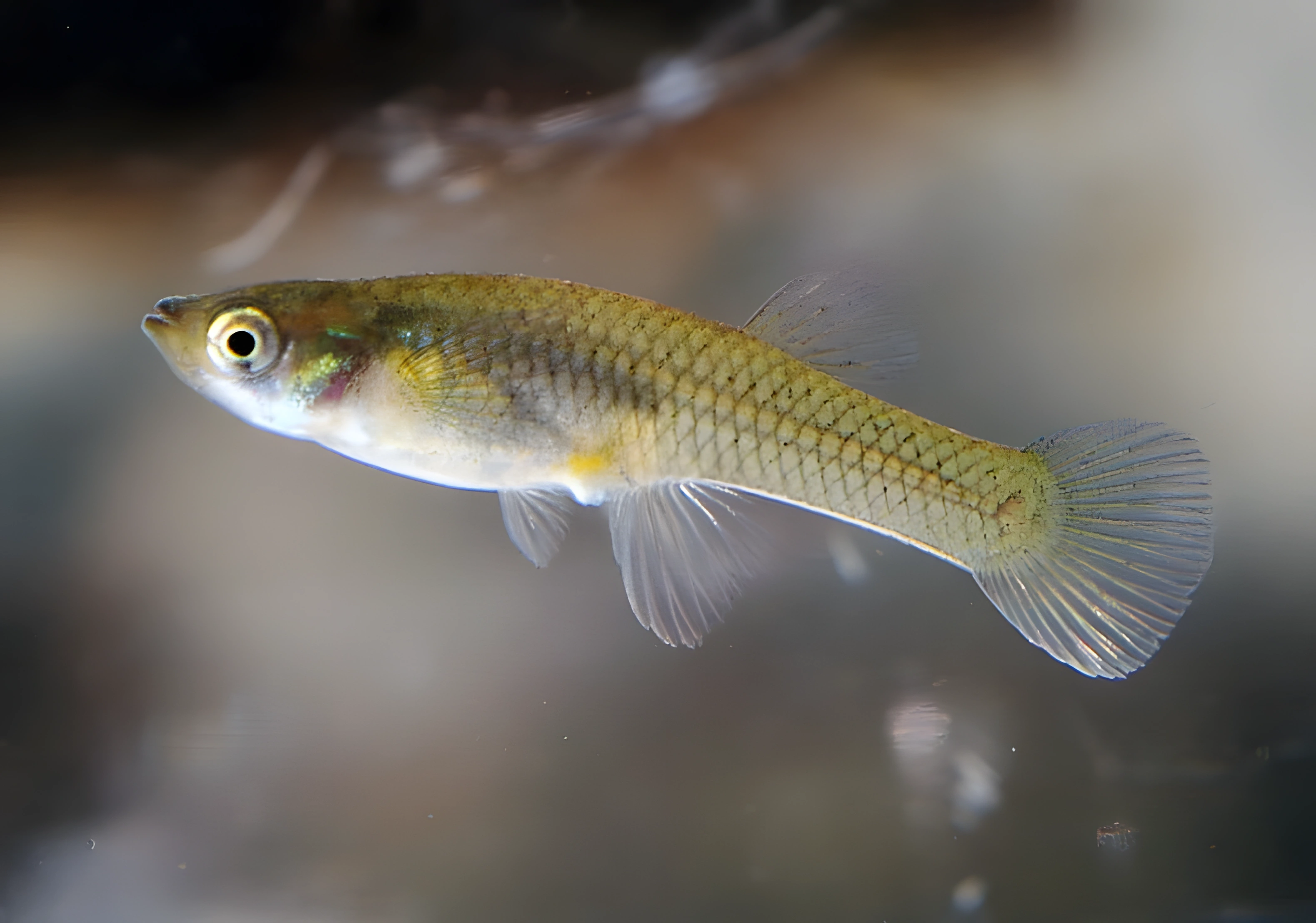
The scientific name Gambusia affinis is given to the mosquitofish, which belongs to the family Poeciliidae. This fish is not particularly attractive in appearance and can be quite gluttonous, and does not always display a friendly disposition. Nevertheless, for those just starting out in aquaristics, the mosquitofish can be an ideal choice due to its extraordinary hardiness and unpretentiousness in keeping.
- Required aquarium volume
- 40 L
- Size in aquarium
- 4 – 7 cm
- Temperature
- 18 – 27 °C
- Temperament
- Aggressive / incompatible / unfriendly
Parameters
Water pHSlightly acidic (6) – Slightly alkaline (8)
Water dHSoft (5) – Very hard (30)
Water salinityvery low (up to ~3 g/L)
Size in aquarium4 – 7 cm
Lifespan2 years
TemperamentAggressive / incompatible / unfriendly
Toward small fishnot a predator
Required aquarium volume40 L
Lightingany
Substrateany (no restrictions)
Water flowweak or moderate
FeedingAny (universal)
CareMixed (solitary / pair / group)
Description
Adult females of this species grow to about 7 cm in length, while males are significantly slimmer and smaller, reaching only about 4 cm. Their coloration is typically gray, with a silvery sheen on the belly and transparent fins. A distinctive feature of males is the presence of a gonopodium — a modified anal fin that serves to transfer seminal fluid to the female.
Habitat
These fish originate from Mexico and the southern regions of the USA, mainly inhabiting marshy areas of rivers and lakes. Here they prefer places with abundant aquatic vegetation, and can even be found in brackish waters near the coast. Today, mosquitofish have spread widely around the world and can be found in more than 60 countries. Their distribution is often associated with initiatives for biological mosquito control.
Behavior and Compatibility
Active and constantly moving, mosquitofish are quite competitive and can create problems for tank mates. They are capable of snatching food from other fish and intimidating smaller inhabitants. Therefore, they should only be kept with large, sufficiently peaceful species that can tolerate such behavior.
Care and Maintenance
Even a small pair of these fish feels quite comfortable in a nano-aquarium of 10 L or more; a larger tank will be required for keeping a small school. The aquarium setup can be anything, but it is recommended to provide both densely planted areas and open spaces for free swimming. Since mosquitofish do not have special requirements for keeping conditions, they can be successfully kept in various freshwater aquariums.
Diet
The main diet for mosquitofish consists of mosquito larvae and bloodworms. They also readily consume small crustaceans, such as Artemia and Daphnia. However, these fish adapt well to most available dry foods of appropriate size. Aqvium flake food for aquarium fish. We invite you to evaluate our new product, which has already become a bestseller on Ozon with a rating of 4.9. This flake food is suitable for most types of aquarium fish. It is based on raw materials that comply with the new European Union standards (EU 2018/848). Contains vitamins A, C, D3, E and Omega 3-6. Buy on Ozon.
Breeding and Reproduction
The breeding process of mosquitofish is remarkably simple. It is enough to place sexually mature males and females in an aquarium, and offspring will not be long in coming. It will be extremely difficult to stop this process unless the parents are separated into different tanks. Gestation lasts approximately 4 weeks, and one brood can contain from 10 to 100 fry, the number of which depends on the age and size of the female. If the fry are not removed in time, they can become victims of their own parents, as cannibalism is widespread among livebearing species. A female is capable of re-conception just a couple of weeks after giving birth, allowing one pair to produce several hundred fry per year.
Diseases
Health problems in these fish arise only in the presence of injuries or keeping in unsuitable conditions, which leads to a weakening of the immune system and the subsequent occurrence of various diseases. At the first signs of illness, it is necessary first to check the water parameters for exceeding permissible values or the presence of toxic substances (such as nitrites, nitrates, ammonia). If deviations are found, all indicators should be normalized, and then treatment should begin. More detailed information on symptoms and treatment methods is available in the "Diseases of Aquarium Fish" section.
How to choose
When choosing mosquitofish, attention should be paid to the overall activity of the individuals in the aquarium: healthy fish are mobile and show a pronounced interest in food. It is important to avoid specimens with visible fin damage, white coating on scales, or signs of emaciation, as these may indicate infectious diseases. Due to the high aggressiveness of the species, it is recommended to assess compatibility with future tank mates in advance and acquire individuals with consideration for the sex ratio, preferably keeping more females per male to reduce stress levels.
Frequently asked questions
The essentials: size, tank volume, water parameters and care
How big does Mosquitofish get?
An adult reaches 4–7 cm in length. Plan the tank around the maximum size: the fish quickly outgrows a cramped setup.
What size aquarium does Mosquitofish need?
The minimum recommended volume is 40 L. A smaller tank speeds up nitrate build-up and raises stress levels.
What water parameters does Mosquitofish need?
Temperature 18–27 °C, pH 6–8, hardness 5–30 dGH. Stability matters more than exact values: sudden swings are harder on the fish than a small deviation from the ideal.
How long does Mosquitofish live?
Around 2 years when kept properly. Lifespan depends directly on tank volume, water quality and a varied diet.
Is Mosquitofish aggressive?
Temperament: aggressive / incompatible / unfriendly. Keep this in mind when choosing tank mates.
How many Mosquitofish should be kept together?
Recommended setup: mixed (solitary / pair / group). Ignoring this is a common cause of stress and disease.
What does Mosquitofish eat?
Diet type: any (universal). Feed small portions that are finished within a couple of minutes — overfeeding does more harm than underfeeding.
What is the scientific name of Mosquitofish?
The scientific name of the species is Gambusia affinis, family Poeciliidae. It also appears in the literature as: Fundulus inurus, Gambusia gracilis, Gambusia humilis.