Temperature20 – 24 °C
Natural range
- Mozambique area
- Zambezi River Floodplain
KillifishConservation status: Least concern LC
Other scientific names: Adiniops rachovi, Nothobranchius rachowi, Notobranchius rachovii
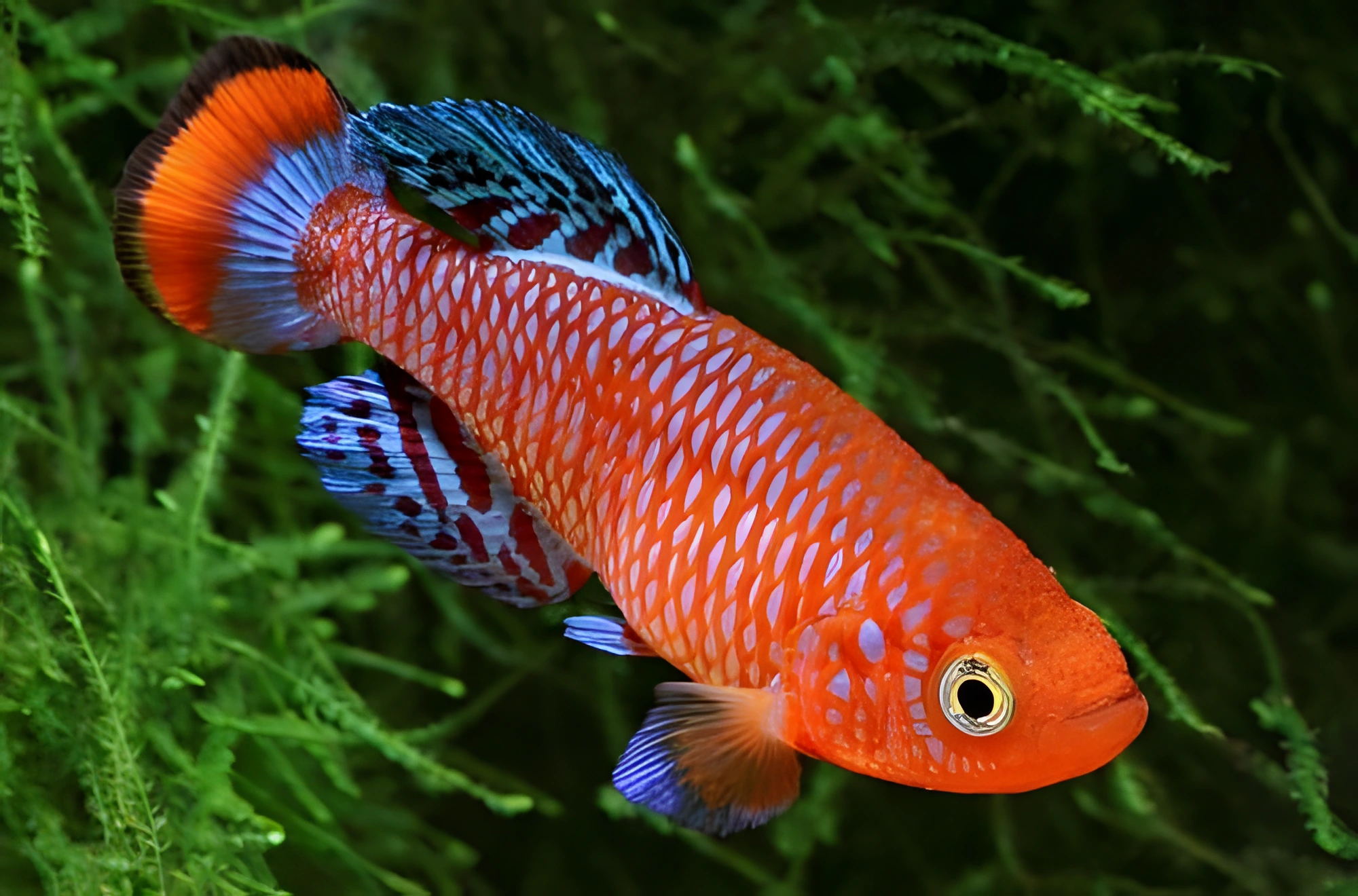
Nothobranchius rachovii, more commonly known as Rachow's Nothobranch, is a member of the family Nothobranchiidae. This fish attracts with its bright and beautiful appearance, displaying one of the most colorful guises among killifish. At the same time, it is surprisingly undemanding to keep. However, behind this beauty lies one nuance: its lifespan is short. In its natural environment, it rarely exceeds one season, while in aquarium conditions, it can last for a couple of years.
- Required aquarium volume
- 50 L
- Size in aquarium
- 5 cm
- Temperature
- 20 – 24 °C
- Temperament
- Territorial (often aggressive)
Parameters
Water pHSlightly acidic (6) – Neutral (7)
Water dHVery soft (3) – Medium hardness (10)
Water salinityno salt (freshwater)
Size in aquarium5 cm
Lifespan1 years
TemperamentTerritorial (often aggressive)
Toward small fishnot a predator
Required aquarium volume50 L
Lightingdimmed or moderate
Substratesandy (regular, light)
Water flowweak or moderate
FeedingHigh protein (predominantly meat)
CareHarem (1 male and several females)
Description
Despite its modest size, the fish has very bright coloration, which more than compensates for its dimensions. Males are generally larger than females and have more intense colors. The coloration can vary from fiery red to blue, depending on the region of origin of the population. Both of these shades are always present to some extent in the coloration. Unfortunately, cohabitation of different morphological forms in aquariums often led to hybridization, resulting in mixed coloration, and finding a true, pure variety today is quite difficult. Professional aquarists, concerned with preserving the individual color characteristics of each variety, often add clarifying labels to the name in commercial collections.
Habitat
The natural habitat of this species is in Africa, in modern-day Mozambique. The fish prefers small bodies of water and swampy areas in the Zambezi River floodplain, especially in its lowland part. A characteristic feature of these places is the seasonal decrease in water levels, and sometimes the complete drying up of water bodies for several months each year. During such periods, adult individuals die, but before that, they manage to lay eggs in the substrate, which retain their viability until the beginning of the rainy season.
Behavior and Compatibility
Although Nothobranchius rachovii is compatible with many peaceful aquarium fish of similar size, it is important to remember that maintaining its population requires annual reproduction of a new generation. Some fish species are characterized by a process of getting used to their aquarium neighbors, and constant renewal of neighbors can cause unnecessary stress. Based on this, Nothobranchius rachovii is often recommended to be kept with its own kind, especially if the goal is breeding.
Care and Maintenance
For a single pair of Nothobranchius rachovii, a tank volume of 50 L is quite sufficient. In such an aquarium, dense vegetation, arranged in groups along the side and back walls, as well as a sandy substrate, is preferred. The choice of other decor elements depends on the individual preferences of the aquarist. Equipment is standard: filtration, lighting, heating, and aeration systems are necessary. Since these fish live in calm, stagnant waters, strong internal currents are undesirable. The main source of current in an aquarium is often the filter, so it is worth providing for the dispersion of the outgoing water flows from it with the help of some obstacle, be it glass, a large stone, or driftwood. The water should be soft and slightly acidic, which is characteristic of most swampy water bodies. More detailed information on pH and dGH parameters can be found in the "Hydrochemical composition of water" section. Weekly care includes changing 10–15% of the water volume with fresh water, as well as periodic cleaning of the glass from plaque and the substrate from organic deposits.
Diet
The diet of these fish should be based on live or frozen foods, such as daphnia, artemia, and small bloodworms. Dry foods are only permissible as a supplement. Feeding should be done 2–3 times a day, giving an amount of food that the fish consume within 5 minutes. It is important to promptly remove stale food remains.
Breeding and Reproduction
For an aquarist passionate about such a unique species as Nothobranchius rachovii, the main goal is often the appearance of a new generation of fish. Typically, the life of this fish lasts about a year, during which time it manages to go through a full development cycle from fry to adult sexually mature individual. Spawning is preferably carried out in a separate tank, where peat or coconut fibers are used as a substrate. The female lays eggs directly into this substrate. For equipping a spawning aquarium, a heater and a lighting system are sufficient. Adult individuals are placed in the spawning tank, gradually raising the temperature above 24°C and lowering the water level, which stimulates the beginning of the breeding period. After the female lays eggs and the male fertilizes them, the fish are returned to the main aquarium, after equalizing the temperature. Returning to familiar conditions often contributes to an increase in their lifespan. The substrate with eggs from the spawning aquarium is removed, after draining the water, and left in a dark, warm, but dry place at a temperature of 21–25°C for 3–4 months. After this period, the substrate is again immersed in water, and after some time, fry appear. They grow very quickly, and soon they can be transferred to the main aquarium. It is important to remember that after each cycle, it is necessary to replace males or females, acquiring new individuals to ensure genetic diversity. Constant interbreeding of close relatives from the same brood can lead to the degeneration of the species.
Diseases
The species is susceptible to flagellate parasites, such as Amyloodinium, which often manifests when keeping conditions are violated. Fish are highly sensitive to medications based on copper sulfate, so treatment requires caution. To prevent diseases, it is recommended to maintain stable water parameters, avoid sudden temperature fluctuations, and provide high-quality feeding with live foods. Some aquarists practice keeping them in slightly brackish water to reduce the risk of infestations.
How to choose
When purchasing, active fish with bright coloration corresponding to their sex and age should be chosen. It is important to carefully inspect the skin and fins for any plaque, spots, or signs of tissue damage, which may indicate illness. Avoid individuals that appear lethargic, stay at the surface, or show signs of emaciation. Given the short life cycle of the species, it is preferable to acquire young individuals, as older fish quickly lose their bright coloration and show signs of physiological aging.
Frequently asked questions
The essentials: size, tank volume, water parameters and care
How big does Nothobranchius rachovii get?
An adult reaches 5 cm in length. Plan the tank around the maximum size: the fish quickly outgrows a cramped setup.
What size aquarium does Nothobranchius rachovii need?
The minimum recommended volume is 50 L. A smaller tank speeds up nitrate build-up and raises stress levels.
What water parameters does Nothobranchius rachovii need?
Temperature 20–24 °C, pH 6–7, hardness 3–10 dGH. Stability matters more than exact values: sudden swings are harder on the fish than a small deviation from the ideal.
How long does Nothobranchius rachovii live?
Around 1 years when kept properly. Lifespan depends directly on tank volume, water quality and a varied diet.
Is Nothobranchius rachovii aggressive?
Temperament: territorial (often aggressive). Keep this in mind when choosing tank mates.
How many Nothobranchius rachovii should be kept together?
Recommended setup: harem (1 male and several females). Ignoring this is a common cause of stress and disease.
What does Nothobranchius rachovii eat?
Diet type: high protein (predominantly meat). Feed small portions that are finished within a couple of minutes — overfeeding does more harm than underfeeding.
What is the scientific name of Nothobranchius rachovii?
The scientific name of the species is Nothobranchius rachovii, family Nothobranchiidae. It also appears in the literature as: Adiniops rachovi, Nothobranchius rachowi, Notobranchius rachovii.