Temperature20 – 25 °C
Natural range
- Malawi area
- Mozambique area
- Lake Chilwa basin
- Lake Chiuta basin
KillifishConservation status: Vulnerable VU
Other scientific names: Nothobranchius schoenbrodti, Notobranchius kirki
Nothobranchius kirki, scientifically known as Nothobranchius kirki, belongs to the family Nothobranchiidae, or African Rivulines. This is an attractive fish with a distinct personality, especially the males. While keeping this species is considered relatively straightforward, breeding it presents certain difficulties. A distinctive feature of these fish is their unique reproductive strategy and a rather short life cycle, which typically lasts only a couple of seasons.
- Required aquarium volume
- 40 L
- Size in aquarium
- 5 – 6 cm
- Temperature
- 20 – 25 °C
- Temperament
- Territorial (often aggressive)
Parameters
Water pHSlightly acidic (6) – Neutral (7)
Water dHSoft (4) – Medium hardness (10)
Water salinityno salt (freshwater)
Size in aquarium5 – 6 cm
Lifespan1 years
TemperamentTerritorial (often aggressive)
Toward small fishnot a predator
Required aquarium volume40 L
Lightingdimmed
Substratesoft sandy (including silted)
Water flownone or stagnant (no flow)
FeedingPlant-based (algae, vegetables)
CarePair (male/female)
Description
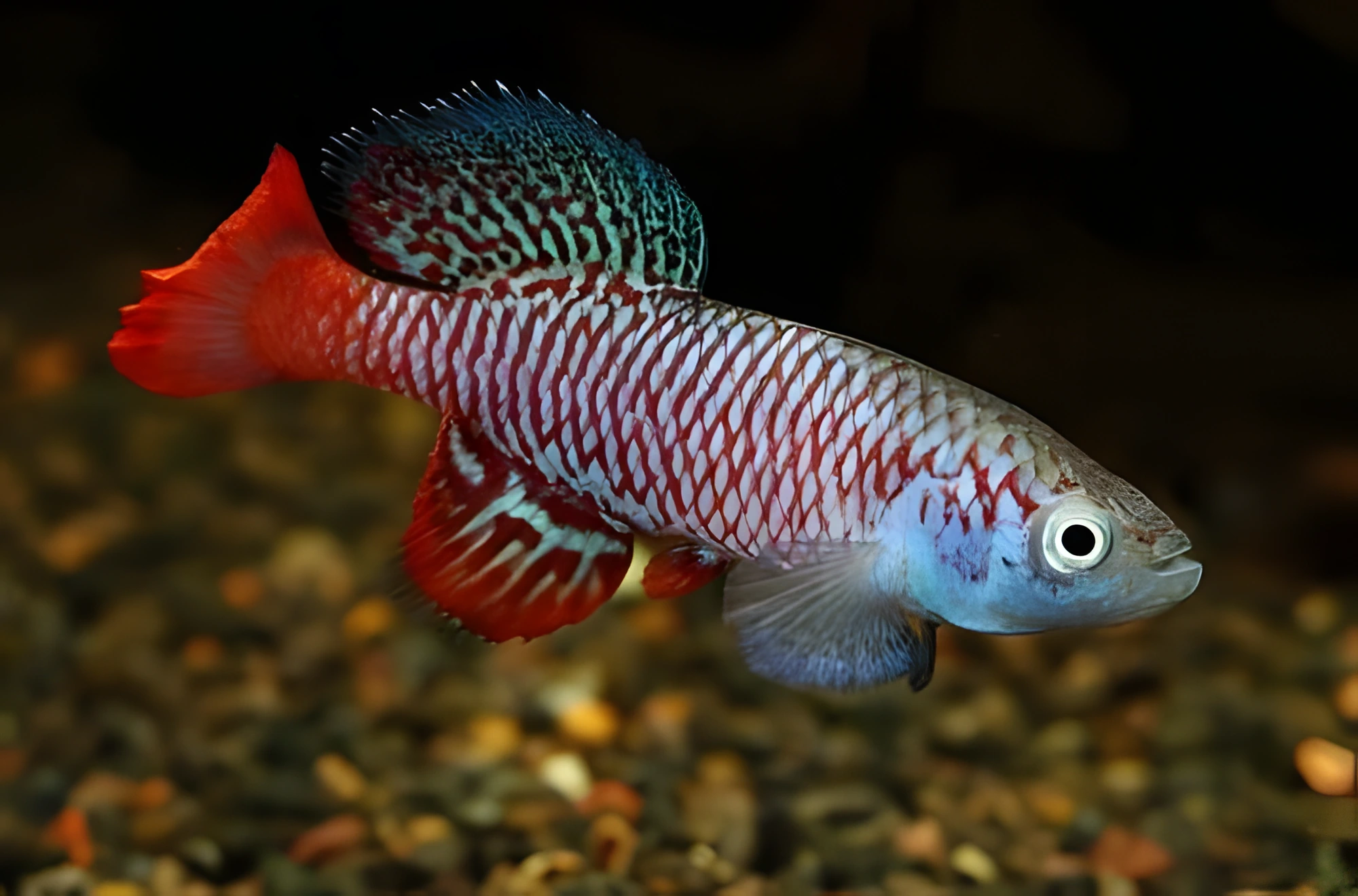
Adults of this fish can reach a size of 5–6 cm. Males are distinguished by bright blue scales edged with contrasting red stripes. In the posterior part of the body and on the fins, red hues become more pronounced. The caudal fin is completely devoid of blue tones. Females, on the other hand, are much more modestly colored, their main color being light gray.
Habitat
Nothobranchius kirki is native to the African continent, specifically the rift valleys of modern-day Malawi and Mozambique. They inhabit river systems that flow into lakes such as Chilwa and Chiuta. The natural habitat of these fish consists of shallow streams with silty substrates that periodically dry up.
Behavior and Compatibility
Males of this species are characterized by a pronounced temperament and do not tolerate the presence of rivals in their territory. In small aquariums, it is recommended to form a group of one male and several females. Nothobranchius kirki are compatible with other peaceful species capable of coexisting in similar confined conditions. However, avoid keeping them with closely related species.
Care and Maintenance
For keeping 3–4 fish, an aquarium of 30–40 liters with a depth of about 25–30 cm is sufficient. When decorating, preference is given to dark, soft substrate. If breeding is planned, a special removable spawning substrate suitable for Killifish must be provided. Dense plant growth and driftwood will serve as excellent hiding places. Additionally, floating plants will help prevent fish from jumping out and provide moderate shading for the aquarium, as bright light can negatively affect their coloration. Keeping this species is relatively simple; they are considered hardy, but this does not negate the need for regular aquarium maintenance. It is important to systematically change a portion of the water and remove organic waste, such as food remnants and excrement.
Diet
The exact composition of these fish's daily diet should be clarified with the seller. As a rule, live and frozen foods form the basis of their diet, but some breeders successfully acclimate them to dry alternative foods.
Breeding and Reproduction
In natural conditions, spawning occurs towards the end of the wet season. Eggs are laid on soft substrate. When the body of water dries up, fertilized eggs enter a state of diapause, which lasts several months until the first rains. When breeding at home, it is necessary to replicate these natural changes. A few days after spawning is complete, the substrate layer with eggs is removed from the water, gently squeezed, and placed in an open container for further drying at a temperature of 20–22°C, bringing it to a slightly damp state. Then the substrate with eggs is transferred to a closed container and stored in a dark place for 5 months. At the end of the incubation period, the eggs are flooded with water at 18–20°C, and fry appear within a few hours. Gradually, the water temperature is raised to 26°C.
Diseases
The fish are hardy and undemanding. Diseases usually manifest only with a significant deterioration in keeping conditions. In a balanced aquarium ecosystem, health problems are generally absent. More detailed information on symptoms and treatment methods can be found in the "Diseases of Aquarium Fish" section.
How to choose
When purchasing, choose active fish with clean fins and no visible body damage. It is important to consider the seasonal life cycle of the species: young individuals are often sold in stores, as the lifespan of adult fish is short. It is recommended to clarify the keeping conditions and current diet with the seller, as adaptation to new conditions can be difficult. Avoid individuals with signs of emaciation or sluggish behavior, as due to their short life cycle, any diseases or stress during transport can lead to rapid death.
Frequently asked questions
The essentials: size, tank volume, water parameters and care
How big does Nothobranchius kirki get?
An adult reaches 5–6 cm in length. Plan the tank around the maximum size: the fish quickly outgrows a cramped setup.
What size aquarium does Nothobranchius kirki need?
The minimum recommended volume is 40 L. A smaller tank speeds up nitrate build-up and raises stress levels.
What water parameters does Nothobranchius kirki need?
Temperature 20–25 °C, pH 6–7, hardness 4–10 dGH. Stability matters more than exact values: sudden swings are harder on the fish than a small deviation from the ideal.
How long does Nothobranchius kirki live?
Around 1 years when kept properly. Lifespan depends directly on tank volume, water quality and a varied diet.
Is Nothobranchius kirki aggressive?
Temperament: territorial (often aggressive). Keep this in mind when choosing tank mates.
How many Nothobranchius kirki should be kept together?
Recommended setup: pair (male/female). Ignoring this is a common cause of stress and disease.
What does Nothobranchius kirki eat?
Diet type: plant-based (algae, vegetables). Feed small portions that are finished within a couple of minutes — overfeeding does more harm than underfeeding.
What is the scientific name of Nothobranchius kirki?
The scientific name of the species is Nothobranchius kirki, family Nothobranchiidae. It also appears in the literature as: Nothobranchius schoenbrodti, Notobranchius kirki.