Temperature23 – 28 °C
Natural range
- Western New Guinea area
- Indonesia area
RainbowfishConservation status: Least concern LC
Other scientific names: Rhombatractus praecox
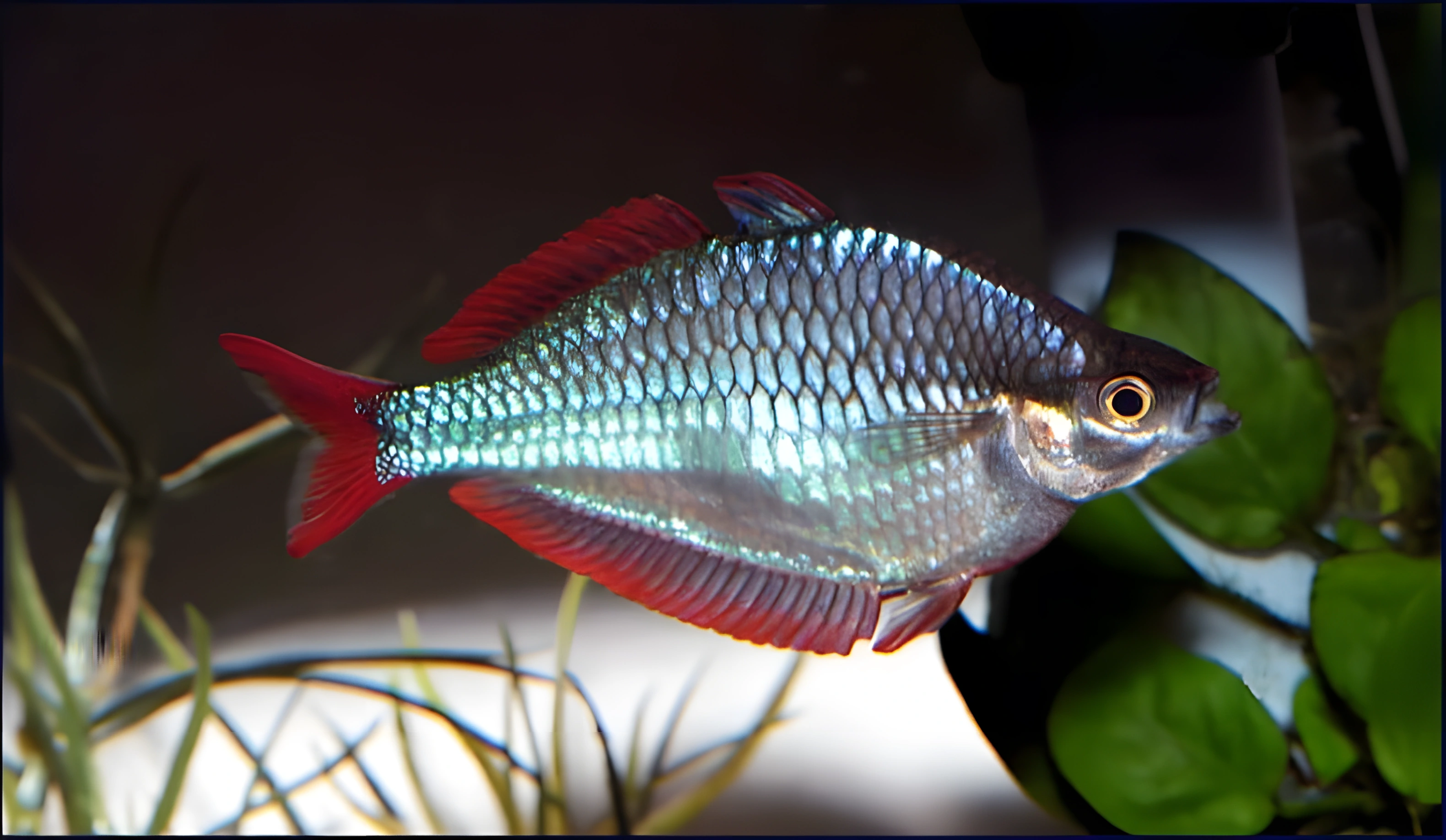
Melanotaenia praecox, also known as the Neon Rainbowfish or Dwarf Rainbowfish, is a member of the family Melanotaeniidae. A relatively small schooling fish, it attracts attention with its beautiful neon shimmer in its coloration. Its ease of care and breeding, as well as its ability to coexist wonderfully with many other tropical species, make it an excellent choice for a community freshwater aquarium.
- Required aquarium volume
- 60 L
- Size in aquarium
- 8 cm
- Temperature
- 23 – 28 °C
- Temperament
- Peaceful (regular)
Parameters
Water pHNeutral (6.8) – Neutral (7.5)
Water dHSoft (5) – Hard (15)
Water salinityno salt (freshwater)
Size in aquarium8 cm
Lifespan4 years
TemperamentPeaceful (regular)
Toward small fishnot a predator
Required aquarium volume60 L
Lightingweak or moderate
Substrateany (no restrictions)
Water flowstrong
FeedingAny (universal)
CareMedium group (6–8 individuals)
Description
Adults reach approximately 8 cm in length. Their coloration has a bluish tint with a characteristic neon effect. Notably, this neon glow only becomes visible under diffused lighting, for example, in aquariums equipped with floating plants. The fins, like the tail, are red. Sexual dimorphism is weakly expressed. Males are usually slightly larger than females and have more intense red hues in their coloration.
Habitat
Its origin is linked to the island of New Guinea, specifically the Indonesian part. Its habitat covers the Mamberamo River basin. This fish can be found in the main channel, in numerous tributaries, and in the surrounding tropical swamps. It prefers areas with abundant aquatic vegetation, often living near submerged trees, bushes, and various snags.
Behavior and Compatibility
The Neon Rainbowfish is characterized by a peaceful and very active nature. It is well compatible with other species of similar size and temperament. However, its activity can cause some disturbance to slower aquarium inhabitants. It is preferably kept in schools of at least 6–8 individuals of both sexes. It has been observed that males display brighter coloration in the presence of potential rivals, thus trying to attract the attention of females.
Care and Maintenance
For a school of 6–8 individuals, the optimal aquarium volume starts from 60 liters. The setup should include numerous rooted and floating plants, placed in groups to maintain open areas for free swimming. The fish does not react well to intense lighting and strong currents, so it is important to consider these features when choosing equipment. Another key aspect is water quality. An effective filtration system and regular partial water changes will ensure suitable conditions for keeping them.
Diet
The Neon Rainbowfish does not have special requirements for its diet. It readily accepts most common foods, whether dry, frozen, or live. To maintain the bright coloration of the fish, it is recommended to combine various products. For example, flakes and granules can be alternated with bloodworms or artemia. Such a varied diet will allow them to fully display their best colors.
Breeding and Reproduction
Rainbowfish can be bred both in a community tank and in a specially prepared spawning aquarium. To stimulate the breeding period, favorable conditions must be created: water temperature should be between 26–28°C, water slightly alkaline (pH 7.5), and medium hardness. The aquarium setup should include dense thickets of fine-leaved plants or their artificial counterparts, which will serve as a place for laying eggs. The spawning period lasts approximately 2 weeks. During this time, the female lays several dozen eggs daily, which are then fertilized by the male. Rainbowfish do not have developed parental instincts, so after spawning, the fish show no interest in the future fry. If breeding occurs in a community aquarium, it is recommended to transfer the eggs to a separate tank with similar water parameters. Otherwise, there is a high risk of the eggs being eaten by other inhabitants. If it is not possible to set up a separate spawning tank, dense floating plants can be used, which will provide reliable cover for the fry. The incubation period for the eggs is approximately 7–12 days. In the first days of life, the fry need microscopic food, such as infusoria. After a week, artemia nauplii or specialized powdered fry foods can be included in their diet. It is important to note that feeding rainbowfish fry in a community aquarium presents certain difficulties compared to keeping them in a separate spawning tank.
Diseases
Health problems in these fish primarily arise from injuries or when kept in unfavorable conditions that weaken the immune system and provoke the development of diseases. Upon detecting the first symptoms, the water parameters should first be checked for exceeding permissible values or the presence of dangerous concentrations of toxic substances (nitrites, nitrates, ammonia, etc.). After eliminating all deviations, treatment can begin. More detailed information on symptoms and treatment methods is available in the “Diseases of Aquarium Fish” section. Source: FishBase.
How to choose
When purchasing, choose active individuals that stay in a school and show interest in their surroundings. Healthy fish should have clean fins without signs of erosion, intact scales, and clear eyes without cloudiness. Avoid specimens with sunken bellies, signs of emaciation, or unnatural behavior, such as sluggish swimming at the surface or bottom alone. Inspect the fish for spots, film, or rashes, which may indicate parasitic or bacterial infections. It is recommended to purchase individuals from reputable sources where quarantine standards are observed, as the species is sensitive to sudden changes in keeping conditions and stress during transportation.
Frequently asked questions
The essentials: size, tank volume, water parameters and care
How big does Neon Rainbowfish get?
An adult reaches 8 cm in length. Plan the tank around the maximum size: the fish quickly outgrows a cramped setup.
What size aquarium does Neon Rainbowfish need?
The minimum recommended volume is 60 L. A smaller tank speeds up nitrate build-up and raises stress levels.
What water parameters does Neon Rainbowfish need?
Temperature 23–28 °C, pH 6.8–7.5, hardness 5–15 dGH. Stability matters more than exact values: sudden swings are harder on the fish than a small deviation from the ideal.
How long does Neon Rainbowfish live?
Around 4 years when kept properly. Lifespan depends directly on tank volume, water quality and a varied diet.
Is Neon Rainbowfish aggressive?
Temperament: peaceful (regular). Keep this in mind when choosing tank mates.
How many Neon Rainbowfish should be kept together?
Recommended setup: medium group (6–8 individuals). Ignoring this is a common cause of stress and disease.
What does Neon Rainbowfish eat?
Diet type: any (universal). Feed small portions that are finished within a couple of minutes — overfeeding does more harm than underfeeding.
What is the scientific name of Neon Rainbowfish?
The scientific name of the species is Melanotaenia praecox, family Rainbowfishes (Melanotaeniidae). It also appears in the literature as: Rhombatractus praecox.