Temperature20 – 25 °C
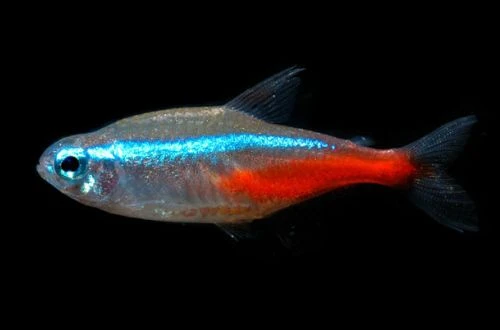
Other scientific names: Hyphessobrycon innesi
Paracheirodon innesi, better known as the Neon Tetra or Blue Neon, belongs to the Acestrorhamphidae family. This aquarium fish rightly holds a place among the most beloved and popular species. As early as the 1930s, it caused a sensation, captivating aquarists with its beauty and unpretentiousness. Since then, for many decades, interest in it has remained consistently high.
This elegant miniature fish reaches a length of no more than 4 cm. Its appearance resembles the Cardinal Tetra due to the characteristic stripes on its body. A distinctive feature of the Neon Tetra is the blue stripe running along its entire body, while the red stripe is interrupted in the middle of the torso. In addition, this species is smaller in size. The differences between the male and female are minor and are mainly manifested in the pattern. The male appears slimmer and has a straight blue line, while in the female, this line has a curved shape.
In their natural habitat, these fish are found in South America, preferring slow-moving rivers and streams that flow under the dense canopy of tropical forests. As a result, sunlight barely reaches the water's surface. Neons choose shallow and mid-water levels, and their diet consists of worms and small crustaceans. It is important to note that all fish sold in retail today are the result of artificial breeding, with the majority of supplies coming from Eastern Europe and the Far East.
Neons coexist well with most peaceful small fish, but they should not be kept with large or aggressive species. They should be kept in schools of at least 8–10 individuals, as in single or paired keeping, the fish lose vitality and color intensity, which significantly shortens their lifespan.
Providing suitable conditions for Neons is quite simple but requires attention to detail: soft and acidic water is necessary, as well as an effective filtration system. The optimal solution would be to use a canister filter, which does not create excessive water movement and effectively cleans it. Since the fish are miniature, it is important to secure the water intake points to prevent them from being sucked into the system; for example, sponge pre-filters can be used. For acidifying the water, alder cones are recommended as a filter material. Among other necessary equipment, an aerator, heater, and a low-power lighting system should be mentioned, as Neons are sensitive to bright light. In aquarium decoration, preference is given to dense plantings of plants, arranged in thick groups along the side and back walls. The presence of several floating plants is also welcome. The substrate should preferably be dark, sandy, with elements of shelters in the form of snags or intertwined roots. A few dry leaves can be added to the bottom; they will give the water a light brown tint, mimicking the natural habitat. Leaves should be replaced every two weeks.
They readily accept all types of dry commercial foods, but it is desirable that the food be finely crushed, as due to their small size, the fish are unable to cope with large particles. Live foods such as daphnia, bloodworms, and others are excellent as an additional diet.
Breeding Neons at home presents certain difficulties; in addition to creating the necessary conditions, pair compatibility is also required. While creating suitable conditions is quite realistic, finding the ideal female and male often resembles a lottery.
In a clean and healthy aquarium, diseases are generally not a problem for Neons. The main causes of ailments are usually deteriorating keeping conditions or contact with already sick fish.
When purchasing, choose active, mobile individuals that stay in a school and do not show signs of lethargy or a desire to isolate themselves. Carefully examine the fish's body: there should be no whitish spots, ulcers, scale damage, or spinal deformities, as these symptoms may indicate the dangerous Neon Tetra disease (Plistophorosis). Avoid purchasing fish from aquariums where dead or visibly sick specimens have been noticed, as infections spread quickly in a group. A healthy individual has a bright, rich coloration without signs of dullness in the neon stripe.
The essentials: size, tank volume, water parameters and care
An adult reaches 4 cm in length. Plan the tank around the maximum size: the fish quickly outgrows a cramped setup.
The recommended volume is 54 L. A smaller tank speeds up nitrate build-up and raises stress levels.
Temperature 20–25 °C, pH 5–7, hardness 1–10 dGH. Stability matters more than exact values: sudden swings are harder on the fish than a small deviation from the ideal.
Around 8 years when kept properly. Lifespan depends directly on tank volume, water quality and a varied diet.
Temperament: peaceful (regular). Keep this in mind when choosing tank mates.
Recommended setup: schooling (usually from 5–6 individuals and more). Ignoring this is a common cause of stress and disease.
Diet type: any (universal). Feed small portions that are finished within a couple of minutes — overfeeding does more harm than underfeeding.
The scientific name of the species is Paracheirodon innesi, family Acestrorhamphidae. It also appears in the literature as: Hyphessobrycon innesi.
Matched by family, categories and overlapping keeping conditions
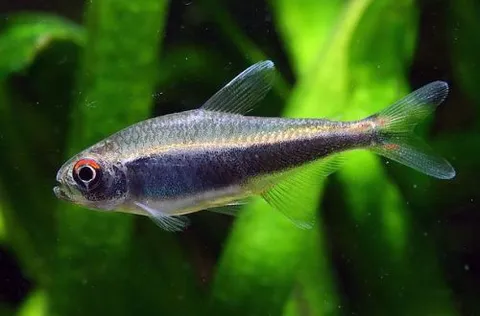
Hyphessobrycon peruvianus
The Peruvian Tetra, or Peruvian Neon (scientific name Hyphessobrycon peruvianus), belongs to the Acestrorhamphidae family. This species has gained widespread popularity in aquaristics due to its moderate requirements,…
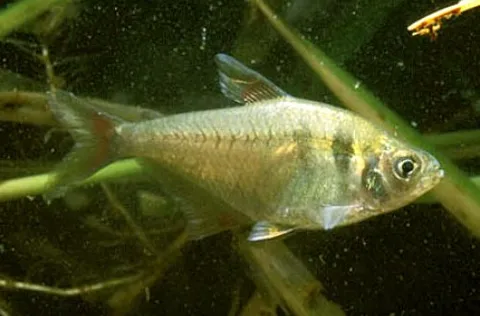
Hyphessobrycon bifasciatus
The Yellow Tetra (Hyphessobrycon bifasciatus), a member of the Acestrorhamphidae family, possesses a pleasant yellow hue that allows it to stand out in an aquarium. These fish are readily available, easy to keep and…
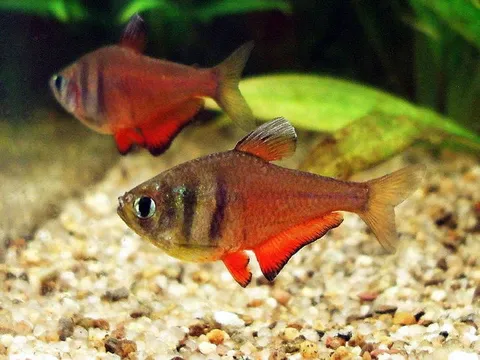
Hyphessobrycon flammeus
Hyphessobrycon flammeus, also known as the Flame Tetra or Red Tetra, belongs to the family Acestrorhamphidae. These fish are distinguished by their beautiful fiery coloration. However, when purchased from pet stores,…
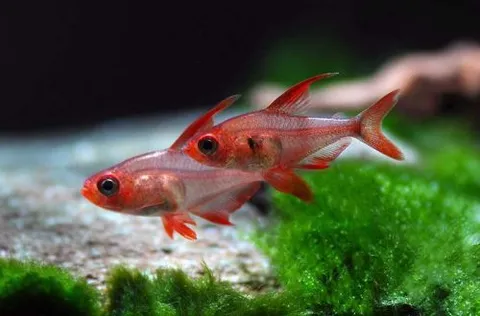
Megalamphodus sweglesi
The Red Phantom Tetra, also known as Megalamphodus sweglesi, belongs to the Acestrorhamphidae family. This fish is popular due to its vibrant coloration and peaceful nature. It is easy to keep and breed, and can adorn…