Temperature22 – 28 °C
Natural range
- Amazon River Basin
- Brazil area
- Peru area
- Colombia area
CharacinsConservation status: Least concern LC
Other scientific names: Poecilobrycon trifasciatus, Poecilobrycon vittatus
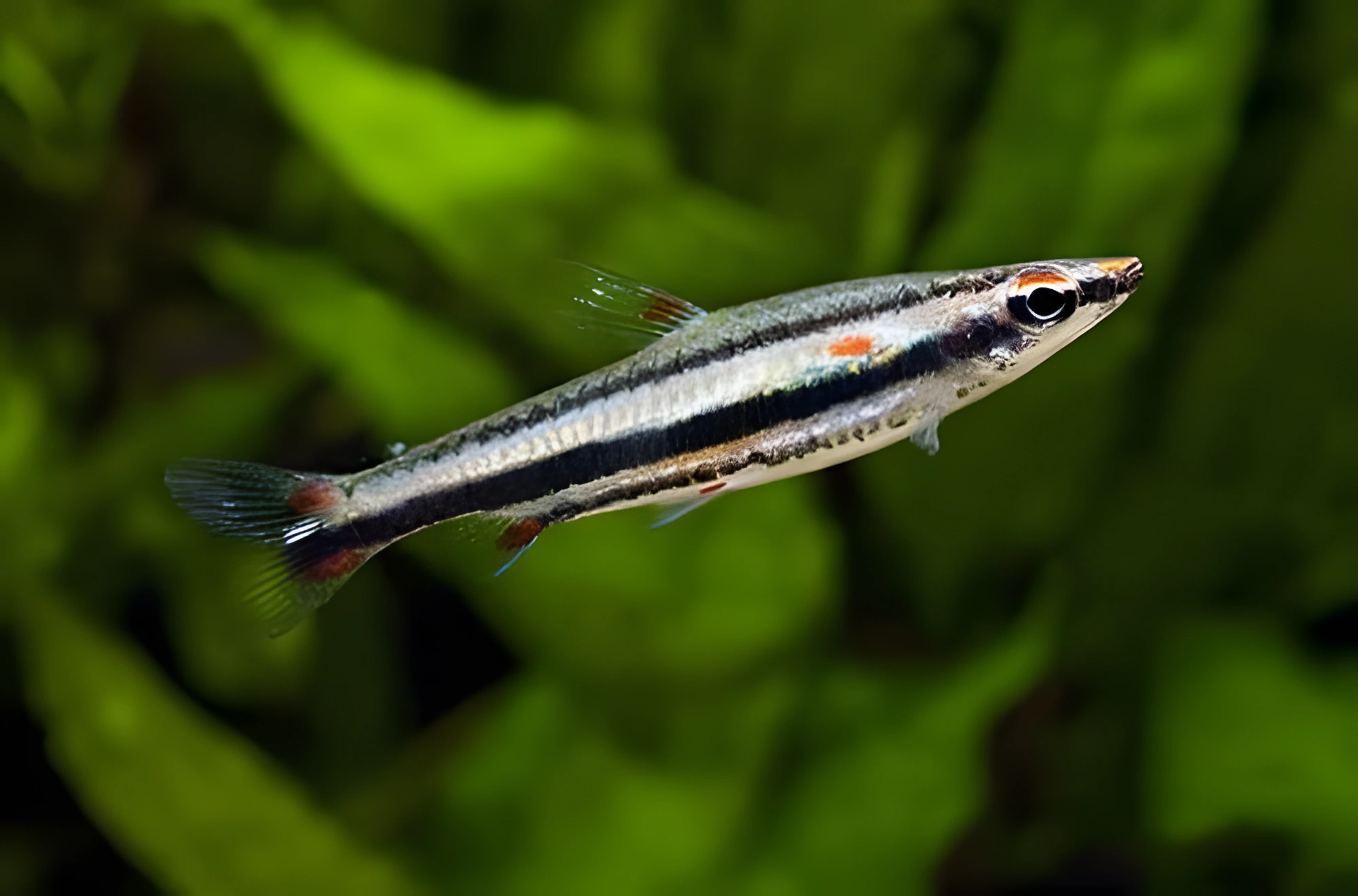
The three-lined pencilfish, scientifically known as Nannostomus trifasciatus, is a popular and well-known aquarium fish from the family Lebiasinidae. This species is easy to keep and breed, coexisting well with other freshwater tank mates. It is often recommended to beginner aquarists as a first fish.
- Required aquarium volume
- 60 L
- Size in aquarium
- 3 – 3.6 cm
- Temperature
- 22 – 28 °C
- Temperament
- Peaceful (regular)
Parameters
Water pHAcidic (4) – Neutral (7.5)
Water dHVery soft (1) – Hard (12)
Water salinityno salt (freshwater)
Size in aquarium3 – 3.6 cm
Lifespan5 years
TemperamentPeaceful (regular)
Toward small fishnot a predator
Required aquarium volume60 L
Lightingdimmed or moderate
Substrateany (no restrictions)
Water flownone or stagnant (no flow)
FeedingAny (universal)
CareLarge group (10+ individuals)
Description
Adult specimens of this fish reach approximately 3 cm in length. Sexual dimorphism is not clearly pronounced, with males being almost identical to females. Interestingly, three-lined pencilfish can vary in coloration depending on their specific region of origin. For example, those found in Peruvian rivers typically have a modest silvery coloration with characteristic black stripes extending from head to tail. At the same time, forms from Brazil display bright red markings across their bodies. In the past, due to these color differences, they were even classified as different species.
Habitat
The habitats of Nannostomus trifasciatus cover vast areas of South America. It is widely distributed in the western part of the Amazon River basin, found in Brazil, Peru, Colombia, and Bolivia, as well as in numerous small river systems of Guyana and Suriname. These fish prefer slow-moving streams and rivers flowing through tropical forests, as well as swamps and floodplain lakes. They show a particular preference for regions with abundant aquatic vegetation.
Behavior and Compatibility
This fish is considered relatively peaceful, although males sometimes show a tendency to compete with each other, especially for the attention of females. Occasionally, these skirmishes can be quite fierce and may even lead to minor injuries. Nevertheless, in a spacious aquarium, the likelihood of such incidents is extremely low. During the daytime, the fish often keep to themselves, but as dusk approaches, they gather in schools. It is advisable to keep a group of at least 10 individuals, including males and females. They are well compatible with other non-aggressive, similarly sized fish species.
Care and Maintenance
For a school of 10 fish, an aquarium of 60–70 liters or more will be optimal. When decorating, it is recommended to use a soft, dark substrate, an abundance of aquatic plants, including floating ones, as well as various sizes of driftwood and other natural decor. Such an arrangement will help recreate an environment close to their natural habitat. A very useful addition will be the leaves of some trees, carefully placed on the bottom. As they decompose, processes similar to natural ones will occur in the water: the release of tannins, which give the water the necessary chemical composition and stain it a light brown hue. The latter is completely normal and should not cause concern. More detailed information on this can be found in a separate article, “Which tree leaves can be added to an aquarium.” It should also be noted that the leaves will serve as an ideal environment for the development of beneficial microorganisms, such as infusoria (paramecium), a valuable food source for fry. Over many years of keeping them in home aquariums, Nannostomus trifasciatus have successfully adapted to conditions somewhat different from those in which their wild relatives live. This is manifested in their ability to tolerate a fairly wide range of hydrochemical parameters. However, slightly acidic waters with low carbonate hardness remain the most comfortable for them. It is extremely important to maintain stable water conditions and ensure that organic waste does not accumulate.
Diet
Nannostomus are undemanding in their diet, readily accepting most appropriately sized foods intended for aquarium fish. Their diet can be based on dry products such as flakes or granules. In addition, live or frozen brine shrimp, daphnia, and small bloodworms will be an excellent supplement.
Breeding and Reproduction
Successful breeding of these fish is not uncommon. Under favorable conditions, they spawn regularly, and in the artificial environment of an aquarium, there is no clear seasonality in reproduction. The more individuals in the school, the more often spawning occurs. Females scatter eggs near the bottom, and males fertilize them. Parental care for the offspring is absent. Moreover, adult fish will readily eat their own fry at any opportunity. Therefore, to preserve the offspring, it is recommended to transfer the eggs to a separate tank with identical water parameters. The incubation period lasts about 3 days. In the first days of life, fry require microscopic food, such as infusoria or specialized powdered foods.
Diseases
Specific diseases that affect only this particular fish species have not been identified. When kept in suitable conditions, including high water quality, a balanced diet, and peaceful tank mates, health issues usually do not arise. The most common cause of illness is a deterioration of living conditions, which weakens the immune system and makes the fish susceptible to infections that are always present in their environment. Upon noticing initial signs of sickness (such as lethargy, emaciation, refusal to eat, or clamped fins), it is crucial to immediately check the basic water parameters. Often, restoring acceptable living conditions will lead to self-recovery, but if the fish is too weak or has suffered visible damage, medicinal treatment may be required. For more details on symptoms and treatment methods, consult the section “Diseases of Aquarium Fish.”
How to choose
When purchasing, choose active individuals that stay in a school and show interest in their surroundings. Inspect the fish for any fin damage, ulcers, or white film on the scales, and also make sure that the abdomen does not appear unnaturally sunken, which could indicate emaciation or internal parasites. Avoid specimens that keep to themselves, constantly hide, or have an uncharacteristic pale coloration for the species, as this often indicates stress or poor health in the store environment.
Frequently asked questions
The essentials: size, tank volume, water parameters and care
How big does Three-lined Pencilfish get?
An adult reaches 3–3.6 cm in length. Plan the tank around the maximum size: the fish quickly outgrows a cramped setup.
What size aquarium does Three-lined Pencilfish need?
The minimum recommended volume is 60 L. A smaller tank speeds up nitrate build-up and raises stress levels.
What water parameters does Three-lined Pencilfish need?
Temperature 22–28 °C, pH 4–7.5, hardness 1–12 dGH. Stability matters more than exact values: sudden swings are harder on the fish than a small deviation from the ideal.
How long does Three-lined Pencilfish live?
Around 5 years when kept properly. Lifespan depends directly on tank volume, water quality and a varied diet.
Is Three-lined Pencilfish aggressive?
Temperament: peaceful (regular). Keep this in mind when choosing tank mates.
How many Three-lined Pencilfish should be kept together?
Recommended setup: large group (10+ individuals). Ignoring this is a common cause of stress and disease.
What does Three-lined Pencilfish eat?
Diet type: any (universal). Feed small portions that are finished within a couple of minutes — overfeeding does more harm than underfeeding.
What is the scientific name of Three-lined Pencilfish?
The scientific name of the species is Nannostomus trifasciatus, family Lebiasinidae. It also appears in the literature as: Poecilobrycon trifasciatus, Poecilobrycon vittatus.