Temperature22 – 28 °C
Natural range
- Guyana area
- Suriname area
- Lower and Middle Amazon Basin
- Peru area
CharacinsConservation status: Least concern LC
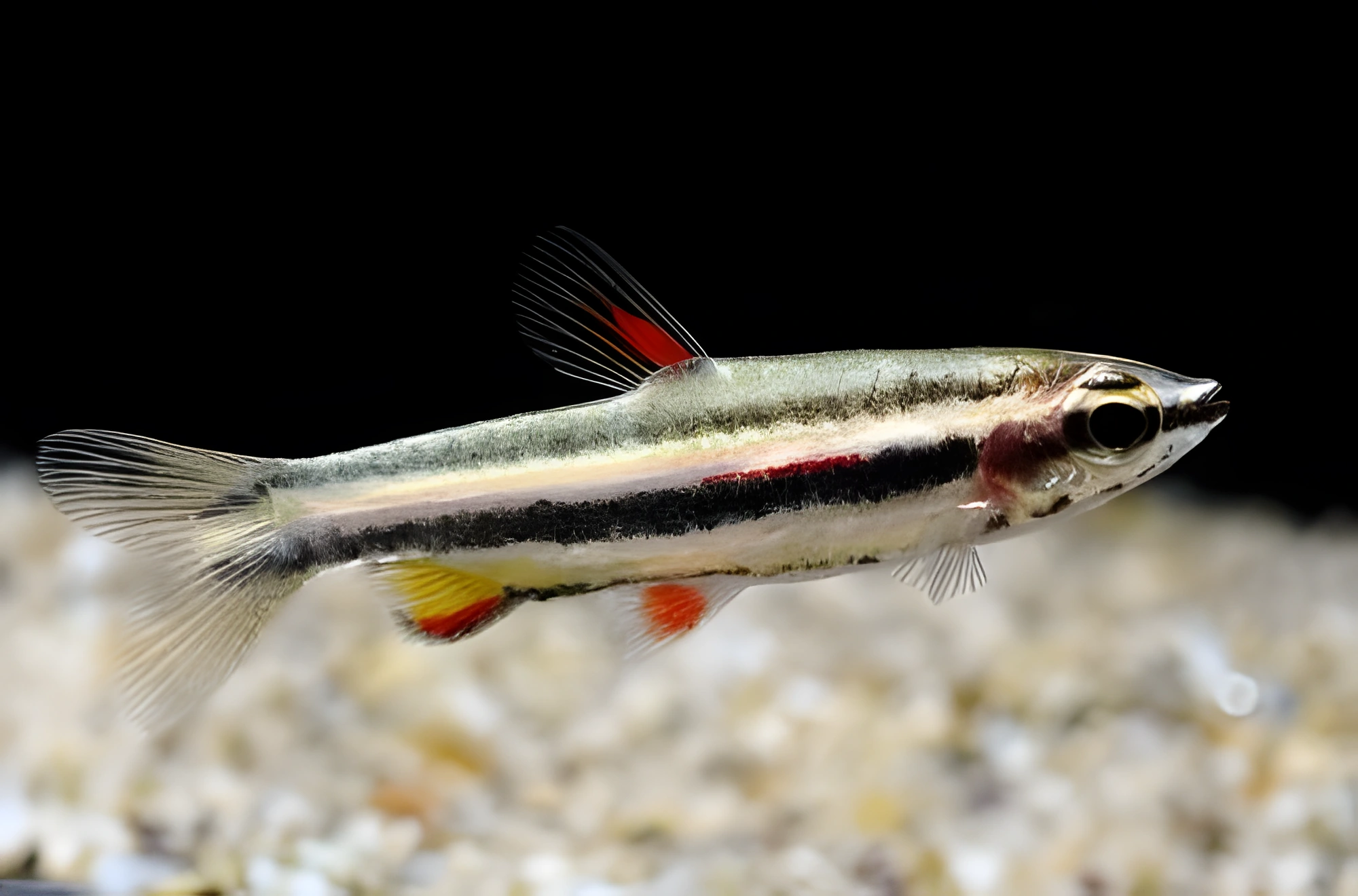
The Dwarf Pencilfish, or Nannostomus marginatus, belongs to the family Lebiasinidae. These active and undemanding fish can become a true adornment to almost any freshwater aquarium. Thanks to their simplicity, they are suitable for aquarists of all levels.
- Required aquarium volume
- 40 L
- Size in aquarium
- 5 cm
- Temperature
- 22 – 28 °C
- Temperament
- Peaceful (regular)
Parameters
Water pHSlightly acidic (5.5) – Neutral (7)
Water dHVery soft (1) – Medium hardness (10)
Water salinityno salt (freshwater)
Size in aquarium5 cm
Lifespan4 years
TemperamentPeaceful (regular)
Toward small fishnot a predator
Required aquarium volume40 L
Lightingdimmed
Substrateany, but dark
Water flownone or stagnant (no flow)
FeedingAny (universal)
CareGroup (8–10 individuals)
Description
These fish are indeed miniature — adult specimens reach a length of only 2.5 cm. Sexual dimorphism is weakly expressed, and it is difficult to notice clear differences between males and females. The coloration of the Dwarf Pencilfish is gray, with characteristic horizontal black and white stripes. Their fins often have reddish hues.
Habitat
The natural habitat of these fish spans South America, including Guyana, Suriname, as well as the lower and middle Amazon River basins in Peru, Colombia, and Brazil. They can be found in small rivers, slow-moving streams, and swamps, as well as in flooded forests and floodplain lakes. Nannostomus prefer areas with dense aquatic vegetation, numerous snags, and fallen leaves.
Behavior and Compatibility
Nannostomus are peaceful and even somewhat timid fish that prefer to live in schools. Therefore, it is advisable to keep a group of at least 10 individuals. No intraspecific conflicts are observed among them. They get along well with other non-aggressive species of comparable size. They can also coexist with larger bottom-dwelling fish, as they spend most of their time in the upper and middle water layers.
Care and Maintenance
Thanks to their size, Dwarf Pencilfish thrive even in nano-aquariums of 10–20 liters. When setting up such an aquarium, it is recommended to use a dark substrate, place several snags, and provide abundant plants, including floating ones. The latter, as is known, create additional shading. It is important to maintain subdued lighting and stable water parameters. Regular cleaning of the substrate from organic waste and weekly water changes of 10–15% with fresh water are essential procedures. When choosing a filtration system, preference should be given to models that create a weak current, such as sponge air-lift filters. Adding Indian almond leaves or their extract is notably beneficial: they impart a characteristic tea-like tint to the water and enrich it with tannins, recreating natural habitat conditions.
Diet
Dwarf Pencilfish readily accept all types of appropriately sized foods. Their diet can consist entirely of dry foods, such as flakes or granules. However, if there is an opportunity and desire to diversify their menu, small crustaceans, such as daphnia and brine shrimp, can be offered.
Breeding and Reproduction
Under favorable conditions, the Dwarf Pencilfish can breed in a home aquarium. Often, some fry survive even without the aquarist's deliberate intervention. However, to increase the chances of success, the breeding process should be controlled. Dense thickets of low-growing plants, such as Java moss, can be placed at the bottom of the aquarium, or artificial spawning substrates can be used, among which the fish will lay their eggs. Since parental instincts in Nannostomus are weakly developed, the eggs will likely be eaten if not transferred to a separate tank with identical water conditions. It is recommended to place Indian almond leaves from the main aquarium into this tank (if they were present). During decomposition, colonies of microorganisms, such as paramecia, form on the leaves, which will serve as excellent first food for newly hatched fry. Alternatively, specialized foods with particle sizes from 5 to 50 microns can be used, gradually transitioning the growing fish to brine shrimp nauplii.
Diseases
Health problems in these fish arise only in the presence of injuries or keeping in unsuitable conditions, which leads to a weakening of the immune system and the subsequent occurrence of various diseases. At the first signs of illness, it is necessary first to check the water parameters for exceeding permissible values or the presence of toxic substances (such as nitrites, nitrates, ammonia). If deviations are found, all indicators should be normalized, and then treatment should begin. More detailed information on symptoms and treatment methods is available in the "Diseases of Aquarium Fish" section.
How to choose
When purchasing, choose active individuals that stay in a school and show no visible damage to fins or scales. Avoid fish with signs of emaciation, sunken bellies, or unnatural behavior, such as constantly staying at the surface or alone at the bottom. The coloration of a healthy fish should be clear, without a cloudy film.
Since Nannostomus are sensitive to sudden changes in water parameters, inquire about their keeping conditions at the store before purchasing. After purchase, a quarantine in a separate tank for 1–2 weeks is mandatory to prevent the transfer of infections to the main aquarium. During transport and acclimatization, use the method of gradual equalization of temperature and water parameters to minimize stress for the fish.
Frequently asked questions
The essentials: size, tank volume, water parameters and care
How big does Nannostomus marginatus get?
An adult reaches 5 cm in length. Plan the tank around the maximum size: the fish quickly outgrows a cramped setup.
What size aquarium does Nannostomus marginatus need?
The minimum recommended volume is 40 L. A smaller tank speeds up nitrate build-up and raises stress levels.
What water parameters does Nannostomus marginatus need?
Temperature 22–28 °C, pH 5.5–7, hardness 1–10 dGH. Stability matters more than exact values: sudden swings are harder on the fish than a small deviation from the ideal.
How long does Nannostomus marginatus live?
Around 4 years when kept properly. Lifespan depends directly on tank volume, water quality and a varied diet.
Is Nannostomus marginatus aggressive?
Temperament: peaceful (regular). Keep this in mind when choosing tank mates.
How many Nannostomus marginatus should be kept together?
Recommended setup: group (8–10 individuals). Ignoring this is a common cause of stress and disease.
What does Nannostomus marginatus eat?
Diet type: any (universal). Feed small portions that are finished within a couple of minutes — overfeeding does more harm than underfeeding.
What is the scientific name of Nannostomus marginatus?
The scientific name of the species is Nannostomus marginatus, family Lebiasinidae.