Temperature22 – 28 °C
Natural range
- Guyana area
CharacinsConservation status: Least concern LC
Other scientific names: Archicheir minutus, Poeciloberycon harrisoni, Poecilobrycon harrisoni
Nannostomus harrisoni, also known as the Black-striped Nannostomus, belongs to the family Lebiasinidae. This species is named after James Harrison, a scientist who actively assisted in the Indiana University and Carnegie Museum expedition during which the fish was first discovered.
- Required aquarium volume
- 50 L
- Size in aquarium
- 4 cm
- Temperature
- 22 – 28 °C
- Temperament
- Peaceful (regular)
Parameters
Water pHSlightly acidic (5) – Neutral (7)
Water dHVery soft (1) – Medium hardness (10)
Water salinityno salt (freshwater)
Size in aquarium4 cm
Lifespan4 years
TemperamentPeaceful (regular)
Toward small fishnot a predator
Required aquarium volume50 L
Lightingdimmed or moderate
Substrateany (no restrictions)
Water flowmoderate
FeedingAny (universal)
CareLarge group (10+ individuals)
Description
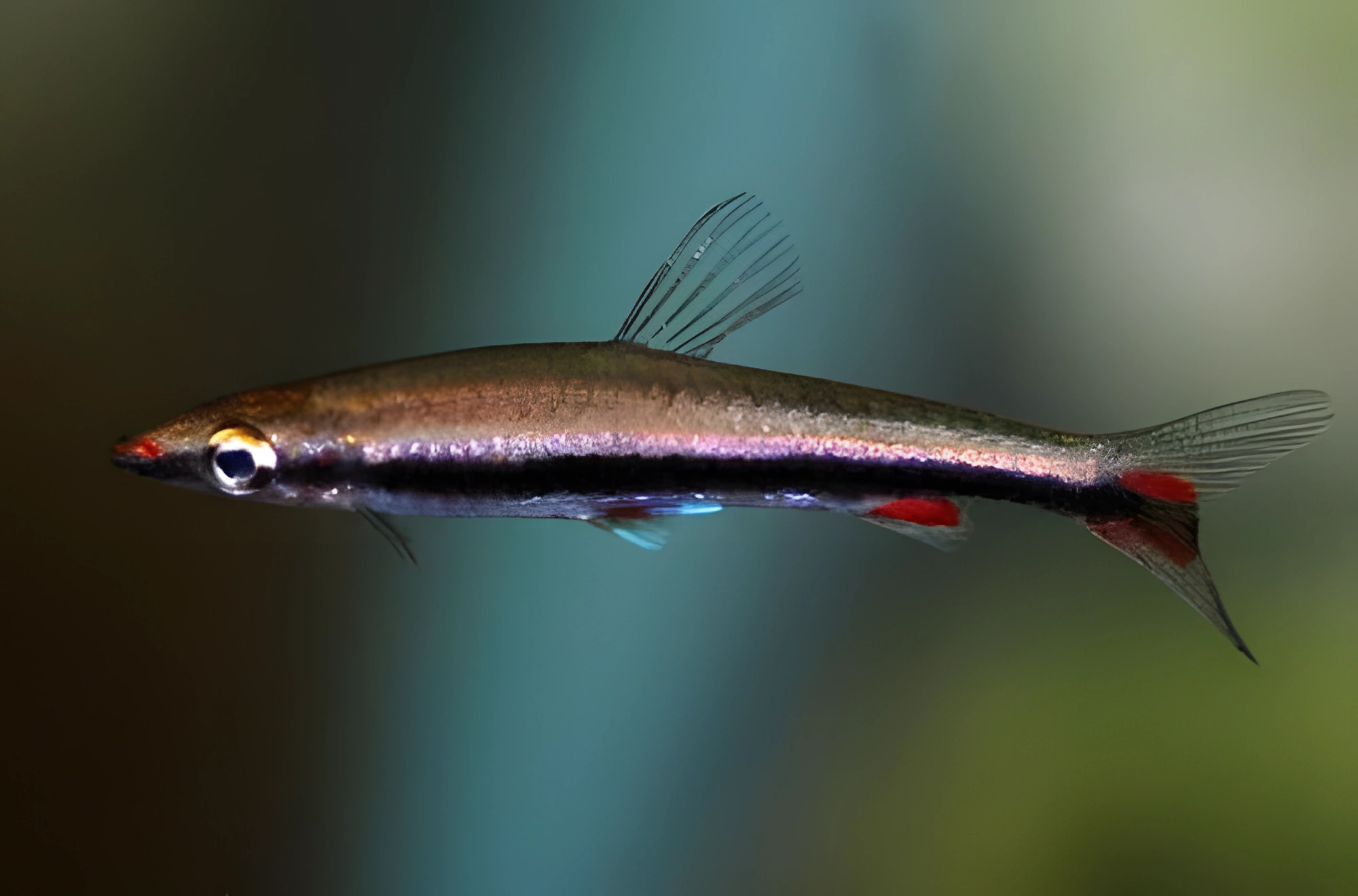
Adults grow up to 4 cm in length. Their body is elongated, with a pointed head, and their eyes are disproportionately large. Males are slimmer than females and have red pigmentation at the base of the caudal and anal fins. The fish's coloration is silvery, with a wide black stripe running along the body.
Habitat
Its natural habitat is in South America. Nannostomus harrisoni is presumably endemic to the Demerara River, located in eastern Guyana. These fish inhabit small, slow-flowing rivers and streams, as well as swampy areas and floodplain lakes. Typical biotopes are characterized by abundant aquatic vegetation, numerous snags, and a bottom covered with plant debris and fallen leaves.
Behavior and Compatibility
This is a peaceful and somewhat timid schooling fish that should not be kept with large or overly active species. It is recommended to maintain a group of at least 10 individuals, as Nannostomus behave more naturally in such numbers. Apistogramma, other small American cichlids, as well as Corydoras catfish and similar fish, make good tank mates.
Care and Maintenance
For a group of 10 fish, the optimal aquarium volume is 50–60 L. It is desirable to keep Nannostomus harrisoni in conditions that are as close as possible to their natural habitat. The fish will look most expressive among snags and thickets of aquatic vegetation, including floating species, where they often gather. Lighting should be subdued, so shade-loving plants are chosen for decoration. An important, though not mandatory, decorative element is the leaves of some trees, which are placed on the bottom. As they decompose, conditions similar to natural bodies of water are created: the water is enriched with tannins and acquires a characteristic brownish tint. In addition, leaves serve as an ideal basis for the formation of colonies of beneficial microorganisms, such as paramecia, which are a valuable additional food source for fry. Long-term and successful keeping of the fish is ensured by maintaining stable water parameters within acceptable hydrochemical limits. For this, the aquarium is equipped with all necessary equipment, part of the water is replaced with fresh water weekly, organic waste is regularly removed, and other mandatory procedures are performed.
Diet
In a home aquarium, these fish readily accept various types of food. Dry foods, such as flakes and granules, can form the basis of their diet, but it is important to regularly offer them live or frozen brine shrimp, daphnia, small bloodworms, and other similar supplements.
Breeding and Reproduction
The breeding process is associated with a number of difficulties, which include both creating suitable conditions and the peculiarities of fish behavior during spawning. However, the greatest difficulty is preserving the fry. When the fish are in an optimal environment and receive high-quality, protein-enriched food, they quickly reach spawning condition. Males actively court females, competing for the right to fertilize the eggs, which the females scatter haphazardly. Parental instincts are not developed in these fish. Immediately after spawning, adults can eat both eggs and newly hatched fry. To protect them, experienced aquarists plant dense thickets of low-growing plants or mosses, such as Java moss, on the bottom, or use special artificial spawning substrates. Eggs that fall among the vegetation have a significantly higher chance of survival. The incubation period lasts 1–2 days. Fry should be transferred to a separate tank with identical water parameters, equipped with a simple air-driven sponge filter and a heater. They do not require an additional light source. In the first days of life, juveniles need microscopic food, such as infusoria or special powdered foods. As they grow, they transition to brine shrimp nauplii and other suitable foods.
Diseases
Specific diseases that affect only this particular fish species have not been identified. When kept in suitable conditions, including high water quality, a balanced diet, and peaceful tank mates, health issues usually do not arise. The most common cause of illness is a deterioration of living conditions, which weakens the immune system and makes the fish susceptible to infections that are always present in their environment. Upon noticing initial signs of sickness (such as lethargy, emaciation, refusal to eat, or clamped fins), it is crucial to immediately check the basic water parameters. Often, restoring acceptable living conditions will lead to self-recovery, but if the fish is too weak or has suffered visible damage, medicinal treatment may be required. For more details on symptoms and treatment methods, consult the section “Diseases of Aquarium Fish.”
How to choose
When purchasing, choose active fish that stay in a school and demonstrate a natural horizontal body orientation. Avoid individuals with signs of emaciation, damaged fins, or visible spots on the body. Since the species often comes to market as accidental bycatch with other Nannostomus, carefully examine the fish for species-specific characteristics: the presence of a characteristic black stripe and red accents on the fins. In the store, the fish may look pale due to stress, but they should show curiosity and react quickly to food.
Frequently asked questions
The essentials: size, tank volume, water parameters and care
How big does Nannostomus harrisoni get?
An adult reaches 4 cm in length. Plan the tank around the maximum size: the fish quickly outgrows a cramped setup.
What size aquarium does Nannostomus harrisoni need?
The minimum recommended volume is 50 L. A smaller tank speeds up nitrate build-up and raises stress levels.
What water parameters does Nannostomus harrisoni need?
Temperature 22–28 °C, pH 5–7, hardness 1–10 dGH. Stability matters more than exact values: sudden swings are harder on the fish than a small deviation from the ideal.
How long does Nannostomus harrisoni live?
Around 4 years when kept properly. Lifespan depends directly on tank volume, water quality and a varied diet.
Is Nannostomus harrisoni aggressive?
Temperament: peaceful (regular). Keep this in mind when choosing tank mates.
How many Nannostomus harrisoni should be kept together?
Recommended setup: large group (10+ individuals). Ignoring this is a common cause of stress and disease.
What does Nannostomus harrisoni eat?
Diet type: any (universal). Feed small portions that are finished within a couple of minutes — overfeeding does more harm than underfeeding.
What is the scientific name of Nannostomus harrisoni?
The scientific name of the species is Nannostomus harrisoni, family Lebiasinidae. It also appears in the literature as: Archicheir minutus, Poeciloberycon harrisoni, Poecilobrycon harrisoni.