Temperature22 – 28 °C
Natural range
- South America area
CharacinsConservation status: Least concern LC
Nannostomus anduzei, known scientifically as Nannostomus anduzei, belongs to the family Lebiasinidae. The fish was named in honor of the Venezuelan biologist and explorer Pablo Anduze, who first provided a detailed description of it. This is not the easiest fish to keep and breed, mainly due to its miniature size. For the same reason, difficulties arise when selecting tank mates.
- Required aquarium volume
- 40 L
- Size in aquarium
- 2 cm
- Temperature
- 22 – 28 °C
- Temperament
- Peaceful (regular)
Parameters
Water pHSlightly acidic (5) – Neutral (7)
Water dHVery soft (1) – Medium hardness (8)
Water salinityno salt (freshwater)
Size in aquarium2 cm
Lifespan3 years
TemperamentPeaceful (regular)
Toward small fishnot a predator
Required aquarium volume40 L
Lightingdimmed or moderate
Substrateany (no restrictions)
Water flownone or stagnant (no flow)
FeedingAny (universal)
CareLarge group (10+ individuals)
Description
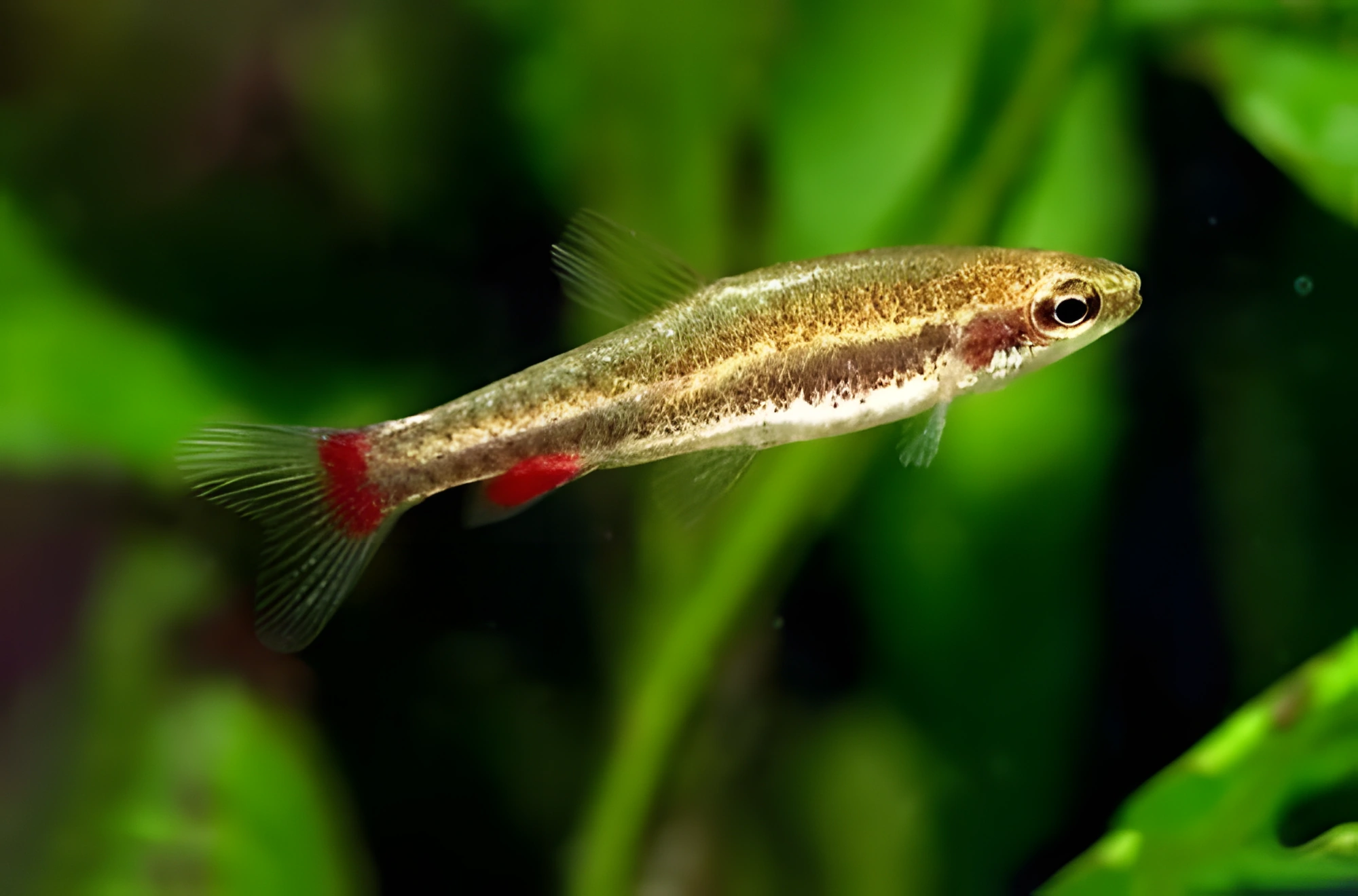
This is a miniature fish, whose size does not exceed 2 cm. Sexual dimorphism is weakly expressed, however, adult males can be distinguished from females by the presence of red pigmentation on the anal and caudal fins. The body coloration is usually gray or sandy, with a silvery belly.
Habitat
The natural habitat of this species is in South America. Wild populations of Nannostomus anduzei are found in the vast basins of the Amazon and Orinoco rivers. Typical for them are small, shallow streams with clear water, usually not exceeding half a meter in depth, flowing in the shade of tropical forests. The bottom of such streams is sandy, covered with numerous snags and a layer of fallen leaves. Along the banks, dense thickets of aquatic vegetation can often be seen.
Behavior and Compatibility
These peaceful schooling fish should be kept in large groups of at least 10 individuals of both sexes. In small aquariums, it is not recommended to house them with other species. However, if Nannostomus anduzei are kept in large tanks, other calm fish of comparable size can be suitable tankmates.
Care and Maintenance
A school of 10 fish can be comfortably housed in an aquarium of 40 liters or more. The main elements of the decor are aquatic plants and snags, imitating tree branches and roots. Dried leaves from certain trees, scattered on the bottom, will be an additional beneficial element. The decomposition of leaves releases tannins, which creates a water chemistry similar to the fish's natural habitat. When keeping them, a key aspect is maintaining stable water conditions within the permissible range of hydrochemical values and temperatures. It is important to regularly clean the aquarium, weekly replace part of the water with fresh water, and monitor its main parameters, such as pH, dGH, and concentrations of nitrogen cycle products. Essential equipment includes a heater and a lighting system, which is critically important for plant growth. In a small tank, a simple air-driven sponge filter is quite sufficient as a filter material.
Diet
Due to their modest size, Nannostomus anduzei require very fine food, typically used for feeding fry. Suitable diets include Artemia nauplii or dry flakes and granules crushed into fine particles.
Breeding and Reproduction
Breeding this species in aquarium conditions is possible; however, raising fry to adulthood is extremely difficult, especially for beginner aquarists, given the tiny size of both the fish themselves and their offspring. Nannostomus lack parental instincts; they do not care for their offspring. There is no pronounced breeding seasonality, so fry can appear at any time. If they are not removed promptly, there is a high probability of them being eaten, which often happens because the spawning moment is easy to miss, and finding fry among dense plants is very difficult. Another problem is selecting suitable food and the feeding process. Specialized powdered foods that form a suspension in water are used for this purpose. Uneaten food residues lead to a new problem — water pollution. Thus, the breeding process is complex and involves a number of difficulties, the solution of which may be overwhelming for an inexperienced aquarist.
Diseases
Specific diseases that affect only this particular fish species have not been identified. When kept in suitable conditions, including high water quality, a balanced diet, and peaceful tank mates, health issues usually do not arise. The most common cause of illness is a deterioration of living conditions, which weakens the immune system and makes the fish susceptible to infections that are always present in their environment. Upon noticing initial signs of sickness (such as lethargy, emaciation, refusal to eat, or clamped fins), it is crucial to immediately check the basic water parameters. Often, restoring acceptable living conditions will lead to self-recovery, but if the fish is too weak or has suffered visible damage, medicinal treatment may be required. For more details on symptoms and treatment methods, consult the section “Diseases of Aquarium Fish.”
How to choose
When purchasing Nannostomus anduzei, it is important to consider that the species is rarely found in mass sale and often enters pet stores as an accidental bycatch with other fish. Choose only active individuals that exhibit schooling behavior and show no visible fin damage or signs of emaciation. Avoid fish with signs of infection, such as body film, rapid breathing, or an unnaturally bloated abdomen.
- Inspect the fish for intact scales and clear eyes.
- Pay attention to behavior: healthy individuals should be active and react to movement near the glass.
- Given their miniature size, ensure that the fish in the store are receiving appropriate food, as prolonged starvation is critical for this species.
Frequently asked questions
The essentials: size, tank volume, water parameters and care
How big does Nannostomus anduzei get?
An adult reaches 2 cm in length. Plan the tank around the maximum size: the fish quickly outgrows a cramped setup.
What size aquarium does Nannostomus anduzei need?
The minimum recommended volume is 40 L. A smaller tank speeds up nitrate build-up and raises stress levels.
What water parameters does Nannostomus anduzei need?
Temperature 22–28 °C, pH 5–7, hardness 1–8 dGH. Stability matters more than exact values: sudden swings are harder on the fish than a small deviation from the ideal.
How long does Nannostomus anduzei live?
Around 3 years when kept properly. Lifespan depends directly on tank volume, water quality and a varied diet.
Is Nannostomus anduzei aggressive?
Temperament: peaceful (regular). Keep this in mind when choosing tank mates.
How many Nannostomus anduzei should be kept together?
Recommended setup: large group (10+ individuals). Ignoring this is a common cause of stress and disease.
What does Nannostomus anduzei eat?
Diet type: any (universal). Feed small portions that are finished within a couple of minutes — overfeeding does more harm than underfeeding.
What is the scientific name of Nannostomus anduzei?
The scientific name of the species is Nannostomus anduzei, family Lebiasinidae.