Temperature24 – 28 °C
Natural range
- Lower Amazon River basin
- Brazil area
- Venezuela area
- Guyana area
CharacinsConservation status: Least concern LC
Other scientific names: Nannostomus anomalus, Nannostomus aripiragensis, Nannostomus aripirangensis, Nannostomus simplex
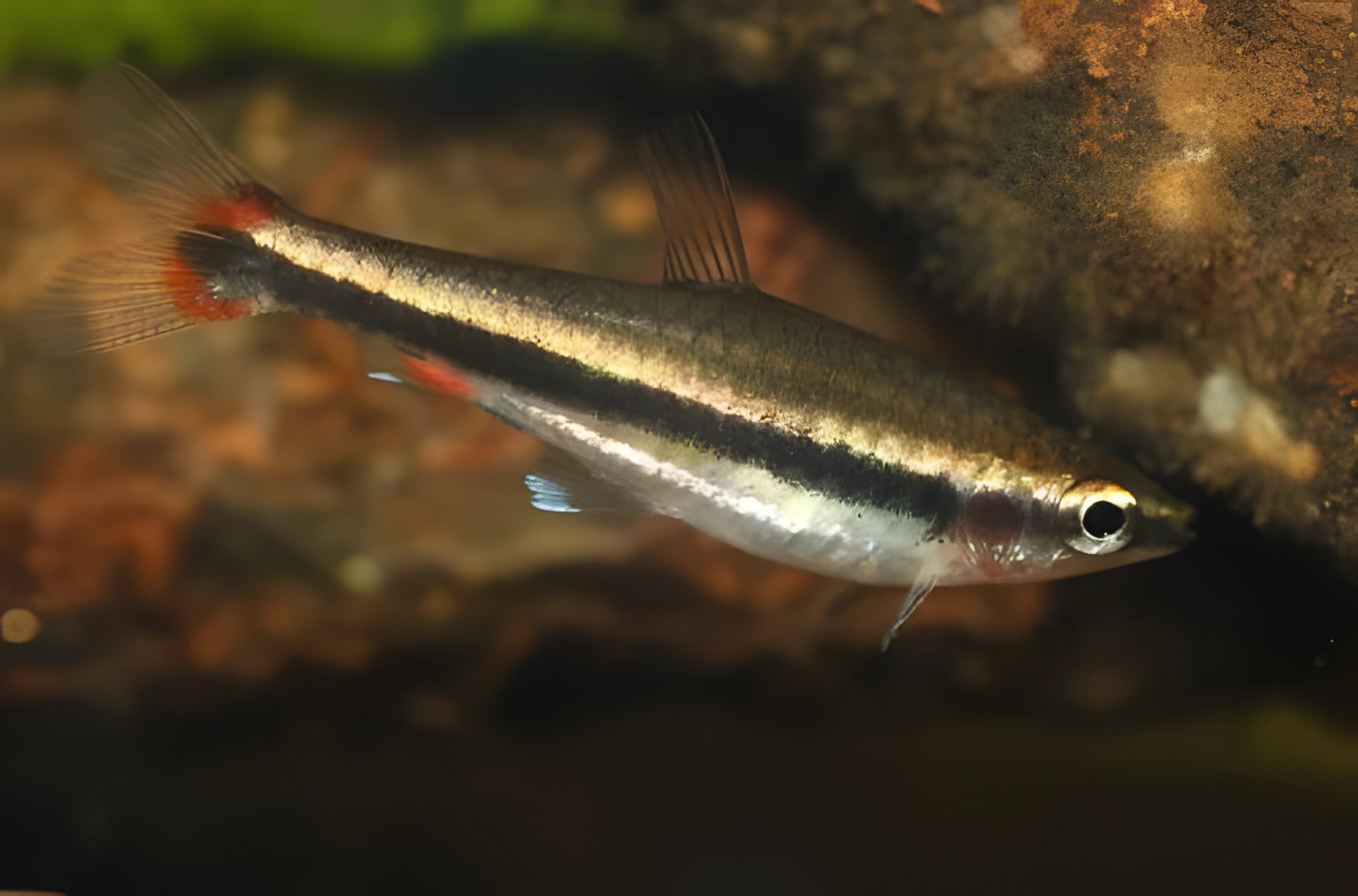
Nannostomus beckfordi, belonging to the family Lebiasinidae, is a miniature and rather active fish, rarely exceeding 4 cm in length. A small school of these fish can be a magnificent addition to a tropical aquarium. They are often used as tankmates for larger and more graceful inhabitants, such as Discus.
- Required aquarium volume
- 60 L
- Size in aquarium
- 4 cm
- Temperature
- 24 – 28 °C
- Temperament
- Peaceful, active/mobile
Parameters
Water pHSlightly acidic (6) – Slightly alkaline (8)
Water dHSoft (5) – Very hard (19)
Water salinityno salt (freshwater)
Size in aquarium4 cm
Lifespan5 years
TemperamentPeaceful, active/mobile
Toward small fishnot a predator
Required aquarium volume60 L
Lightingdimmed
Substrateany, but dark
Water flownone or stagnant (no flow)
FeedingSmall / appropriate size / pieces
CareLarge group (10+ individuals)
Description
The fish has an elongated, shallow body; females are generally more rounded. A distinctive feature of this species is the absence of an adipose fin. The coloration is usually brownish-pink, with a dark longitudinal stripe running along the lower part of the body. Females are usually paler than males. There are several closely related species, very similar to Beckford's Pencilfish, but distinguished by the presence of several dark longitudinal stripes across the entire body.
Habitat
This species is widespread in the lower Amazon River basin, in the territories of modern Brazil, Venezuela, as well as Guyana and Suriname. The fish inhabit small rivers and streams with weak currents, as well as swampy areas. They prefer dense thickets of aquatic vegetation, as well as submerged trees and shrubs.
Behavior and Compatibility
Nannostomus beckfordi is a peaceful and calm fish, but for its comfortable keeping, schooling is necessary, consisting of at least 10 individuals. In small groups, the fish become excessively timid and do not exhibit their natural behavior. Moreover, in a school, they are less susceptible to attacks from tankmates. This species is compatible with all peaceful fish; however, due to their small size, it is advisable to avoid keeping them with aggressive tankmates.
Care and Maintenance
These fish can be successfully kept in both spacious and relatively small aquariums, from 60 liters for a small school. The aquarium setup must include areas with dense vegetation; floating plants are also highly desirable. It is important to provide shelters in the form of snags, tree roots, or branches. Any substrate can be used, but dark is preferable. A small amount of dry fallen leaves on the bottom of the aquarium will give the setup a natural look. As they decompose, the leaves will tint the water a light brownish hue. Leaves should be replaced weekly. When preparing the water, pay special attention to its hardness – it should be soft. This can be achieved by boiling (where dissolved salts will precipitate as scale) or by using special reagents from a pet store. Nannostomus can adapt to a wide pH range, but slightly acidic water is preferred. Over time, the water in the aquarium naturally acidifies due to decomposing organic matter, so artificially maintaining a low pH is usually not required. Weekly, 15–20% of the water volume should be replaced, and the substrate should be siphoned to remove debris. The minimum set of necessary equipment includes a lighting system, a heater, an aerator, and a filter. It is recommended to use a filter with peat as a media, as it effectively lowers the pH level, which can be especially relevant for new aquariums or large volumes of water.
Diet
In their natural habitat, Beckford's Pencilfish's diet consists of small invertebrates and various zooplankton. In aquarium conditions, they readily accept any high-quality dry food. The main requirements for food are small particles and the presence of protein components. The diet can be diversified by offering live foods, such as bloodworms, daphnia, or nauplii.
Breeding and Reproduction
Beckford's Pencilfish lays eggs directly on the substrate, for example, on dense, low-growing grass. Parental care for the offspring is absent, and the fish may even eat their fry if given the opportunity. If you plan to breed them, it is recommended to prepare a separate small aquarium where a male and female will be placed for the spawning period. The female's readiness to spawn can be determined by a significantly swollen abdomen. In this improvised spawning tank, it is important to create similar water parameters. For decoration, a few low-growing plants, such as Java moss, are sufficient. It is advisable to raise the temperature to 27–28°C and leave the room without bright lighting; diffused light from the room will be enough. Under such conditions, the fish will quickly begin to spawn. After spawning, the parents should be returned to the main aquarium. Fry should be fed micro-food, as well as flakes or granules ground into powder.
Diseases
The fish are susceptible to all common diseases, however, this only occurs under unfavorable keeping conditions, with poor nutrition, or contact with an already sick individual. No specific diseases inherent to this species have been observed. Sometimes problems arise for beginner aquarists who offer food with particles that are too large. In such a case, the Nannostomus simply cannot swallow the food, suffers from hunger, and this naturally lowers its immunity. More detailed information on symptoms and treatment methods can be found in the "Aquarium Fish Diseases" section.
How to choose
When choosing Beckford's Pencilfish, attention should be paid to the overall activity of the school in the display tank. Healthy fish should be active, with a bright, clearly defined longitudinal stripe, without visible fin damage, ulcers, or white film on the scales. Avoid purchasing individuals that keep to themselves, appear emaciated, or have sunken bellies, as this may indicate chronic stress or infectious diseases. Since the fish are sensitive to water quality, it is recommended to assess the condition of the aquarium in the store: clean substrate and the absence of dead individuals nearby are important indicators of the fish's well-being.
Frequently asked questions
The essentials: size, tank volume, water parameters and care
How big does Beckford's Pencilfish get?
An adult reaches 4 cm in length. Plan the tank around the maximum size: the fish quickly outgrows a cramped setup.
What size aquarium does Beckford's Pencilfish need?
The minimum recommended volume is 60 L. A smaller tank speeds up nitrate build-up and raises stress levels.
What water parameters does Beckford's Pencilfish need?
Temperature 24–28 °C, pH 6–8, hardness 5–19 dGH. Stability matters more than exact values: sudden swings are harder on the fish than a small deviation from the ideal.
How long does Beckford's Pencilfish live?
Around 5 years when kept properly. Lifespan depends directly on tank volume, water quality and a varied diet.
Is Beckford's Pencilfish aggressive?
Temperament: peaceful, active/mobile. Keep this in mind when choosing tank mates.
How many Beckford's Pencilfish should be kept together?
Recommended setup: large group (10+ individuals). Ignoring this is a common cause of stress and disease.
What does Beckford's Pencilfish eat?
Diet type: small / appropriate size / pieces. Feed small portions that are finished within a couple of minutes — overfeeding does more harm than underfeeding.
What is the scientific name of Beckford's Pencilfish?
The scientific name of the species is Nannostomus beckfordi, family Lebiasinidae. It also appears in the literature as: Nannostomus anomalus, Nannostomus aripiragensis, Nannostomus aripirangensis.