Temperature22 – 26 °C
Natural range
- Congo River Basin
- Niger River Basin
- Cameroon area
- Nigeria area
CharacinsConservation status: Least concern LC
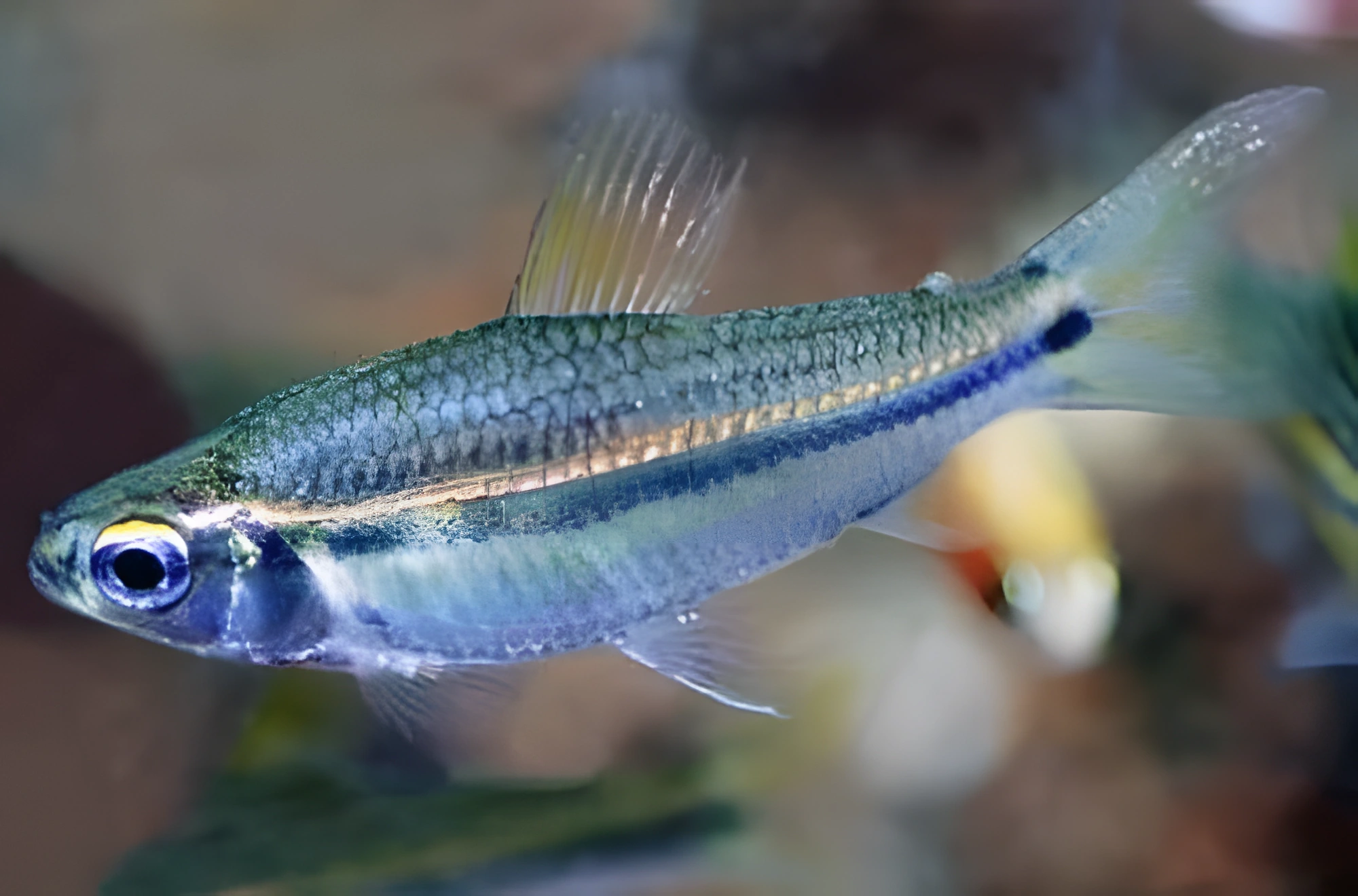
Nannaethiops unitaeniatus, known as the One-striped Nannaethiops, belongs to the family Distichodontidae. These fish are rarely found in hobbyists' aquariums, although they have all the qualities to become truly popular. They are distinguished by their original coloration, peaceful nature, and are relatively easy to keep, especially after adapting to dry foods.
- Required aquarium volume
- 55 L
- Size in aquarium
- 5 – 6.5 cm
- Temperature
- 22 – 26 °C
- Temperament
- Peaceful, calm/shy/inactive
Parameters
Water pHNeutral (6.5) – Neutral (7.5)
Water dHSoft (5) – Hard (12)
Water salinityno salt (freshwater)
Size in aquarium5 – 6.5 cm
Lifespan6 years
TemperamentPeaceful, calm/shy/inactive
Toward small fishnot a predator
Required aquarium volume55 L
Lightingweak or moderate
Substrateany (no restrictions)
Water flowweak or moderate
FeedingHigh protein (predominantly meat)
CareGroup (8–10 individuals)
Description
The body coloration has a bluish tint and is adorned with two horizontal stripes of yellow and dark blue. There is a dark spot at the base of the caudal fin. Females can reach a length of 6.5 cm, while males only grow up to 4.5 cm. During the breeding season, males acquire a reddish hue.
Habitat
Its natural habitat encompasses the river systems of the Congo and Niger, extending across the territories of modern-day Cameroon, Nigeria, Gabon, the Republic of the Congo, and the Democratic Republic of the Congo. The species is widely found in various streams, rivers, as well as in floodplain lakes and ponds.
Behavior and Compatibility
This species is particularly shy and timid: at the slightest threat, the fish immediately seek refuge. They must be kept exclusively in a group consisting of at least 8–10 individuals. They get along well with similarly sized and smaller peaceful species. Active fish should be avoided in the aquarium, even if they are significantly smaller than Nannaethiops unitaeniatus.
Care and Maintenance
For comfortable keeping of a small group of these fish, an aquarium of at least 55 liters will be required. It is desirable that it be shallow (i.e., height less than width), as this will help simulate shallow water conditions. The decor uses a sandy or gravel substrate, supplemented with several large smooth stones. Various shelters should also be provided: these can be snags or decorative elements such as sunken ships or castles. Dense thickets of plants, including floating species, are also welcome. Lighting should be subdued, so shade-loving plants should be chosen for landscaping, for example, Anubias, Java fern, Java moss, and Cryptocorynes. Water parameters are preferred with a neutral pH level and low carbonate hardness. Aquarium care includes regular cleaning of the substrate from accumulated waste (food remnants, excrement) and weekly water changes of 15–20% of the volume with fresh water.
Diet
In nature, their diet consists primarily of small crustaceans, insect larvae, and other zooplankton, supplemented by algae. If you acquire Nannostomus that are not yet accustomed to dry foods, the task of adapting them to such a diet will fall to you.
Breeding and Reproduction
In a community tank, the appearance of fry is a rather rare event, but by creating the necessary conditions, the chances of successful reproduction significantly increase. For spawning, it is recommended to use a separate tank, which will protect the offspring from both other inhabitants and the parents themselves. The spawning tank should be about 20 liters. Special attention should be paid to the substrate: the bottom should be covered with a dense layer of fine-leaved low-growing plants or mosses, or covered with a fine-mesh net that allows the eggs to fall through. Lighting should be subdued, and equipment should be limited to a heater and a simple air-driven filter. The onset of the breeding period can be stimulated by gradually changing water parameters: pH should be set in the range of 6.0–6.5, and dGH should not exceed 5. The diet during this period should consist mainly of live foods. As soon as the males acquire a red hue and the females become rounded with roe, they should be transferred to a separate tank. Spawning may not begin immediately; the fish will need time to adapt. The process can last several days or even a week. Its completion can be judged by noticeably "thinner" females and the appearance of eggs among the plants or under the net. Fry hatch after 30–36 hours, and after another 2–3 days, they begin to swim freely and search for food independently. They should be fed specialized micro-foods for aquarium fish fry.
Diseases
The best guarantee of fish health from any disease is a balanced aquarium biosystem with optimal keeping conditions. Therefore, if you notice changes in behavior, fish coloration, the appearance of uncharacteristic spots, or other symptoms, you should first check the water parameters, and only after that proceed with treatment measures.
How to choose
When selecting individuals, attention should be paid to their activity and the condition of their skin. Healthy fish should have clean fins without signs of erosion, tightly pressed scales, and clear eyes. Avoid specimens with visible damage, film, or atypical spots on the body. Since this species is schooling and rather timid, fish in the store may show signs of stress, hiding in shelters or at the bottom. Before purchasing, it is recommended to clarify what exactly the fish in a particular aquarium are fed, as adaptation to dry foods may take time. Given the rarity of the species, when purchasing a group, it is important to ensure that all individuals show no obvious signs of emaciation.
Frequently asked questions
The essentials: size, tank volume, water parameters and care
How big does Nannaethiops unitaeniatus get?
An adult reaches 5–6.5 cm in length. Plan the tank around the maximum size: the fish quickly outgrows a cramped setup.
What size aquarium does Nannaethiops unitaeniatus need?
The minimum recommended volume is 55 L. A smaller tank speeds up nitrate build-up and raises stress levels.
What water parameters does Nannaethiops unitaeniatus need?
Temperature 22–26 °C, pH 6.5–7.5, hardness 5–12 dGH. Stability matters more than exact values: sudden swings are harder on the fish than a small deviation from the ideal.
How long does Nannaethiops unitaeniatus live?
Around 6 years when kept properly. Lifespan depends directly on tank volume, water quality and a varied diet.
Is Nannaethiops unitaeniatus aggressive?
Temperament: peaceful, calm/shy/inactive. Keep this in mind when choosing tank mates.
How many Nannaethiops unitaeniatus should be kept together?
Recommended setup: group (8–10 individuals). Ignoring this is a common cause of stress and disease.
What does Nannaethiops unitaeniatus eat?
Diet type: high protein (predominantly meat). Feed small portions that are finished within a couple of minutes — overfeeding does more harm than underfeeding.
What is the scientific name of Nannaethiops unitaeniatus?
The scientific name of the species is Nannaethiops unitaeniatus, family Distichodontidae.