Temperature22 – 28 °C
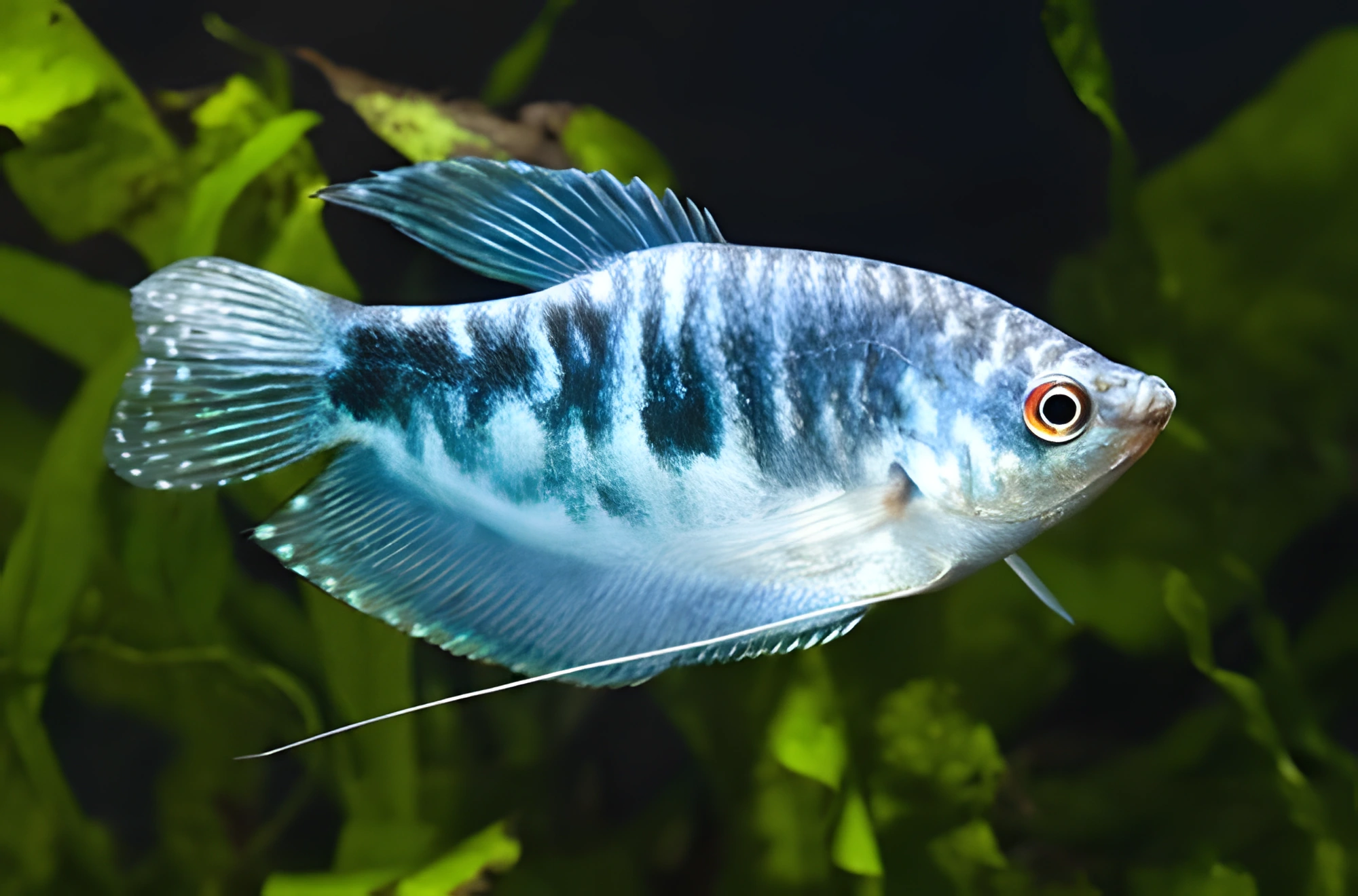
Labyrinth fishConservation status: Least concern LC
Other scientific names: Colisa maculatus, Labrus trichopterus, Labrvs trichoptervs, Nemaphoerus maculosus, Osphromenus insulatus, Osphromenus siamensis
The Marble Gourami, known by its scientific name Trichopodus trichopterus, is a member of the Osphronemidae family. Its distinctive feature is a unique body pattern combining blue and dark blue hues, reminiscent of marble veins. Many aquarists worldwide value this fish for its attractive appearance and ease of care.
- Required aquarium volume
- 130 L
- Size in aquarium
- 13 cm
- Temperature
- 22 – 28 °C
- Temperament
- Territorial (often aggressive)
Parameters
Water pHSlightly acidic (6) – Slightly alkaline (8)
Water dHSoft (5) – Very hard (19)
Water salinityno salt (freshwater)
Size in aquarium13 cm
Lifespan6 years
TemperamentTerritorial (often aggressive)
Toward small fishnot a predator
Required aquarium volume130 L
Lightingmoderate (regular)
Substrateany, but dark
Water flownone or stagnant (no flow)
FeedingAny (universal)
CarePair (male/female)
Description
This fish is of medium size, with an elongated, slightly oval, and laterally compressed body. Its fins are quite large in proportion to its body and are rounded. During evolution, the pelvic fins transformed into filamentous, sensitive appendages that the Gourami uses to explore its surroundings. Like other labyrinth fish, it possesses a special organ that allows it to breathe atmospheric air by gulping bubbles from the water surface. Its coloration is characterized by a pale blue background with dark, irregular spots, creating a marbled pattern. Numerous small, light specks distributed over the entire body form a unique ornament.
Males are easily distinguished by a more elongated and pointed dorsal fin, while in females, it is shorter and rounded.
Habitat
Blue Gourami was created as a result of selective breeding in the USA in the 70s of the last century. Today, its breeding is mainly carried out in Southeast Asia. This species is not found in its natural habitat.
Behavior and Compatibility
The behavior of adult individuals can vary from shyness to aggression, which can sometimes create difficulties, especially if the fish turns out to be too temperamental. However, animosity is more often directed at newcomers to the aquarium and less so at those with whom the Gourami grew up. Intraspecific hierarchy is clearly expressed: a dominant male can show aggression towards weaker relatives. Optimal keeping formats include single, paired, or harem. Large and peaceful fish species, such as some catfishes, are suitable as tank mates. Active fish can provoke aggression, and very small individuals may be perceived as prey or food.
Care and Maintenance
For a group of fish, an aquarium of approximately 150 L will be required, but for a single individual, 40–50 L will suffice. The aquarium design should include a tightly fitting lid. Underneath it, an air layer with increased temperature and humidity forms, which minimizes the risk of damage to the fish's labyrinth organ during the process of absorbing atmospheric air. The recommended equipment set includes a filter, aerator, heater, and lighting system. There are combined filters that can diffuse air bubbles instead of an aerator, eliminating the need for the latter. It is important to note that the fish prefers very weak water movement; strong currents can cause stress and excessive physical exertion as the fish tries to cope with it. When choosing a filter, opt for a powerful model that still provides a weak water flow. The aquarium decor must include shelters such as grottoes, rocks, driftwood, as well as sparse plant cover. Plants are optimally placed along the side and back walls of the aquarium. Floating plants are welcome. It is advisable to use a dark substrate, as it will highlight the fish's coloration.
Diet
In home aquariums, these fish readily accept a variety of dry commercial foods, as well as meaty products, both live and frozen. As a staple diet, it is recommended to use specialized high-quality food designed for Gouramis (widely available in pet stores), supplementing it with live foods such as bloodworms, mosquito larvae, and similar. Feeding should be done once a day if meaty products are included in the diet, or according to the instructions on the food packaging.
Breeding and Reproduction
The breeding process is quite simple. If you keep only two fish, spawning may well occur in the main aquarium; otherwise, it is recommended to use a separate spawning tank, where the pair and then their offspring will be temporarily housed. The stimulus for spawning is enriching the diet with meaty products and raising the water temperature to 26°C. If there are not enough plants in the aquarium, including floating ones, the fish may not start spawning. Over time, the female will become full of eggs, and the male will begin to build a bubble nest with plant fragments, most often in a corner of the tank. After the nest is completed, the courtship period begins: the male presses against the female, touching her, and invites her to the nest. An adult can lay up to 700 eggs, which are immediately fertilized; after this, the male collects them and transfers them to the nest, and the female should be immediately removed from the aquarium. The male guards the clutch and attacks anyone who comes too close; his attacks can be fatal to those attacked. After the fry hatch, the male must leave the offspring and join the female, otherwise, they may become his prey. The fry should be fed micro-foods, Artemia, and infusoria.
Diseases
This species is highly resilient, capable of adapting to various conditions and surviving short-term deterioration in water quality. In a properly set up aquarium, health problems are generally absent. However, systematic dietary imbalances, prolonged feeding interruptions, or significant deterioration of living conditions will inevitably lead to disease outbreaks. More detailed information on symptoms and treatment methods is presented in the "Aquarium Fish Diseases" section.
How to choose
When choosing a Marble Gourami, pay attention to the fish's activity: healthy individuals are curious, swim in the water column, and actively explore the space with their filamentous fins. Avoid specimens with damaged or clamped fins, white film, ulcers, or an unnaturally bloated abdomen. Observe their behavior in the store: the fish should not be lethargic, hiding in corners, or constantly staying at the surface, unless it is due to fright. It is best to acquire young individuals, as they adapt more easily to new conditions and get along better with each other in the future.
Frequently asked questions
The essentials: size, tank volume, water parameters and care
How big does Marble Gourami get?
An adult reaches 13 cm in length. Plan the tank around the maximum size: the fish quickly outgrows a cramped setup.
What size aquarium does Marble Gourami need?
The minimum recommended volume is 130 L. A smaller tank speeds up nitrate build-up and raises stress levels.
What water parameters does Marble Gourami need?
Temperature 22–28 °C, pH 6–8, hardness 5–19 dGH. Stability matters more than exact values: sudden swings are harder on the fish than a small deviation from the ideal.
How long does Marble Gourami live?
Around 6 years when kept properly. Lifespan depends directly on tank volume, water quality and a varied diet.
Is Marble Gourami aggressive?
Temperament: territorial (often aggressive). Keep this in mind when choosing tank mates.
How many Marble Gourami should be kept together?
Recommended setup: pair (male/female). Ignoring this is a common cause of stress and disease.
What does Marble Gourami eat?
Diet type: any (universal). Feed small portions that are finished within a couple of minutes — overfeeding does more harm than underfeeding.
What is the scientific name of Marble Gourami?
The scientific name of the species is Trichopodus trichopterus, family Osphronemidae. It also appears in the literature as: Colisa maculatus, Labrus trichopterus, Labrvs trichoptervs.