Temperature22 – 28 °C
Natural range
- Honduras area
- El Salvador area
- Guatemala area
- Pacific slope of Central America area
LivebearersConservation status: Data deficient DD
The Free Molly, also known as Poecilia salvatoris, belongs to the family Poeciliidae, which includes livebearers or gambusias. Discovered in 1907, this fish lost its species identity shortly after its description. For a long time, it was considered a variety of Poecilia sphenops. The species was then reclassified as a subspecies of Poecilia gillii. Only since the 2000s has the Free Molly regained its status as an independent species.
- Required aquarium volume
- 100 L
- Size in aquarium
- 7 cm
- Temperature
- 22 – 28 °C
- Temperament
- Semi-peaceful (including aggression during spawning / intraspecific conflicts)
Parameters
Water pHNeutral (7) – Neutral (7.5)
Water dHMedium hardness (10) – Hard (15)
Water salinityno salt (freshwater)
Size in aquarium7 cm
Lifespan3 years
TemperamentSemi-peaceful (including aggression during spawning / intraspecific conflicts)
Toward small fishnot a predator
Required aquarium volume100 L
Lightingany
Substrateany (no restrictions)
Water flowweak
FeedingAny (universal)
CareMixed (solitary / pair / group)
Description
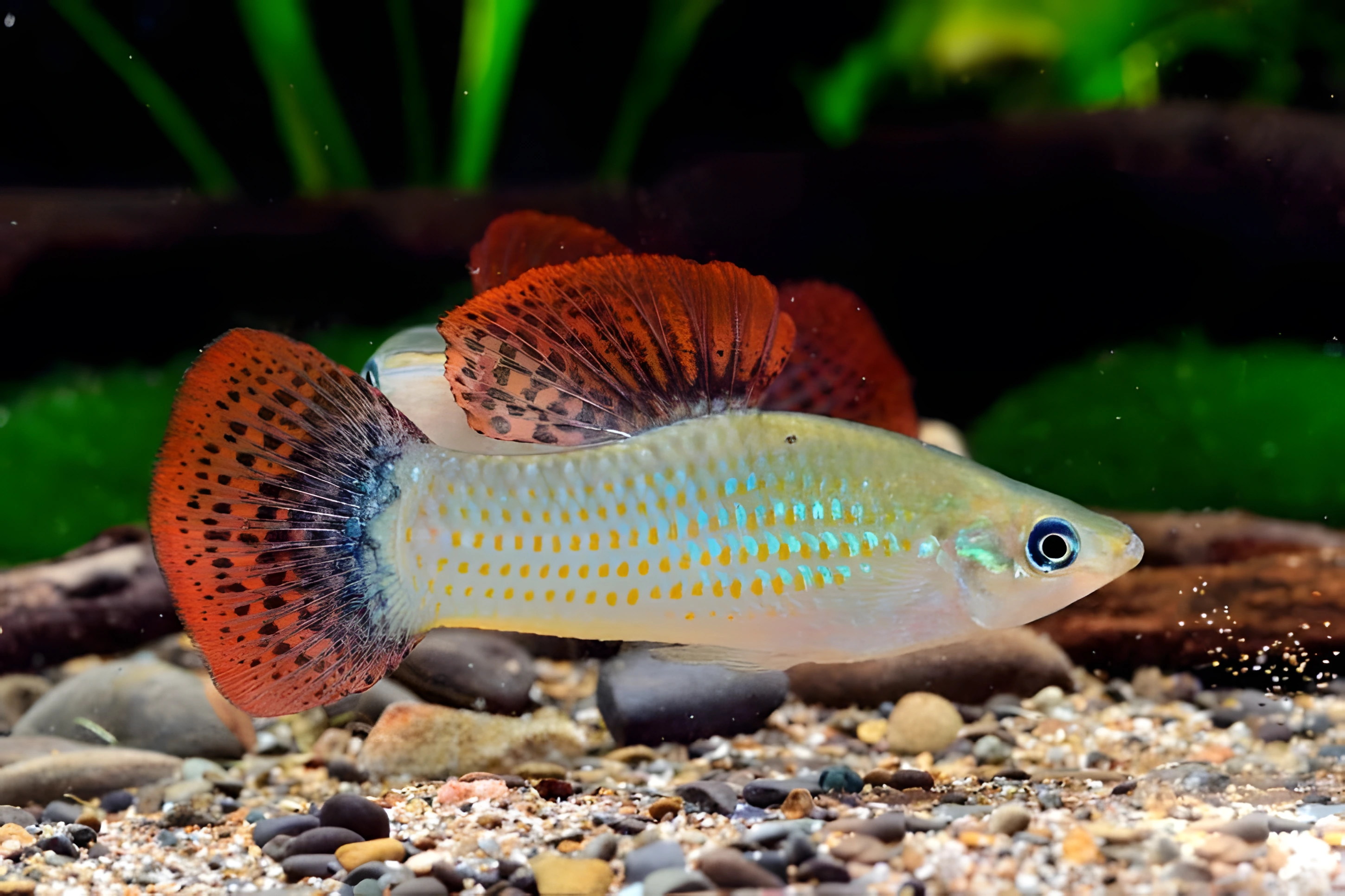
Wild populations of these fish exhibit an astonishing variety of coloration, and sometimes morphological differences in fin and body shape. Scientists often debate the reasons for such variations: whether they are the result of adaptation to ecological conditions, hybridization, or manifestations of sexual dimorphism. For example, young males have less vibrant coloration compared to adult specimens. Additionally, the intensity of coloration can be linked to social hierarchy within the group: dominant individuals usually have more saturated colors, while those of subdued fish become duller. Adult members of the species reach a length of about 7 cm. Males have a silvery body with emerald speckles, and their caudal and dorsal fins are colored in orange-red tones with black spots. Females have similar body coloration, but their fins lack color. The history of the Free Molly in aquaristics began in 1935, but at that time, suitable conditions for its keeping could not be provided. Over time, from generation to generation, the fish's coloration faded, and soon colorless specimens lost their appeal to aquarists. Currently, the Free Molly is once again gaining popularity.
Habitat
Its natural habitat is Central America, encompassing the territories of Honduras, El Salvador, and Guatemala. This species inhabits various shallow streams and rivers that flow through hilly terrain towards the Pacific Ocean. The fish is also found in overgrown backwaters, lakes, and swamps.
Behavior and Compatibility
In various sources, one can find completely contradictory information regarding the behavior of these fish. Some claim that the Free Molly is very temperamental and prone to fighting, while others, on the contrary, describe it as peaceful. The truth, most likely, lies somewhere in the middle. Towards other species, the fish are peaceful, but intraspecific relationships can be different. Males compete for the attention of females, actively pursuing them. If females do not have sufficient hiding places, such pursuit can lead to undesirable consequences. This behavior is also characteristic of other Molly species. In small aquariums, it is recommended to keep a group consisting of one male and several females.
Care and Maintenance
The ideal aquarium volume for a group of 3–4 individuals starts from 100 liters. When setting up the aquarium, attention should be paid to creating several areas with dense vegetation. Poecilia salvatoris prefers slightly alkaline water with a high level of carbonate hardness. Maintaining the necessary water parameters can present certain difficulties for beginner aquarists, so it is recommended to familiarize yourself with methods for "Determining and Changing GH and pH Parameters." Otherwise, the care for these fish is considered relatively simple and includes a series of mandatory, but standard procedures. These include weekly replacement of 20–30% of the water volume with fresh water, which should be combined with the removal of organic waste (food remnants, excrement) from the substrate surface, as well as regular preventive maintenance of equipment.
Diet
In natural conditions, their primary diet consists of plant matter. However, over decades of life in an aquarium environment, the fish have successfully adapted to alternative foods. Dry and freeze-dried foods, such as flakes, granules, and tablets containing plant components, can form the basis of their daily diet. We present Aqvium flake food for aquarium fish. This new product has become a bestseller on Ozon with a rating of 4.9. It is suitable for most aquarium fish. The raw materials for its production comply with new European Union standards (EU 2018/848) and are enriched with vitamins A, C, D3, E, as well as Omega 3-6. Buy on Ozon.
Breeding and Reproduction
A key feature of this group of fish is the intrauterine gestation of eggs. They do not lay eggs but give birth to fully formed fry. Under favorable conditions, fry appear regularly. It is important to note that parental instincts are not developed in these fish, and adults may eat their own offspring. To preserve the young, it is necessary to timely transfer them to a separate tank.
Diseases
In a healthy aquarium ecosystem, fish diseases are rare. As a rule, they are caused by a deterioration of habitat parameters, contact with sick individuals, or physical damage. In such cases, it is often sufficient to restore optimal conditions, and the fish's body can cope with the ailment on its own. However, with prolonged negative impact or in advanced cases, medication will be required. More detailed information on symptoms and treatment methods can be found in the section "Diseases of Aquarium Fish."
How to choose
When choosing Poecilia salvatoris in a store, pay attention to the activity and appearance of the individuals. A healthy fish should swim in the water column, actively react to external stimuli, and show interest in food. Avoid specimens with clamped fins, film on scales, visible ulcers, or an unnaturally bloated abdomen, which may indicate infectious diseases or parasites.
- Choose individuals with clean, undamaged fins and clear, unclouded eyes.
- Observe their behavior in the main aquarium: avoid fish that hide in corners, stay at the surface, or make chaotic movements.
- Consider intraspecific aggression: it is advisable to acquire a group with a predominance of females to minimize stress from male pursuit.
Frequently asked questions
The essentials: size, tank volume, water parameters and care
How big does Free Molly get?
An adult reaches 7 cm in length. Plan the tank around the maximum size: the fish quickly outgrows a cramped setup.
What size aquarium does Free Molly need?
The minimum recommended volume is 100 L. A smaller tank speeds up nitrate build-up and raises stress levels.
What water parameters does Free Molly need?
Temperature 22–28 °C, pH 7–7.5, hardness 10–15 dGH. Stability matters more than exact values: sudden swings are harder on the fish than a small deviation from the ideal.
How long does Free Molly live?
Around 3 years when kept properly. Lifespan depends directly on tank volume, water quality and a varied diet.
Is Free Molly aggressive?
Temperament: semi-peaceful (including aggression during spawning / intraspecific conflicts). Keep this in mind when choosing tank mates.
How many Free Molly should be kept together?
Recommended setup: mixed (solitary / pair / group). Ignoring this is a common cause of stress and disease.
What does Free Molly eat?
Diet type: any (universal). Feed small portions that are finished within a couple of minutes — overfeeding does more harm than underfeeding.
What is the scientific name of Free Molly?
The scientific name of the species is Poecilia salvatoris, family Poeciliidae.