Temperature21 – 26 °C
Natural range
- Texas area
- Central America area
- Colombia area
- Venezuela area
LivebearersConservation status: Least concern LC
Other scientific names: Gambusia modesta, Gambusia plumbea, Lembesseia parvianalis, Mollienesia altissima, Mollienesia macrura, Mollienesia pallida
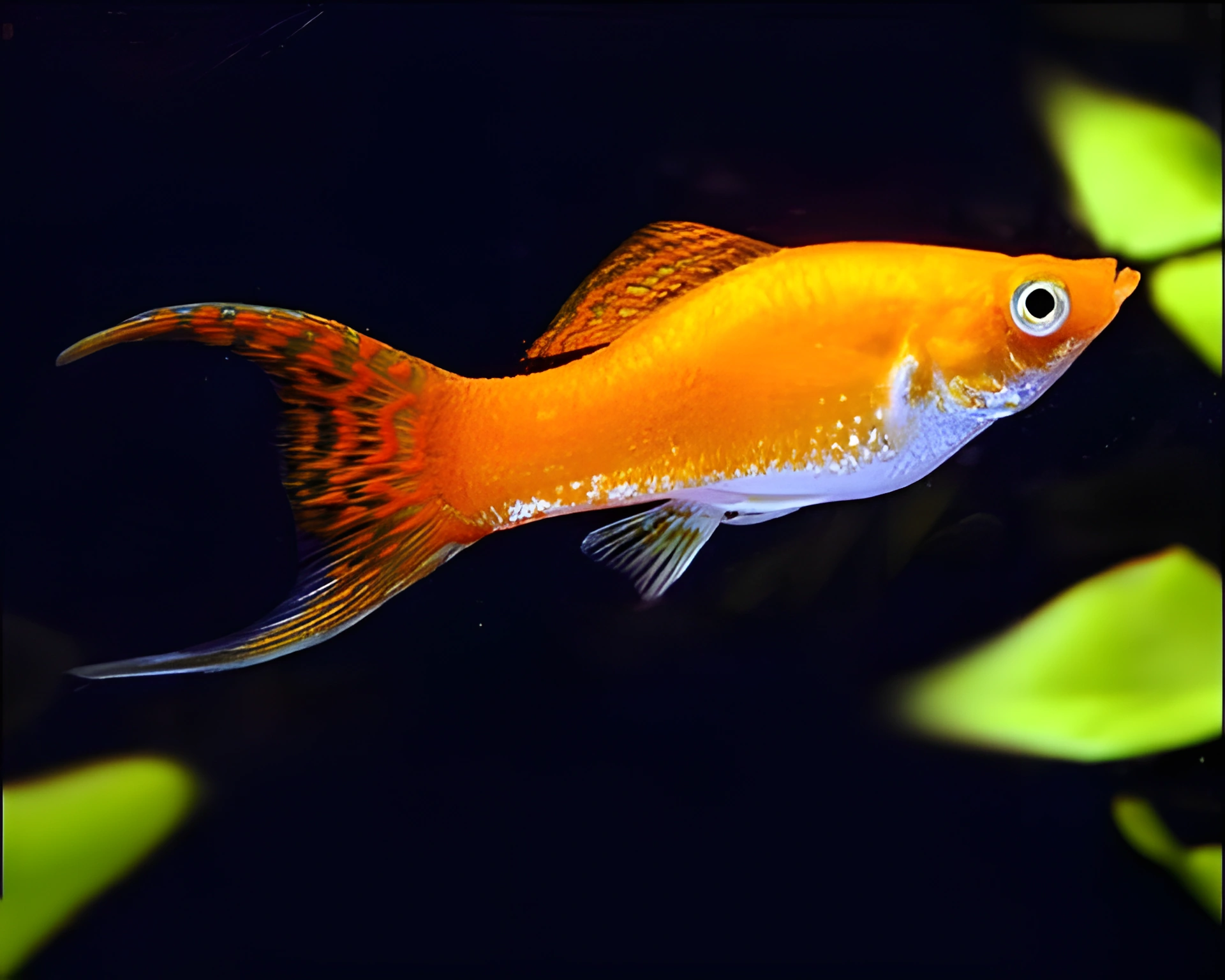
The Lyretail Molly, known in the English-speaking trade as LyreTail Molly, is a breed created artificially and has no natural counterparts. The subject of selection, presumably leading to its appearance, was the Sailfin Molly (Poecilia latipinna).
- Required aquarium volume
- 150 L
- Size in aquarium
- 12 – 18 cm
- Temperature
- 21 – 26 °C
- Temperament
- Peaceful (regular)
Parameters
Water pHNeutral (7) – Slightly alkaline (8.5)
Water dHMedium hardness (10) – Very hard (25)
Water salinitymoderate (5–10 g/L)
Size in aquarium12 – 18 cm
Lifespan5 years
TemperamentPeaceful (regular)
Toward small fishnot a predator
Required aquarium volume150 L
Lightingany
Substrateany (no restrictions)
Water flowweak
FeedingMixed diet (meat + plant-based)
CareMixed (solitary / pair / group)
Description
The Lyretail Molly is a selective breeding form derived from the species Poecilia sphenops. Its characteristic feature is the lyre-shaped caudal fin, with elongated outer rays. The fish's body is robust, elongated, and laterally compressed. Coloration varies from velvety black to spotted or golden. Sexual dimorphism is distinctly expressed: males are smaller than females, have a pointed anal fin transformed into a gonopodium, and reach about 8-10 cm in length, while females can grow up to 12 cm or more.
Habitat
The wild species Poecilia sphenops inhabits fresh and brackish waters of Central and South America, from Texas to Colombia and Venezuela. In nature, these fish prefer coastal areas of rivers, estuaries, and lagoons with dense vegetation. Water parameters in their habitats are characterized by alkaline reaction and significant hardness. The species has high adaptability to water salinity, allowing it to survive in various biotopes.
Behavior and Compatibility
These are active, peaceful schooling fish that prefer to stay in the middle and upper water layers. For comfortable existence, it is recommended to keep them in a group with a predominance of females to reduce intraspecific aggression among males. They are compatible with most peaceful fish of similar size but may show territoriality or nip the long fins of slow-moving tank mates. The aquarium should have both open swimming areas and dense plant thickets for hiding.
Care and Maintenance
The size of adult individuals can range from 11 to 18 cm, and when considering the elongated caudal fin, it can exceed 20 cm. From this, it follows that a group of 3–4 Lyretail Mollies will require an aquarium with a capacity of at least 100–150 liters. In this case, the rule applies: the larger the volume, the better. When decorating the tank, numerous shelters created by dense plant thickets and natural snags are preferred. The latter often become a place for algae to grow, which serves as an additional element in the fish's diet.
Key keeping parameters:
Aquarium volume: from 100–150 liters. Water temperature: 21–26°C. pH level: 7.0–8.5. Water hardness: medium to high (15–35 dGH). Substrate type: any. Lighting: any. Brackish water: salt addition up to 10–15 g per liter is permissible. Water movement: weak. Fish size: 12–18 cm. Diet: any food with essential plant components. Temperament: peaceful. Keeping: possible individually, in pairs, or in groups.
Feeding. Fish require food rich in plant fibers. Sometimes they may damage delicate parts of aquarium plants in an attempt to satisfy this need. Specialized molly foods from reputable manufacturers will be an optimal choice. These products come in various forms, among which flakes and granules remain the most common and convenient.
Aqvium Flake Food for Aquarium Fish Our new product, flake food, has already become a bestseller on Ozon with a high rating of 4.9. It is perfectly suitable for most aquarium fish. The raw material is produced in accordance with new European standards (EU 2018/848). The product contains vitamins A, C, D3, E, and Omega 3-6 fatty acids. Purchase on Ozon
Warm, slightly alkaline water with a high level of general hardness is considered ideal. However, thanks to decades of selective breeding and adaptation to artificial conditions, Lyretail Mollies have successfully adapted to a wider range of parameters, including lower pH and dGH values.
It is extremely important to prevent the accumulation of organic waste, as this can lead to a dangerous increase in nitrate levels. Regular aquarium maintenance is key to the health of its inhabitants. This includes weekly partial water changes, removal of food remnants and excrement. The continuous operation of the filtration system plays a crucial, and sometimes defining, role. Behavior and Compatibility. Males often exhibit competitive behavior for the attention of females. In small aquariums with few hiding places, it is recommended to keep a group consisting of one male and several females. These fish get along well with most peaceful species of comparable size. Avoid keeping them with fish known for their tendency to nip the long fins of other inhabitants, such as some species of barbs.
Diet
Mollies are omnivorous fish with a pronounced need for plant-based food. Their diet should include high-quality dry foods with a high content of spirulina or other plant components, as well as blanched vegetables (zucchini, spinach). Periodically, it is recommended to offer live or frozen foods, such as Artemia or bloodworms. Feeding frequency should be 2-3 times a day in small portions, as the fish are prone to overeating.
Breeding and Reproduction
Breeding is relatively simple, as the species is livebearing. Fertilization occurs inside the female's body with the help of the male's gonopodium. Pregnancy lasts 4-6 weeks, after which the female gives birth to fully formed fry. To preserve the offspring, it is recommended to use dense plant thickets or a breeding trap, as adult fish are prone to cannibalism. From the first days, fry are capable of feeding on Artemia nauplii, infusoria, or specialized finely crushed foods.
Diseases
Fish are sensitive to water quality and sudden temperature changes. They are often susceptible to ichthyophthiriosis (white spot disease) when stressed or chilled. Digestive problems can also arise from a lack of plant fiber in their diet. Prevention includes maintaining stable hardness and pH parameters, regular water changes, and adding aquarium salt (1-3 g per liter), which positively affects immunity and prevents fungal infections.
How to choose
When purchasing, choose active fish with clean fins, free of white spots, film, or ulcers on the body. It is important to pay attention to the condition of the abdomen — it should not be excessively sunken. The behavior of a healthy individual is characterized by curiosity and constant foraging. It is recommended to avoid fish that stay at the bottom, clamp their fins, or appear sluggish, as this may indicate health problems or recent transport stress.
Frequently asked questions
The essentials: size, tank volume, water parameters and care
How big does Lyretail Molly get?
An adult reaches 12–18 cm in length. Plan the tank around the maximum size: the fish quickly outgrows a cramped setup.
What size aquarium does Lyretail Molly need?
The minimum recommended volume is 150 L. A smaller tank speeds up nitrate build-up and raises stress levels.
What water parameters does Lyretail Molly need?
Temperature 21–26 °C, pH 7–8.5, hardness 10–25 dGH. Stability matters more than exact values: sudden swings are harder on the fish than a small deviation from the ideal.
How long does Lyretail Molly live?
Around 5 years when kept properly. Lifespan depends directly on tank volume, water quality and a varied diet.
Is Lyretail Molly aggressive?
Temperament: peaceful (regular). Keep this in mind when choosing tank mates.
How many Lyretail Molly should be kept together?
Recommended setup: mixed (solitary / pair / group). Ignoring this is a common cause of stress and disease.
What does Lyretail Molly eat?
Diet type: mixed diet (meat + plant-based). Feed small portions that are finished within a couple of minutes — overfeeding does more harm than underfeeding.
What is the scientific name of Lyretail Molly?
The scientific name of the species is Poecilia sphenops, family Poeciliidae. It also appears in the literature as: Gambusia modesta, Gambusia plumbea, Lembesseia parvianalis.