Temperature22 – 28 °C
Natural range
- Southeastern United States
- Mexico area
LivebearersConservation status: Least concern LC
Other scientific names: Limia matamorensis, Limia poeciloides, Mollienesia latipinna, Mollienisia latipinna, Poecilia lineolata, Poecilia multilineata
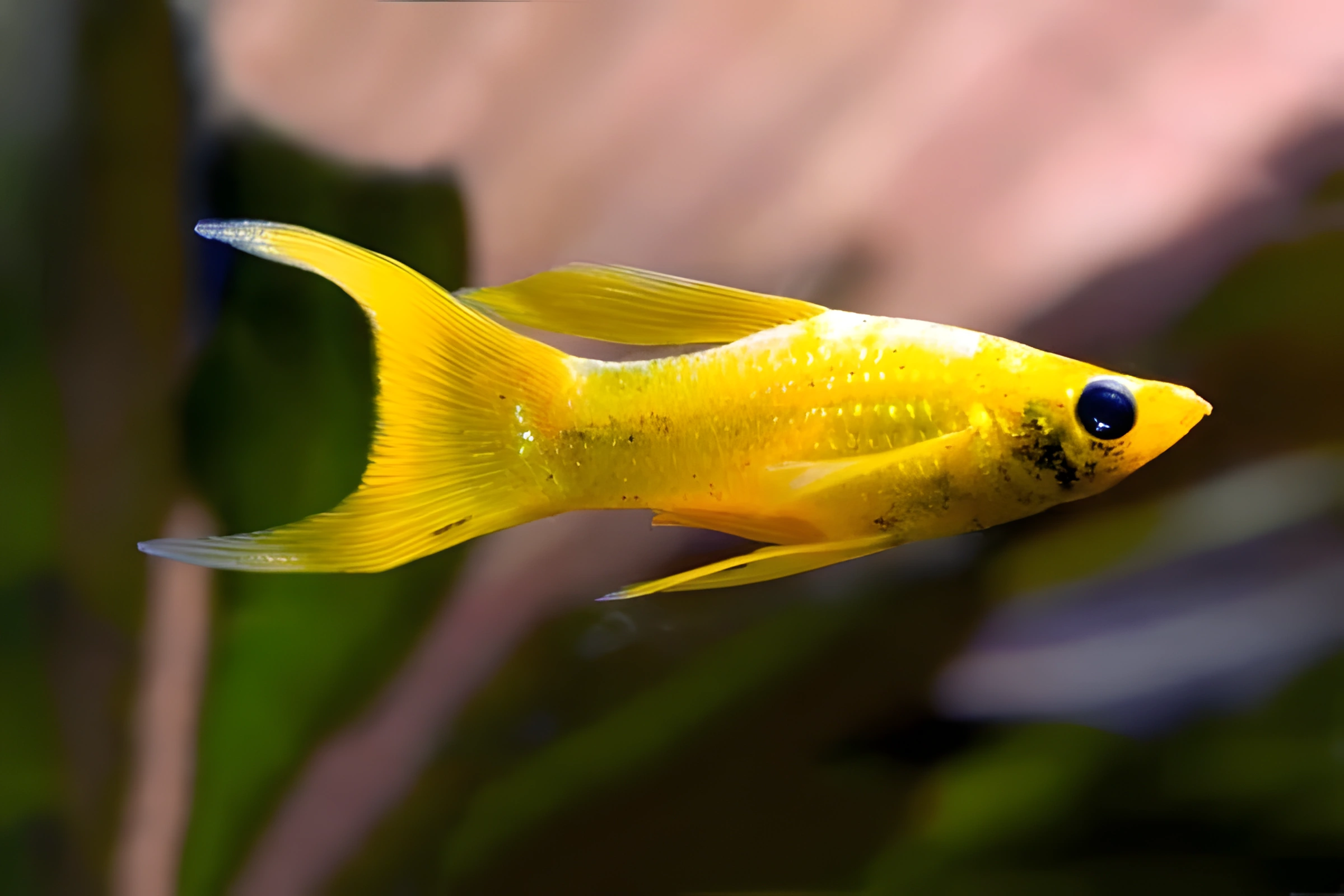
The Sailfin Molly, also known as Poecilia latipinna, belongs to the Poeciliidae family. This beautiful fish attracts attention with its unusually large and wide dorsal fin, which outwardly resembles a sail. Nowadays, it has become difficult to find purebred representatives of this species; more often, hybrid forms are encountered, which are distinguished by a rich variety of colors.
- Required aquarium volume
- 100 L
- Size in aquarium
- 11 – 12 cm
- Temperature
- 22 – 28 °C
- Temperament
- Peaceful (regular)
Parameters
Water pHNeutral (7) – Slightly alkaline (8.5)
Water dHMedium hardness (10) – Very hard (25)
Water salinityno salt (freshwater)
Size in aquarium11 – 12 cm
Lifespan3 years
TemperamentPeaceful (regular)
Toward small fishnot a predator
Required aquarium volume100 L
Lightingany
Substrateany (no restrictions)
Water flowweak
FeedingAny (universal)
CareMixed (solitary / pair / group)
Description
In aquaristics, hybrid varieties predominate. Over time, Poecilia latipinna has lost its original appearance, becoming noticeably different from its wild relatives. The hybridization situation is exacerbated by the fish's ability to successfully interbreed with closely related species, such as Poecilia velifera, producing healthy offspring. The size of these fish varies depending on the specific variety: males reach 10–15 cm, and females 12–18 cm, although in the wild, the length of the fish rarely exceeded 11–12 cm. Their body shape is typical for the Poeciliidae family, but the main distinguishing feature of males is a large, rectangular dorsal fin; in females, it is significantly smaller. The caudal fin, depending on the morphological form, can be either rounded or lyre-shaped. The coloration is striking in its diversity: pale gold with rows of bright colored spots, orange, black, red with stripes, as well as solid color variations are found.
Habitat
Originally, the habitat of these fish covered North and Central America, including the southern states of the USA, Mexico, and the Yucatán Peninsula. Today, the Sailfin Molly has adapted to almost all continents and various parts of the world, from Africa to Australia and New Zealand, where it arrived from aquariums. In their natural environment, these fish inhabit coastal brackish waters, such as lakes and swamps, as well as the estuaries of rivers flowing into the sea.
Behavior and Compatibility
The Sailfin Molly is a compatible and peaceful fish. As tank mates, species with similar temperament and size should be chosen, capable of adapting to hard, slightly alkaline water. Some active fish, such as Barbs, are prone to nipping long fins, and the Sailfin Molly can become their victim.
Care and Maintenance
A key requirement for aquarium design is an abundance of floating and rooted plants, or their artificial counterparts, while maintaining open areas for swimming. Other decor elements depend on the aquarist's preferences or the needs of other inhabitants. When keeping them, special attention should be paid to water parameters; an optimal environment is achieved with high pH and GH values. Maintaining stable water parameters can be challenging for beginners, so it is recommended to study information on “Determining and Changing GH and pH Parameters.” Standard aquarium maintenance includes weekly partial water changes with fresh water, combined with the removal of organic waste (food remnants, excrement) and equipment maintenance.
Diet
These fish readily accept all types of food: dry, frozen, and live. It is recommended to supplement their diet with plant-based additives, such as spirulina flakes, which is especially relevant when feeding brine shrimp, daphnia, and similar products. Dry foods typically already contain plant components. Aqvium flake food for aquarium fish Check out our new product, a bestseller on Ozon with a rating of 4.9. Flake food is suitable for most aquarium fish. The raw material is produced according to new European Union standards (EU 2018/848). Contains vitamins A, C, D3, E, and Omega 3-6 Buy on Ozon
Breeding and Reproduction
Breeding this species does not present significant difficulties. With the creation of a favorable environment, spawning can begin at any time. The female is capable of producing offspring several times a year. The incubation period, lasting up to two months, sees the eggs developing inside the mother's body. After this, the fry are born fully ready for independent life. Since the parents do not care for their offspring, it is crucial to provide dense thickets of floating plants to ensure the survival of the young. In these shelters, the fry can remain until they are moved to a separate tank.
Diseases
First and foremost, the health of fish is affected by the external environment: declining water quality, an unbalanced diet, or prolonged stay in unsuitable conditions (incorrect pH, GH, low temperature) will inevitably affect their well-being. As a rule, a return to normal keeping conditions promotes self-recovery, but if symptoms persist, medication will be required. More detailed information on symptoms and treatment methods can be found in the “Diseases of Aquarium Fish” section.
How to choose
When purchasing, choose active individuals with clean fins and scales, free of visible damage, spots, or film. Avoid fish that stay at the surface, breathe heavily, or show signs of emaciation, as this species is sensitive to transport conditions and water quality. In the store, fish should show interest in food and actively swim throughout the aquarium. Given the species' propensity for hybridization, carefully examine the fin shape and coloration to ensure there are no deformities characteristic of poor breeding.
Frequently asked questions
The essentials: size, tank volume, water parameters and care
How big does Sailfin Molly get?
An adult reaches 11–12 cm in length. Plan the tank around the maximum size: the fish quickly outgrows a cramped setup.
What size aquarium does Sailfin Molly need?
The minimum recommended volume is 100 L. A smaller tank speeds up nitrate build-up and raises stress levels.
What water parameters does Sailfin Molly need?
Temperature 22–28 °C, pH 7–8.5, hardness 10–25 dGH. Stability matters more than exact values: sudden swings are harder on the fish than a small deviation from the ideal.
How long does Sailfin Molly live?
Around 3 years when kept properly. Lifespan depends directly on tank volume, water quality and a varied diet.
Is Sailfin Molly aggressive?
Temperament: peaceful (regular). Keep this in mind when choosing tank mates.
How many Sailfin Molly should be kept together?
Recommended setup: mixed (solitary / pair / group). Ignoring this is a common cause of stress and disease.
What does Sailfin Molly eat?
Diet type: any (universal). Feed small portions that are finished within a couple of minutes — overfeeding does more harm than underfeeding.
What is the scientific name of Sailfin Molly?
The scientific name of the species is Poecilia latipinna, family Poeciliidae. It also appears in the literature as: Limia matamorensis, Limia poeciloides, Mollienesia latipinna.