Temperature21 – 26 °C
Natural range
- Mexico area
- Gulf Coast of Mexico area
LivebearersConservation status: Least concern LC
Other scientific names: Gambusia modesta, Gambusia plumbea, Lembesseia parvianalis, Mollienesia altissima, Mollienesia macrura, Mollienesia pallida
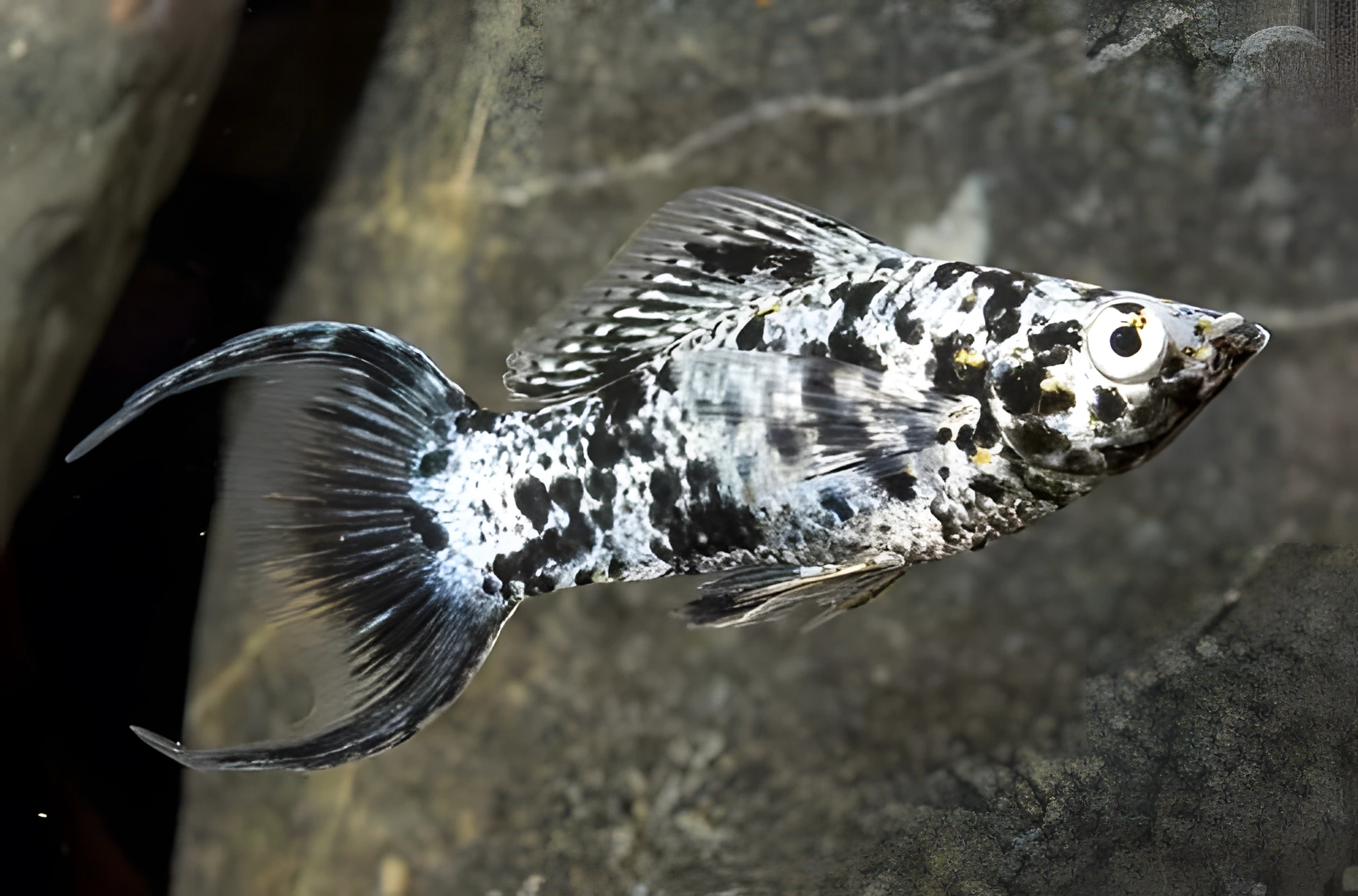
The Dalmatian Molly, known in English-speaking countries as the Molly Dalmatian, is a result of selective breeding and does not occur in natural conditions. Precise information about its origin has not been preserved, but it is assumed that it was bred from a spotted variety of the Sailfin Molly (Poecilia latipinna). This fish is distinguished by its unique pattern: black spots and speckles are distributed over a white body, giving it a resemblance to the well-known dog breed — Dalmatians.
- Required aquarium volume
- 150 L
- Size in aquarium
- 12 – 18 cm
- Temperature
- 21 – 26 °C
- Temperament
- Peaceful (regular)
Parameters
Water pHNeutral (7) – Slightly alkaline (8.5)
Water dHHard (15) – Very hard (35)
Water salinitymoderate (5–10 g/L)
Size in aquarium12 – 18 cm
Lifespan3 years
TemperamentPeaceful (regular)
Toward small fishnot a predator
Required aquarium volume150 L
Lightingany
Substrateany (no restrictions)
Water flowweak
FeedingMixed diet (meat + plant-based)
CareMixed (solitary / pair / group)
Description
The Dalmatian Molly is a selective form obtained through artificial breeding. The fish has a characteristic coloration: contrasting black spots are located on a white or silver background, resembling the coloring of the dog breed of the same name. Variations with a lyre-shaped caudal fin are also found. Females are usually larger than males and have a more rounded abdomen, while in males, the anal fin is transformed into a pointed organ — the gonopodium.
Habitat
In nature, the species Poecilia sphenops inhabits the coastal zones of Mexico, populating both freshwater streams and brackish river estuaries with mangrove thickets. Wild ancestors prefer an alkaline environment with high general water hardness. Artificially bred forms are adapted to aquarium conditions, but retain the need for stable water parameters and good aeration.
Behavior and Compatibility
Dominant males are highly active and can quite persistently pursue females. Therefore, in compact aquariums, it is recommended to maintain a ratio of “one male to several females (harem type)”. In more spacious aquariums, where there are enough shelters, the number of males does not have strict limitations. These fish exhibit a peaceful nature towards other species. They get along well with calm, non-aggressive fish of a similar size. Other livebearing fish species make excellent tankmates for them.
Care and Maintenance
For a group consisting of 2–3 fish, an aquarium of at least 100–150 liters will be required. The internal decoration of the aquarium should include an abundance of live plants. It is important that the vegetation does not become too dense, while providing enough free swimming space. Plants serve a dual function: they provide shelter from excessive attention from active males and other tankmates, and they are also an important food source. Mollies need a diet rich in plant components. Due to this feature, it is not recommended to use expensive decorative plants in the aquarium, as they are likely to be damaged. Natural forms of these fish live in alkaline water with high general hardness, even found in the marine water of estuaries and mangrove thickets. However, artificially bred specimens are less demanding and adapt well to soft, slightly acidic conditions. It is important to remember that the Dalmatian Molly, like its relatives, is sensitive to nitrate levels, which should not exceed 20 mg/L. To maintain optimal water quality, regular partial water changes and an effective filtration system are necessary. Active plant growth and balanced feeding also help reduce nitrate concentrations.
Diet
These fish readily accept a variety of foods available in dry, frozen, and live forms. Flakes or granules with added plant ingredients are suitable as the basis of their daily diet. "Aqvium flakes for aquarium fish" is a new product that has become a bestseller on Ozon with a rating of 4.9. This food is suitable for most aquarium fish, and its raw materials are produced according to new European Union standards (EU 2018/848). The product contains vitamins A, C, D3, E, and Omega 3-6. It can be purchased on Ozon.
Breeding and Reproduction
Mollies are livebearing fish, which makes their reproduction relatively simple. Fertilization occurs inside the female's body, which carries the fry for 28 to 45 days. To preserve the offspring, it is recommended to use a breeding box with floating plants, as adult individuals are prone to eating fry. After birth, the young are immediately able to feed on small foods, such as Artemia nauplii or finely crushed dry mixes.
Diseases
The fish have good immunity but are sensitive to water quality and nitrate content, the level of which should not exceed 20 mg/L. If maintenance conditions are violated, ichthyophthiriasis, manifested by white spots on the body, and fin rot are often encountered. Improper nutrition with a deficiency of plant components can lead to bloating. The addition of aquarium salt is useful for the prevention of fungal infections.
How to choose
When purchasing, choose active fish with clean fins without signs of plaque or damage. A healthy individual should show interest in food and not have signs of emaciation or unnatural abdominal distension. It is recommended to avoid specimens that stay near the water surface or appear apathetic, as this may indicate stress or the presence of hidden diseases.
Frequently asked questions
The essentials: size, tank volume, water parameters and care
How big does Dalmatian Molly get?
An adult reaches 12–18 cm in length. Plan the tank around the maximum size: the fish quickly outgrows a cramped setup.
What size aquarium does Dalmatian Molly need?
The minimum recommended volume is 150 L. A smaller tank speeds up nitrate build-up and raises stress levels.
What water parameters does Dalmatian Molly need?
Temperature 21–26 °C, pH 7–8.5, hardness 15–35 dGH. Stability matters more than exact values: sudden swings are harder on the fish than a small deviation from the ideal.
How long does Dalmatian Molly live?
Around 3 years when kept properly. Lifespan depends directly on tank volume, water quality and a varied diet.
Is Dalmatian Molly aggressive?
Temperament: peaceful (regular). Keep this in mind when choosing tank mates.
How many Dalmatian Molly should be kept together?
Recommended setup: mixed (solitary / pair / group). Ignoring this is a common cause of stress and disease.
What does Dalmatian Molly eat?
Diet type: mixed diet (meat + plant-based). Feed small portions that are finished within a couple of minutes — overfeeding does more harm than underfeeding.
What is the scientific name of Dalmatian Molly?
The scientific name of the species is Poecilia sphenops, family Poeciliidae. It also appears in the literature as: Gambusia modesta, Gambusia plumbea, Lembesseia parvianalis.