Temperature21 – 26 °C
Natural range
- Central America area
- South America area
LivebearersConservation status: Least concern LC
Other scientific names: Gambusia modesta, Gambusia plumbea, Lembesseia parvianalis, Mollienesia altissima, Mollienesia macrura, Mollienesia pallida
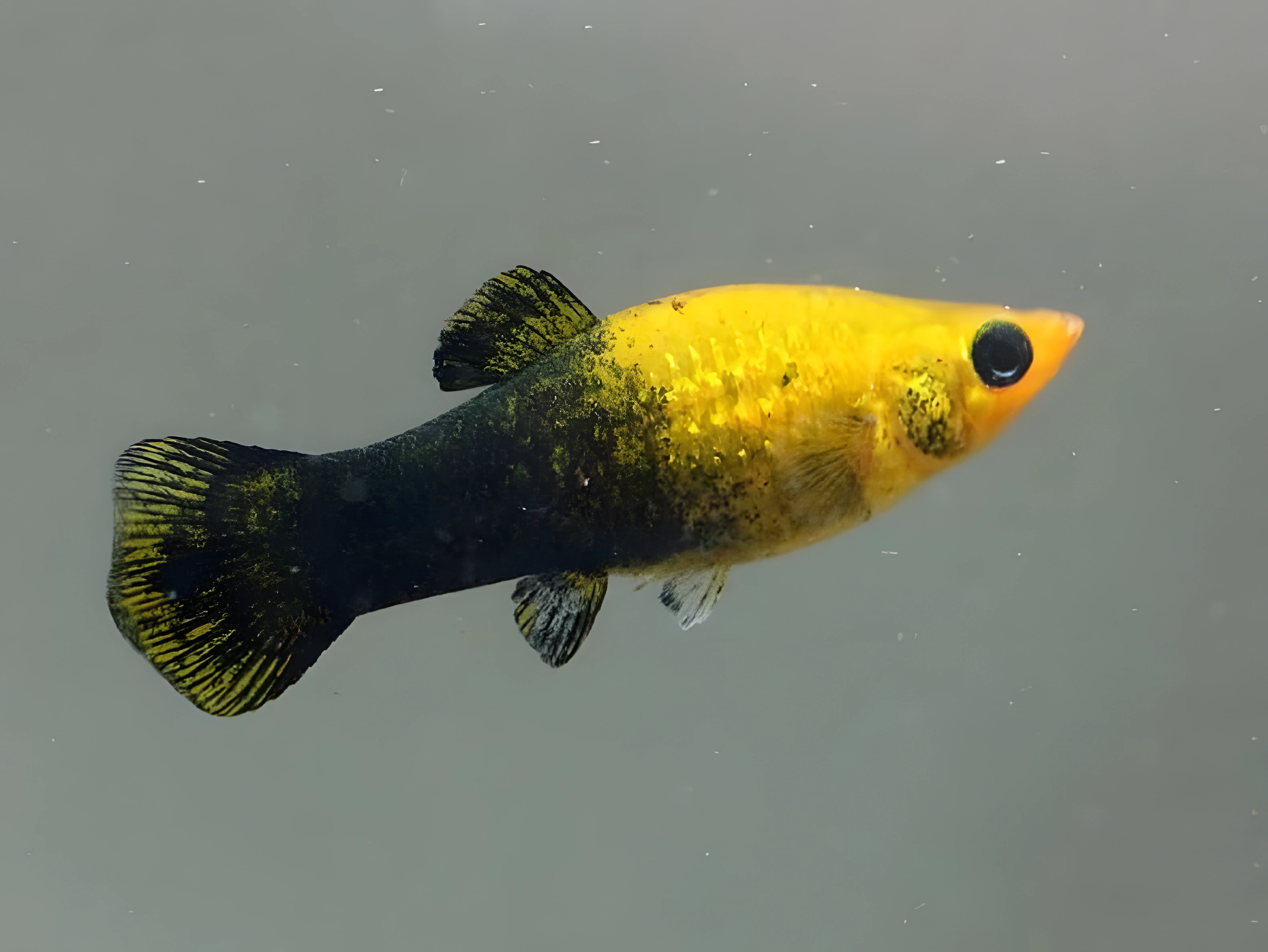
The Black and Yellow Molly, also known as the “Gold Dust Molly,” gets its names from the English trade names Gold And Black Molly Fish and Gold Dust Molly, respectively. These names refer to a color morph of Poecilia sphenops, distinguished by its contrasting, two-tone body coloration. Its front part is typically colored in yellow or gold hues, while the rear, caudal part has a dark, almost black coloration. Interestingly, the dark color is formed by the fusion of many small speckles, which are particularly noticeable in the transition area from yellow to black. It is hypothesized that such “spotting” is the result of hybridization with another selective form – the Dalmatian Molly.
- Required aquarium volume
- 100 L
- Size in aquarium
- 8 – 12 cm
- Temperature
- 21 – 26 °C
- Temperament
- Peaceful (regular)
Parameters
Water pHNeutral (7) – Slightly alkaline (8.5)
Water dHHard (15) – Very hard (35)
Water salinitymoderate (5–10 g/L)
Size in aquarium8 – 12 cm
Lifespan5 years
TemperamentPeaceful (regular)
Toward small fishnot a predator
Required aquarium volume100 L
Lightingany
Substrateany (no restrictions)
Water flowweak
FeedingMixed diet (meat + plant-based)
CareMixed (solitary / pair / group)
Description
Poecilia sphenops is a selective form with an elongated body, slightly compressed laterally. Females are larger than males and can reach 12 cm in length, while males typically grow up to 7–8 cm. Sexual dimorphism is clearly expressed: in males, the anal fin is transformed into a pointed organ – the gonopodium, while in females it has a fan-like shape. The coloration varies from deep black to various combinations of yellow, often with a spotted pattern.
Habitat
In nature, the original species inhabits Central and South America, populating fresh and brackish waters, including river estuaries and coastal lagoons. These fish prefer areas with dense vegetation. In their natural environment, they are adapted to high water hardness and can withstand salinity fluctuations, which explains their hardiness in aquarium conditions.
Behavior and Compatibility
This fish coexists perfectly with most species that have similar sizes and temperament. The most harmonious community is usually formed with other livebearing fish, such as Swordtails, Guppies, and Platies.
Care and Maintenance
For a group of 3–4 Mollies, the optimal aquarium size should start from 100 liters. When setting up the aquarium, it is recommended to provide dense plant thickets: they will serve as reliable shelters and become an additional food source, which is especially valuable since Mollies prefer a diet rich in plant components. For this reason, it is worth choosing unpretentious and robust species such as Vallisneria, Anubias, Najas, Myriophyllum, as well as various aquatic ferns and mosses. Brief information indicates that keeping these fish is considered quite simple, provided several important conditions are met: daily feeding with high-quality foods, peaceful tank mates, and maintaining consistently high water quality within acceptable temperature ranges and hydrochemical parameters. Although the fish prefer slightly alkaline water with high general hardness, due to artificial selection, they have successfully adapted to living in other conditions, including soft, slightly acidic water. It is critically important to prevent the accumulation of organic waste – food remnants and excrement – for which regular aquarium maintenance and uninterrupted operation of the filtration system are necessary.
Diet
As a staple diet, most common dry foods available on the market can be used. Many well-known manufacturers offer special foods developed to meet the needs of this fish species, which will be an excellent choice. Fish should be fed 1–2 times a day, offering a portion they can completely consume within 5 minutes.
Breeding and Reproduction
Mollies are livebearing fish, and their breeding process does not require complex stimulation. The female carries the fry for 4–6 weeks, after which she gives birth to up to 100 fully formed individuals. Due to the parents' tendency towards cannibalism, it is recommended to use dense plant thickets or a breeding trap. Fry are fed with Artemia nauplii, microworms, or finely ground dry foods.
Diseases
The most characteristic diseases are ichthyophthiriosis (white spots on the body) and fungal infections, often occurring when water parameters are violated or the temperature drops sharply. Digestive problems caused by a deficiency of plant fiber are also common. Prevention includes maintaining stable hardness, regular water changes, and adding a small amount of aquarium salt.
How to choose
When purchasing, choose active fish with clean fins and no white film on their scales. Avoid individuals with clamped fins or an unnaturally bloated abdomen, which may indicate infectious diseases. It is important to ensure there are no signs of emaciation, as fish raised in unsuitable conditions may be weakened and require a long adaptation period.
Frequently asked questions
The essentials: size, tank volume, water parameters and care
How big does Black and Yellow Molly get?
An adult reaches 8–12 cm in length. Plan the tank around the maximum size: the fish quickly outgrows a cramped setup.
What size aquarium does Black and Yellow Molly need?
The minimum recommended volume is 100 L. A smaller tank speeds up nitrate build-up and raises stress levels.
What water parameters does Black and Yellow Molly need?
Temperature 21–26 °C, pH 7–8.5, hardness 15–35 dGH. Stability matters more than exact values: sudden swings are harder on the fish than a small deviation from the ideal.
How long does Black and Yellow Molly live?
Around 5 years when kept properly. Lifespan depends directly on tank volume, water quality and a varied diet.
Is Black and Yellow Molly aggressive?
Temperament: peaceful (regular). Keep this in mind when choosing tank mates.
How many Black and Yellow Molly should be kept together?
Recommended setup: mixed (solitary / pair / group). Ignoring this is a common cause of stress and disease.
What does Black and Yellow Molly eat?
Diet type: mixed diet (meat + plant-based). Feed small portions that are finished within a couple of minutes — overfeeding does more harm than underfeeding.
What is the scientific name of Black and Yellow Molly?
The scientific name of the species is Poecilia sphenops, family Poeciliidae. It also appears in the literature as: Gambusia modesta, Gambusia plumbea, Lembesseia parvianalis.