Temperature24 – 27 °C
Natural range
- Mexico area
- Central America area
- Colombia area
- Venezuela area
LivebearersConservation status: Least concern LC
Other scientific names: Gambusia modesta, Gambusia plumbea, Lembesseia parvianalis, Mollienesia altissima, Mollienesia macrura, Mollienesia pallida
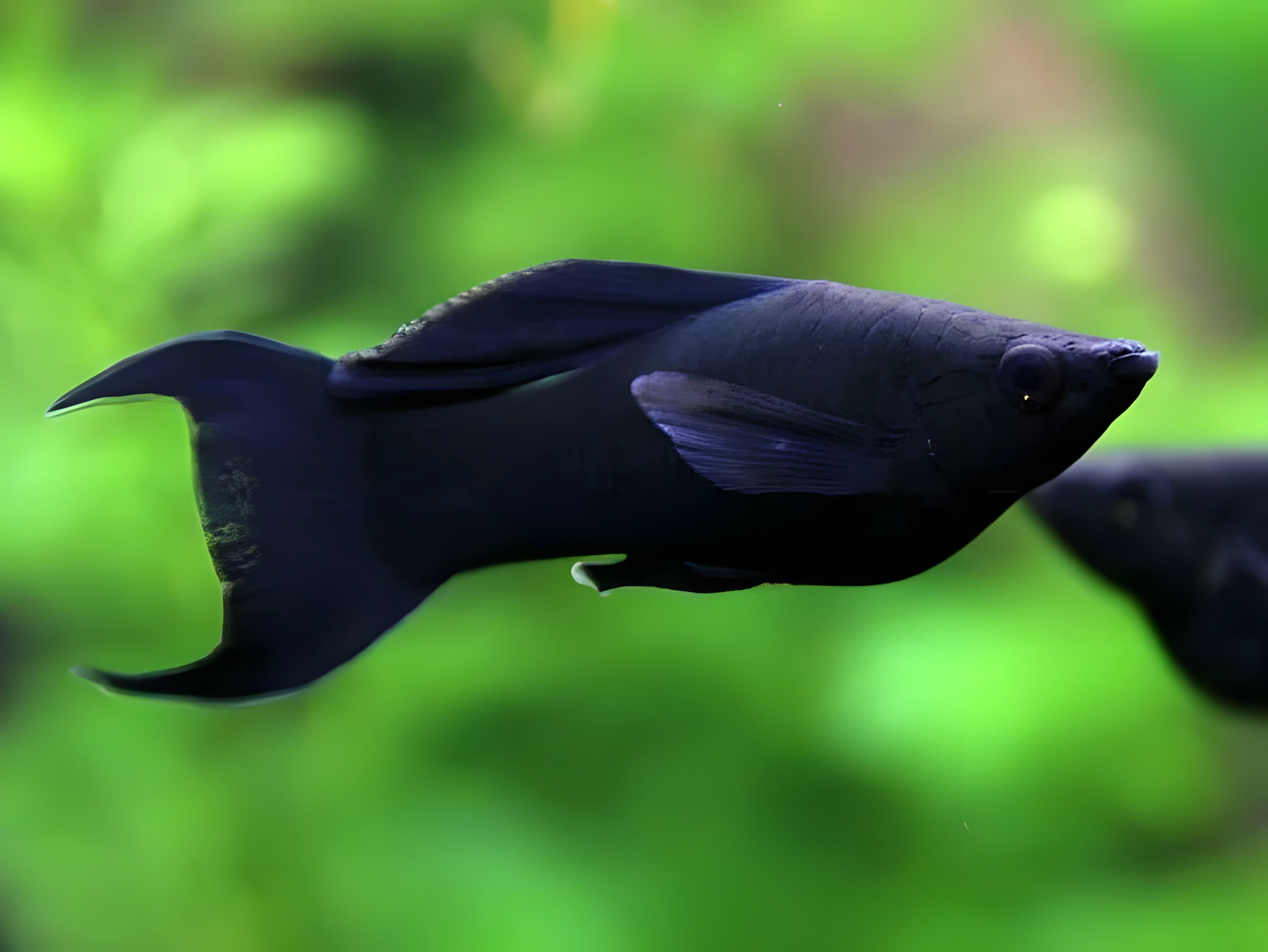
The Black Molly, often simply called Black Molly, is apparently a selective color variation of the well-known Sailfin Molly (Poecilia sphenops). At the same time, some authoritative breeders prefer the version that it originated from the Liberty Molly (Poecilia latipinna). There is no precise and undeniable information about the true lineage of this form, but for most aquarists, this is not of fundamental importance, as it does not affect the requirements for its keeping.
- Required aquarium volume
- 100 L
- Size in aquarium
- 8 – 10 cm
- Temperature
- 24 – 27 °C
- Temperament
- Peaceful (regular)
Parameters
Water pHNeutral (7) – Slightly alkaline (8.5)
Water dHMedium hardness (11) – Very hard (30)
Water salinitymoderate (5–10 g/L)
Size in aquarium8 – 10 cm
Lifespan5 years
TemperamentPeaceful (regular)
Toward small fishnot a predator
Required aquarium volume100 L
Lightingany
Substrateany (no restrictions)
Water flowweak
FeedingMixed diet (meat + plant-based)
CareMixed (solitary / pair / group)
Description
Adults reach a length of 8–10 cm, with females generally appearing larger than males. Compared to other closely related species, this variety is distinguished by the more modest size of its fins and caudal finnage. The most noticeable distinguishing feature is its rich, coal-black body coloration. Fry at birth can be either black or gray with dark spots. Usually, by five months, these spots grow to cover the entire body, but sometimes individual areas of gray-brown color remain. Such unevenly colored individuals are considered defective by breeders and are not allowed for sale.
Habitat
The wild species Poecilia sphenops inhabits fresh and brackish waters of Central and South America, including territories from Mexico to Colombia and Venezuela. The fish populate river estuaries, coastal lagoons, and flowing waters, where salinity fluctuations are often observed. In their natural environment, they prefer areas with abundant aquatic vegetation, which serves as shelter and a food source.
Behavior and Compatibility
These fish typically have a peaceful and friendly disposition. Although males sometimes show increased activity, especially during the breeding season, the presence of sufficient hiding places ensures the females' tranquility. They coexist perfectly with most warm-water species that thrive in slightly alkaline environments and high GH values. Many livebearers, rainbowfish, Corydoras catfish, as well as some tetras and other species can be considered as tank mates.
Care and Maintenance
For the comfortable keeping of 3–4 fish, the optimal aquarium volume starts from 80–100 liters. When decorating, it is recommended to pay attention to dense thickets of aquatic plants. It should be noted that this selective form is very sensitive to keeping conditions. It is important to maintain the water temperature within 24–27°C, the pH level should ideally be around neutral values or slightly higher, and the GH level should not drop below 15. Deviations from these parameters can make the fish vulnerable to various diseases. A sufficient level of oxygen in the water is also critically important. It is worth remembering that in aquariums with abundant vegetation, the O2 level may decrease at night, so enhanced aeration is recommended during this time to prevent hypoxia. Aquarium maintenance is determined by the number of inhabitants, feeding frequency, and installed equipment. However, minimum care always includes weekly partial water changes with fresh water and the removal of accumulated organic debris (such as uneaten food and excrement). Despite the fact that in many sources the Black Molly is described as a simple and unpretentious fish, this view is usually formed by experienced aquarists. Beginners are not recommended to keep this fish; they should rather consider other related species, such as Guppies, Swordtails, or Platies.
Diet
These fish readily accept most common foods: both dry, frozen, and live. A good choice would be foods specially developed for Mollies, which are produced by many companies. Such products already contain all the necessary nutrients, including vegetable additives — an integral part of their daily diet. For example, we note Aqvium flake food for aquarium fish, which has become a bestseller on Ozon with a high rating of 4.9. It is suitable for most aquarium fish, and the raw materials for it are produced according to new European standards (EU 2018/848). It contains vitamins A, C, D3, E, and Omega 3-6. You can purchase it on Ozon.
Breeding and Reproduction
Although keeping this fish can be associated with certain difficulties, spawning usually occurs without delay when a favorable habitat is created. Females reach sexual maturity by 5–7 months, and males by 3–4 months, although in some cases their maturation can be delayed up to 6–7 months. The incubation period for eggs lasts about 30 days. Fry are born fully formed and are immediately ready to accept food. Special products for juveniles (powders, suspensions) or microorganisms, such as Artemia nauplii, are used to feed them. Alternatively, regular flake food, finely crushed to a size that the fry can swallow, can be offered. It should be noted that adult Mollies sometimes eat their own offspring, so to preserve them, the entire brood should be immediately transferred to a separate tank.
Diseases
The main cause of most aquarium fish diseases lies in unsuitable environmental conditions. As a rule, under favorable conditions, fish health problems do not arise. Consequently, a deterioration in environmental parameters inevitably leads to a weakening of immunity, which opens the way for infection by fungi, pathogenic bacteria, and other pathogenic organisms. More detailed information on symptoms and treatment methods can be found in the section "Diseases of Aquarium Fish."
How to choose
When choosing fish, pay attention to their activity and the cleanliness of their skin: there should be no white spots, coatings, or fin damage on the body. Healthy individuals stay in a school, show curiosity, and actively react to food. Avoid buying fish with sunken bellies, signs of apathy, or those that keep apart from other individuals, as this may indicate hidden diseases or stress from improper keeping conditions in the store.
Frequently asked questions
The essentials: size, tank volume, water parameters and care
How big does Black Molly get?
An adult reaches 8–10 cm in length. Plan the tank around the maximum size: the fish quickly outgrows a cramped setup.
What size aquarium does Black Molly need?
The minimum recommended volume is 100 L. A smaller tank speeds up nitrate build-up and raises stress levels.
What water parameters does Black Molly need?
Temperature 24–27 °C, pH 7–8.5, hardness 11–30 dGH. Stability matters more than exact values: sudden swings are harder on the fish than a small deviation from the ideal.
How long does Black Molly live?
Around 5 years when kept properly. Lifespan depends directly on tank volume, water quality and a varied diet.
Is Black Molly aggressive?
Temperament: peaceful (regular). Keep this in mind when choosing tank mates.
How many Black Molly should be kept together?
Recommended setup: mixed (solitary / pair / group). Ignoring this is a common cause of stress and disease.
What does Black Molly eat?
Diet type: mixed diet (meat + plant-based). Feed small portions that are finished within a couple of minutes — overfeeding does more harm than underfeeding.
What is the scientific name of Black Molly?
The scientific name of the species is Poecilia sphenops, family Poeciliidae. It also appears in the literature as: Gambusia modesta, Gambusia plumbea, Lembesseia parvianalis.