Temperature21 – 26 °C
Natural range
- Mexico area
- Central America area
- Colombia area
- Venezuela area
LivebearersConservation status: Least concern LC
Other scientific names: Gambusia modesta, Gambusia plumbea, Lembesseia parvianalis, Mollienesia altissima, Mollienesia macrura, Mollienesia pallida
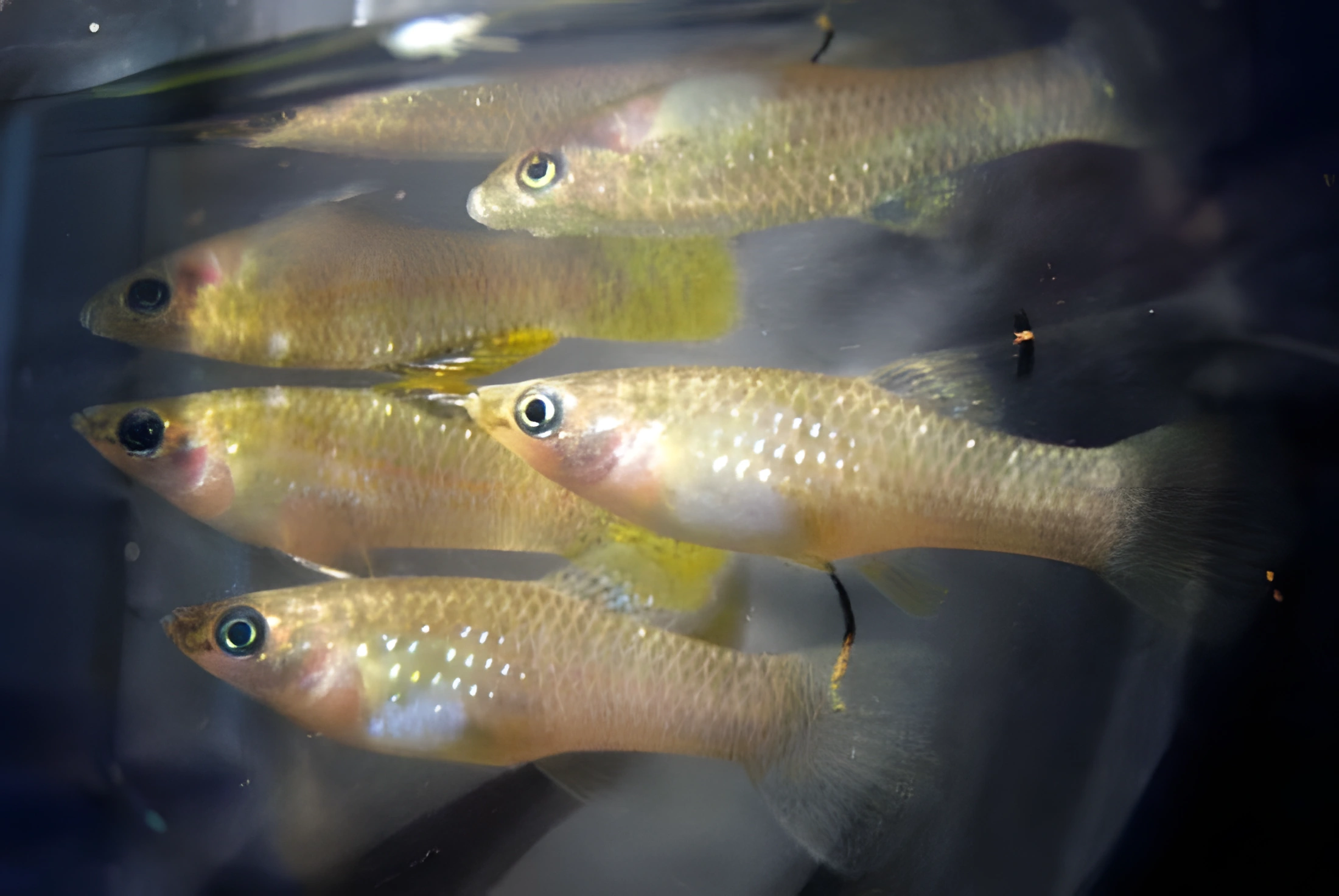
The Molly sphenops (Poecilia sphenops), or simply Molly, belongs to the Poeciliidae family. This fish is known for its unpretentiousness in keeping and relative ease of breeding. Additionally, it attracts attention with its bright, variegated body coloration. However, it is worth noting that this statement primarily applies to selective and hybrid forms, while wild specimens look different and are rarely found in aquariums.
- Required aquarium volume
- 150 L
- Size in aquarium
- 8 – 12 cm
- Temperature
- 21 – 26 °C
- Temperament
- Peaceful (regular)
Parameters
Water pHNeutral (7) – Slightly alkaline (8.5)
Water dHHard (15) – Very hard (30)
Water salinitymoderate (5–10 g/L)
Size in aquarium8 – 12 cm
Lifespan5 years
TemperamentPeaceful (regular)
Toward small fishnot a predator
Required aquarium volume150 L
Lightingany
Substrateany (no restrictions)
Water flowweak
FeedingMixed diet (meat + plant-based)
CareMixed (solitary / pair / group)
Description
Female Molly sphenops reach up to 12 cm in length and are generally noticeably larger than males, whose size does not exceed 8 cm; their rounded abdomen also contributes to this. Wild specimens have a modest gray-silver coloration, with iridescent turquoise specks visible on their scales. Selective varieties, however, impress with a diversity of colors, including white, yellow, red, and other shades, as well as patterns such as "dalmatian" or "marble." Differences are also observed in the shape of the dorsal and caudal fins, for example, in Lyretails.
Habitat
The natural habitat of the Molly sphenops covers significant territories of South and Central America, extending from Venezuela and Colombia in the south to Mexico in the north. Isolated populations are also found on the Caribbean islands. Currently, this species has successfully colonized new territories and inhabits natural conditions in the USA, Southeast Asia, and southern regions of Europe. In nature, the fish prefer shallow, heavily vegetated bodies of water, including coastal zones where fresh and saltwater mix.
Behavior and Compatibility
Molly sphenops are characterized by a peaceful nature and coexist well with other non-aggressive fish of comparable size. Males may exhibit excessive activity during courtship, and in the absence of sufficient hiding places in small aquariums, this can cause stress to females. For this reason, in small tanks, it is preferable to maintain a group according to the harem principle: one male and several females.
Care and Maintenance
For a group consisting of 3–4 fish, an aquarium of optimal size should have a volume of 100–150 liters. It is recommended to use aquatic plants abundantly when decorating the aquarium; both rooted and floating species will provide reliable cover for females, subdominant males, and growing fry. Initially, for successful keeping of Molly sphenops, slightly alkaline water and high general hardness were necessary. However, as a result of long-term selective breeding, modern varieties have successfully adapted to various conditions, including soft water, so pH and GH parameters no longer play such a decisive role. It is much more critical to prevent water quality deterioration caused by the accumulation of organic waste, such as food remnants and excrement. The best protection against problems is regular weekly partial water changes with fresh water and the uninterrupted operation of the filtration system. Some populations of this species are often found in brackish waters in nature, which led to recommendations to add salt to the aquarium. This procedure is permissible but not mandatory, and beginners may encounter difficulties in correctly calculating the concentration.
Diet
Molly sphenops are an omnivorous species. In a home aquarium, they readily accept most common specialized foods. The optimal choice will be foods developed to meet the needs of Mollies, which are produced by many companies. Such foods often contain a significant amount of plant additives, which is an essential component of their daily diet. Without these additives, the fish can significantly damage delicate aquarium plants. Aqvium flake food for aquarium fish Check out our new product, a bestseller on Ozon with a rating of 4.9. Flake food is suitable for most aquarium fish. The raw material is manufactured according to new European Union standards (EU 2018/848). Contains vitamins A, C, D3, E and Omega 3-6 Buy on Ozon
Breeding and Reproduction
Breeding this species usually does not cause difficulties. Under favorable conditions, the fish regularly produce offspring. The incubation period is approximately 3–5 weeks, after which the female gives birth to fully formed fry. Since Mollies do not show parental care for their offspring, it is recommended to transfer the fry to a separate tank to prevent them from being eaten by adult specimens. Nevertheless, with a sufficient number of hiding places in the form of dense plant thickets, many fry are quite capable of growing to adulthood even in a community tank. It is important to remember that color variations of this species can successfully interbreed, producing mixed offspring.
Diseases
Wild representatives of this species show significant resilience, but as a result of many years of selective breeding, many commercially available varieties and hybrids have become less robust and more susceptible to various diseases. This is especially true for the popular Black Molly. The only way to minimize the risk of disease outbreaks is to provide the fish with suitable living conditions. Low temperatures, frequent and sharp fluctuations in pH and GH values, as well as inadequate nutrition, negatively affect immunity, which can provoke the development of various diseases. Detailed information on symptoms and treatment methods can be found in the "Aquarium Fish Diseases" section.
How to choose
When purchasing, choose active and mobile fish with clean scales without visible damage, white spots, or film. Avoid specimens that stay near the water surface, frequently gulp air, or exhibit apathetic behavior, pressing their fins against their body. In the store, it is advisable to inspect the condition of the abdomen: it should not be excessively sunken, as this may indicate emaciation or the presence of internal parasites. Keep in mind that selective forms, especially entirely black varieties, may be more sensitive to transportation and adaptation conditions, so prefer fish from aquariums with good filtration and no signs of disease in tank mates.
Frequently asked questions
The essentials: size, tank volume, water parameters and care
How big does Molly sphenops get?
An adult reaches 8–12 cm in length. Plan the tank around the maximum size: the fish quickly outgrows a cramped setup.
What size aquarium does Molly sphenops need?
The minimum recommended volume is 150 L. A smaller tank speeds up nitrate build-up and raises stress levels.
What water parameters does Molly sphenops need?
Temperature 21–26 °C, pH 7–8.5, hardness 15–30 dGH. Stability matters more than exact values: sudden swings are harder on the fish than a small deviation from the ideal.
How long does Molly sphenops live?
Around 5 years when kept properly. Lifespan depends directly on tank volume, water quality and a varied diet.
Is Molly sphenops aggressive?
Temperament: peaceful (regular). Keep this in mind when choosing tank mates.
How many Molly sphenops should be kept together?
Recommended setup: mixed (solitary / pair / group). Ignoring this is a common cause of stress and disease.
What does Molly sphenops eat?
Diet type: mixed diet (meat + plant-based). Feed small portions that are finished within a couple of minutes — overfeeding does more harm than underfeeding.
What is the scientific name of Molly sphenops?
The scientific name of the species is Poecilia sphenops, family Poeciliidae. It also appears in the literature as: Gambusia modesta, Gambusia plumbea, Lembesseia parvianalis.