Temperature26 – 28 °C
Natural range
- Trinidad area
- Guatemala area
- Brazil area
- Central America area
LivebearersConservation status: Least concern LC
Other scientific names: Poecilia picta
Micropoecilia picta, widely known as the Swamp Guppy, belongs to the family Poeciliidae. This species was first introduced to aquarists in 1939 in Germany, where it was referred to as Micropoecilia melanzonus. It occasionally appears in home aquariums but is less popular than its close relatives, the common guppies.
- Required aquarium volume
- 40 L
- Size in aquarium
- 3 – 5 cm
- Temperature
- 26 – 28 °C
- Temperament
- Peaceful (regular)
Parameters
Water pHNeutral (7.5) – Slightly alkaline (8.2)
Water dHVery hard (20) – Very hard (40)
Water salinitymoderate (5–10 g/L)
Size in aquarium3 – 5 cm
Lifespan3 years
TemperamentPeaceful (regular)
Toward small fishnot a predator
Required aquarium volume40 L
Lightingany
Substrateany (no restrictions)
Water flowweak or moderate
FeedingAny (universal)
CareBoth solitary and in group (flexible)
Description
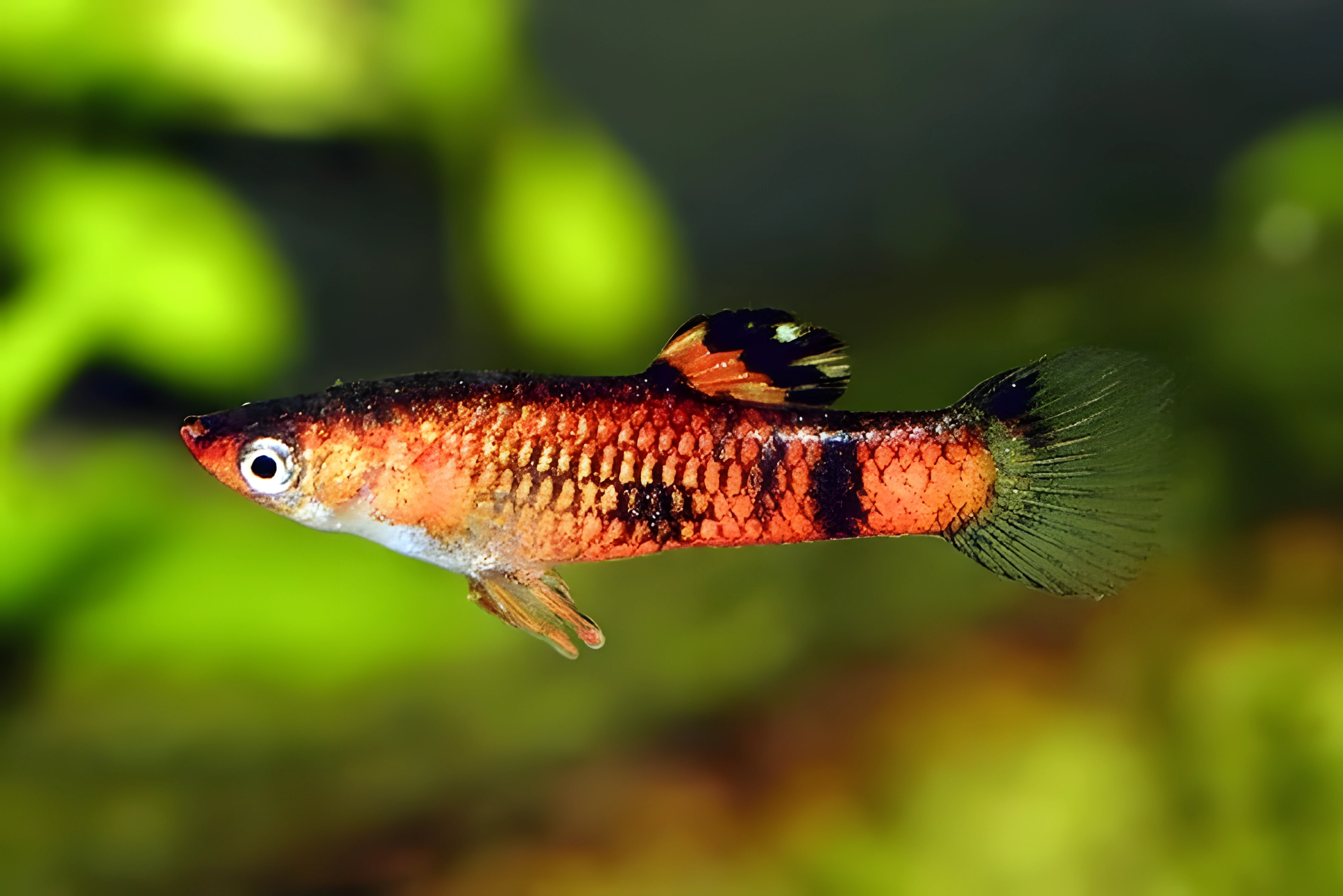
Adult males reach a length of about 3 cm. Their coloration can vary depending on their region of origin. For example, specimens from Trinidad typically display red coloration, while fish from the Orinoco River delta have gray-orange hues. A characteristic feature of their appearance is a black spot on the upper part of the caudal fin. Females are noticeably larger, reaching up to 5 cm in length. Their abdomen is usually rounded, especially enlarged during the breeding period. Females have a more modest coloration—uniformly gray with a silvery belly.
Habitat
This fish originates from Central and South America; its natural habitats extend from Guatemala to Brazil. Wild populations of the Swamp Guppy can also be found on the island of Trinidad. It prefers river deltas and coastal swamps where fresh and marine waters mix. Typical biotopes are quiet, sun-warmed shallow backwaters, abundantly overgrown with aquatic vegetation.
Behavior and Compatibility
These fish are distinguished by their peaceful nature and activity. The Swamp Guppy will be an excellent addition to a community of other miniature species. Intraspecific conflicts are generally not observed. Males are polygamous and prefer to be in a group with several females.
Care and Maintenance
Thanks to their modest size, this species can be successfully kept in aquariums of various volumes. Although Micropoecilia picta does not have specific requirements for decor, it is recommended to use many aquatic plants, including floating species, to create comfortable conditions. High water hardness can be maintained by adding shells, limestone fragments, and other carbonate materials. The fish prefers brackish water; in nature, salinity levels are unstable and can fluctuate from 5 to 20 or more grams of salt per liter, and replicating such periodic changes in the aquarium will be beneficial. Micropoecilia picta can survive in freshwater, but reproduction may be difficult under such conditions. For long-term keeping, it is crucial to ensure water purity with minimal contaminants—for example, nitrate concentration should not exceed 50 mg/L. An important and mandatory procedure is weekly partial water changes (10–15% of the total volume) with fresh water, as well as regular removal of organic debris.
Diet
This species is omnivorous. These fish readily accept various types of appropriately sized food, whether dry flakes, frozen, or live foods. As an example, Aqvium flake food, which is popular on Ozon with a high rating of 4.9, can be considered. It is suitable for most aquarium fish; its raw materials are produced in accordance with new European Union standards (EU 2018/848) and contain essential vitamins (A, C, D3, E) and Omega 3-6 acids. It can be purchased on Ozon.
Breeding and Reproduction
Micropoecilia picta are livebearing fish, meaning there is no egg stage. Fry are born fully formed. As mentioned, freshwater is not an optimal environment for their reproduction. The best conditions are achieved in slightly brackish, warm water (around 25°C) with a pH level of about 8.0. Parental instincts are not developed in these fish, so to preserve the offspring, the fry should be moved to a separate aquarium. They are fed microfoods such as Artemia nauplii, finely crushed dry flakes, or special suspensions.
Diseases
The main causes of various diseases in these fish are unsuitable keeping conditions, poor quality of offered food, and possible injuries. Eliminating these factors will ensure a long and comfortable life for the aquarium inhabitants.
How to choose
When choosing Micropoecilia picta, preference should be given to active individuals that stay in the middle and upper water layers. Healthy fish should have clean fins without signs of erosion, clear eyes, and tightly adhering scales without visible spots or film. Avoid specimens with sunken bellies, lethargic behavior, or those that constantly stay at the bottom, as this may indicate stress or hidden diseases. Given that the species is estuarine, inquire with the seller about the keeping conditions in the store: fish accustomed to brackish water may react poorly to an abrupt transfer to a freshwater environment. When purchasing, it is recommended to acquire a group of individuals, maintaining a sex ratio where there are at least two to three females per male, which reduces the level of intraspecific aggression.
Frequently asked questions
The essentials: size, tank volume, water parameters and care
How big does Micropoecilia picta get?
An adult reaches 3–5 cm in length. Plan the tank around the maximum size: the fish quickly outgrows a cramped setup.
What size aquarium does Micropoecilia picta need?
The minimum recommended volume is 40 L. A smaller tank speeds up nitrate build-up and raises stress levels.
What water parameters does Micropoecilia picta need?
Temperature 26–28 °C, pH 7.5–8.2, hardness 20–40 dGH. Stability matters more than exact values: sudden swings are harder on the fish than a small deviation from the ideal.
How long does Micropoecilia picta live?
Around 3 years when kept properly. Lifespan depends directly on tank volume, water quality and a varied diet.
Is Micropoecilia picta aggressive?
Temperament: peaceful (regular). Keep this in mind when choosing tank mates.
How many Micropoecilia picta should be kept together?
Recommended setup: both solitary and in group (flexible). Ignoring this is a common cause of stress and disease.
What does Micropoecilia picta eat?
Diet type: any (universal). Feed small portions that are finished within a couple of minutes — overfeeding does more harm than underfeeding.
What is the scientific name of Micropoecilia picta?
The scientific name of the species is Micropoecilia picta, family Poeciliidae. It also appears in the literature as: Poecilia picta.