Temperature22 – 29 °C
Natural range
- Brazil area
- South America area
LivebearersConservation status: Least concern LC
Other scientific names: Poecilia branneri, Poecilia heteristia
The scientific name Micropoecilia branneri belongs to the species Branner's Micropoecilia, which is part of the Poeciliidae family. This fish originates from South America, where it can be found widely in various biotopes across the vast basin of the great Amazon River.
- Required aquarium volume
- 40 L
- Size in aquarium
- 3 – 4 cm
- Temperature
- 22 – 29 °C
- Temperament
- Peaceful (regular)
Parameters
Water pHSlightly acidic (6) – Neutral (7)
Water dHVery soft (2) – Medium hardness (8)
Water salinityno salt (freshwater)
Size in aquarium3 – 4 cm
Lifespan3 years
TemperamentPeaceful (regular)
Toward small fishnot a predator
Required aquarium volume40 L
Lightingdimmed
Substrateany (no restrictions)
Water flowweak or moderate
FeedingAny (universal)
CareGroup (8–10 individuals)
Description
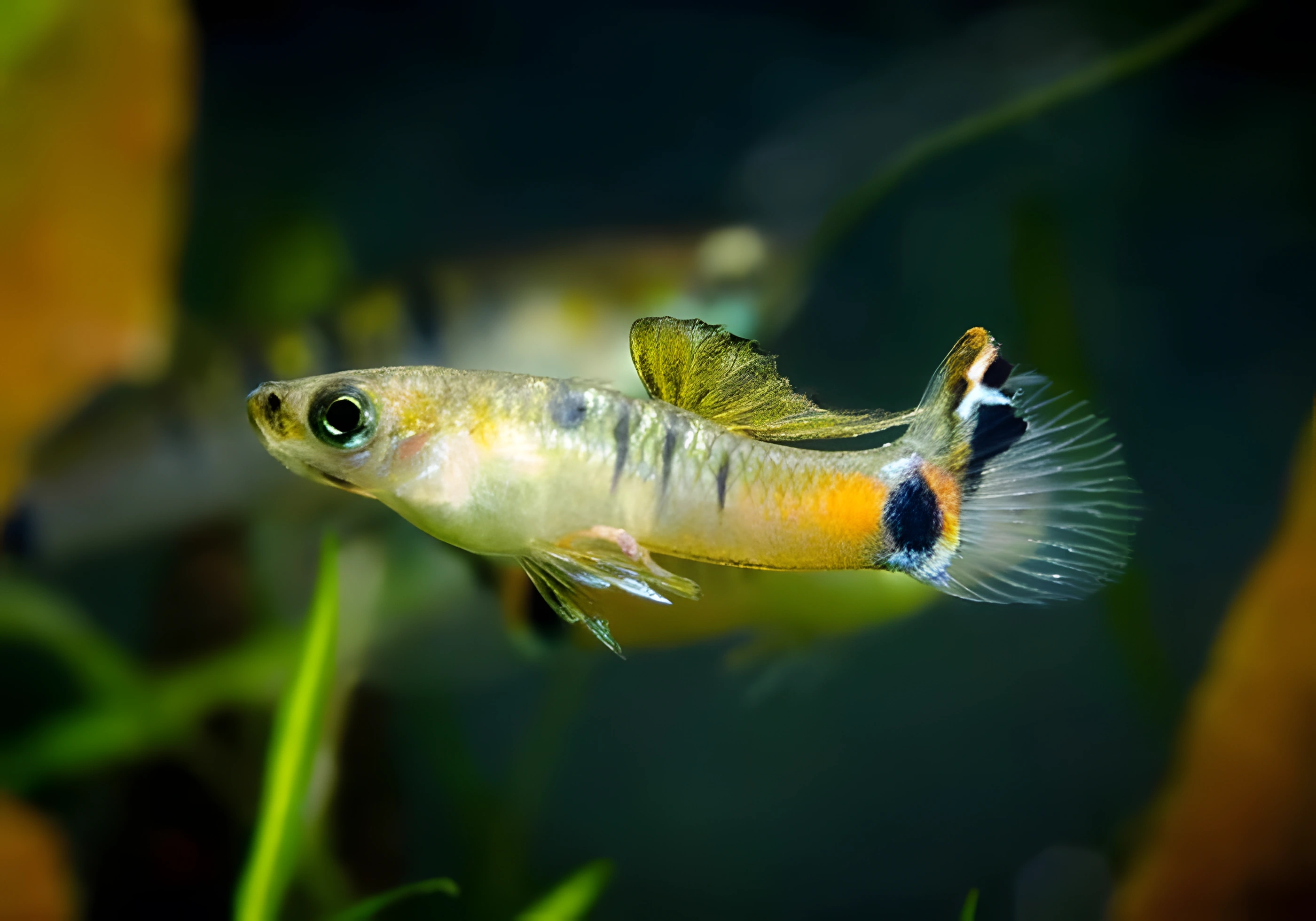
Adults reach a modest size, only 3–4 cm in length. Males are characterized by vibrant coloration, the intensity of which depends on their age and position in the shoal's hierarchy. The most dominant males display more variegated hues, in contrast to those occupying lower rungs of the “social ladder.” Their coloration predominantly features golden and turquoise tones, complemented by specks of red, green, and blue. The body has a pattern of 7–9 dark transverse stripes, and a large black spot, also known as a “false eye spot,” is noticeable at the base of the caudal peduncle. An additional spot is sometimes located on the back, directly beneath the dorsal fin. Unlike many livebearer species where distinct sexual dimorphism is observed (bright males, dull females), the situation with Micropoecilia branneri is somewhat different. Females have a pattern and coloration similar to males, though less intense, making them resemble subdominant males. However, the clear difference lies in size: females are noticeably larger and have a characteristically prominent silvery belly.
Habitat
This species inhabits South America, primarily within Brazil, including the Amazon River basin. In nature, it occupies various types of water bodies, often found in stagnant or slow-moving waters with dense vegetation providing cover. Water parameters in their natural environment can vary, but the fish adapt to both slightly acidic and neutral pH levels.
Behavior and Compatibility
This species is exclusively schooling, which underscores their need for the company of conspecifics. Therefore, it is recommended to keep a group of at least 8–10 individuals. Keeping them alone or in pairs significantly increases the likelihood of their coloration fading, especially in males. These fish are peaceful and get along well with other species of comparable size and temperament.
Care and Maintenance
The optimal aquarium volume for a small shoal of these fish starts at 40 L. The aquarium setup can be chosen at your discretion; however, the presence of shelters in the form of dense plant thickets, including floating plants, will be very beneficial. Among Russian-language sources, information circulates that Micropoecilia branneri naturally inhabits not only fresh but also brackish water, which has led to corresponding recommendations for their keeping. Nevertheless, English-language sources, including the authoritative international scientific fish catalog Fishbase, do not confirm the presence of these fish in brackish environments. Given that most sources, including Russian ones, indicate a preference for soft, slightly acidic water (with low dGH and pH values), it is advisable to refrain from using salt when keeping Branner's Micropoecilia. Otherwise, aquarium care does not pose particular difficulties. It is important to regularly perform partial water changes, promptly remove organic waste, and maintain equipment in good working order. These fish are omnivorous and readily accept most popular foods, such as dry flakes, as well as live or frozen brine shrimp, daphnia, bloodworms, and other invertebrates. We present our product – Aqvium flake food for aquarium fish, which has become a bestseller on Ozon with a rating of 4.9. It is suitable for most aquarium fish and is made from raw materials that comply with new European Union standards (EU 2018/848), and is also enriched with vitamins A, C, D3, E, and Omega 3-6. You can purchase it on Ozon.
Diet
Being an omnivorous species, these fish readily accept most common foods, such as dry flakes, as well as live or frozen brine shrimp, daphnia, bloodworms, and other small invertebrates. Aqvium flake food for aquarium fish — our new product, a bestseller on Ozon with a rating of 4.9, is ideal for most aquarium fish. Its raw materials are produced according to new European Union standards (EU 2018/848) and contain important vitamins A, C, D3, E, as well as Omega 3-6. You can purchase it on Ozon. Many livebearer species are easy to breed and do not require any specific conditions. However, they lack parental instincts, and fry often become food for adult fish. If you want to save the offspring, you should timely catch the fry and move them to a separate container. Some fry may survive and reach maturity even without the aquarist's help if the aquarium has sufficiently dense plant thickets.
Breeding and Reproduction
Most livebearer species are known for their ease of breeding, requiring no special conditions. However, parental instincts are undeveloped in them, so fry often become easy prey for adult fish. To preserve the offspring, it is recommended to timely catch the fry and transfer them to a separate tank. If the aquarium has sufficiently dense plant thickets, some of the fry may survive and reach maturity even without the aquarist's intervention.
Diseases
Branner's Micropoecilia is susceptible to diseases typical of livebearing killifish, often associated with inadequate keeping conditions. Common symptoms include clamped fins, changes in belly shape, the appearance of white stringy feces, or rapid breathing at the water surface. Fish are sensitive to water quality and can suffer from bacterial infections if fins are damaged or due to stress. Prevention involves maintaining stable environmental parameters, regular water changes, and providing a complete diet.
How to choose
When selecting individuals, attention should be paid to the general activity of the fish and the cleanliness of their skin. Healthy specimens should show curiosity, swim actively, and have no visible fin damage or signs of emaciation. It is recommended to avoid purchasing fish that stay at the surface, show signs of apathy, or have an unnaturally swollen belly. It is important to assess the group's behavior in the store: the presence of a clear hierarchy and the absence of constant aggression indicate the normal health of the individuals.
Frequently asked questions
The essentials: size, tank volume, water parameters and care
How big does Branner's Micropoecilia get?
An adult reaches 3–4 cm in length. Plan the tank around the maximum size: the fish quickly outgrows a cramped setup.
What size aquarium does Branner's Micropoecilia need?
The minimum recommended volume is 40 L. A smaller tank speeds up nitrate build-up and raises stress levels.
What water parameters does Branner's Micropoecilia need?
Temperature 22–29 °C, pH 6–7, hardness 2–8 dGH. Stability matters more than exact values: sudden swings are harder on the fish than a small deviation from the ideal.
How long does Branner's Micropoecilia live?
Around 3 years when kept properly. Lifespan depends directly on tank volume, water quality and a varied diet.
Is Branner's Micropoecilia aggressive?
Temperament: peaceful (regular). Keep this in mind when choosing tank mates.
How many Branner's Micropoecilia should be kept together?
Recommended setup: group (8–10 individuals). Ignoring this is a common cause of stress and disease.
What does Branner's Micropoecilia eat?
Diet type: any (universal). Feed small portions that are finished within a couple of minutes — overfeeding does more harm than underfeeding.
What is the scientific name of Branner's Micropoecilia?
The scientific name of the species is Micropoecilia branneri, family Poeciliidae. It also appears in the literature as: Poecilia branneri, Poecilia heteristia.