Temperature24 – 28 °C
Natural range
- Amazon River Basin
- Guyana area
- Paraguay area
- South America area
CharacinsConservation status: Least concern LC
Other scientific names: Metynnis calichromus, Metynnis ehrhardti, Metynnis schreitmuelleri, Myletes hypsauchen
The Common Metynnis, also known by its scientific name Metynnis hypsauchen, belongs to the family Serrasalmidae, which also includes piranhas. However, unlike its formidable relatives, this fish exhibits much more peaceful behavior. This species is part of a group of fish called "Silver Dollars," which includes other popular aquarium species such as the Spotted Metynnis, Lippincott's Metynnis, and the Silver Metynnis.
- Required aquarium volume
- 300 L
- Size in aquarium
- 15 – 18 cm
- Temperature
- 24 – 28 °C
- Temperament
- Peaceful (regular)
Parameters
Water pHSlightly acidic (6) – Neutral (7)
Water dHVery soft (2) – Hard (15)
Water salinityno salt (freshwater)
Size in aquarium15 – 18 cm
Lifespan10 years
TemperamentPeaceful (regular)
Toward small fishnot a predator
Required aquarium volume300 L
Lightingdimmed
Substrateany (no restrictions)
Water flowweak or moderate
FeedingPlant-based (algae, vegetables)
CareSmall group (3–4 individuals)
Description
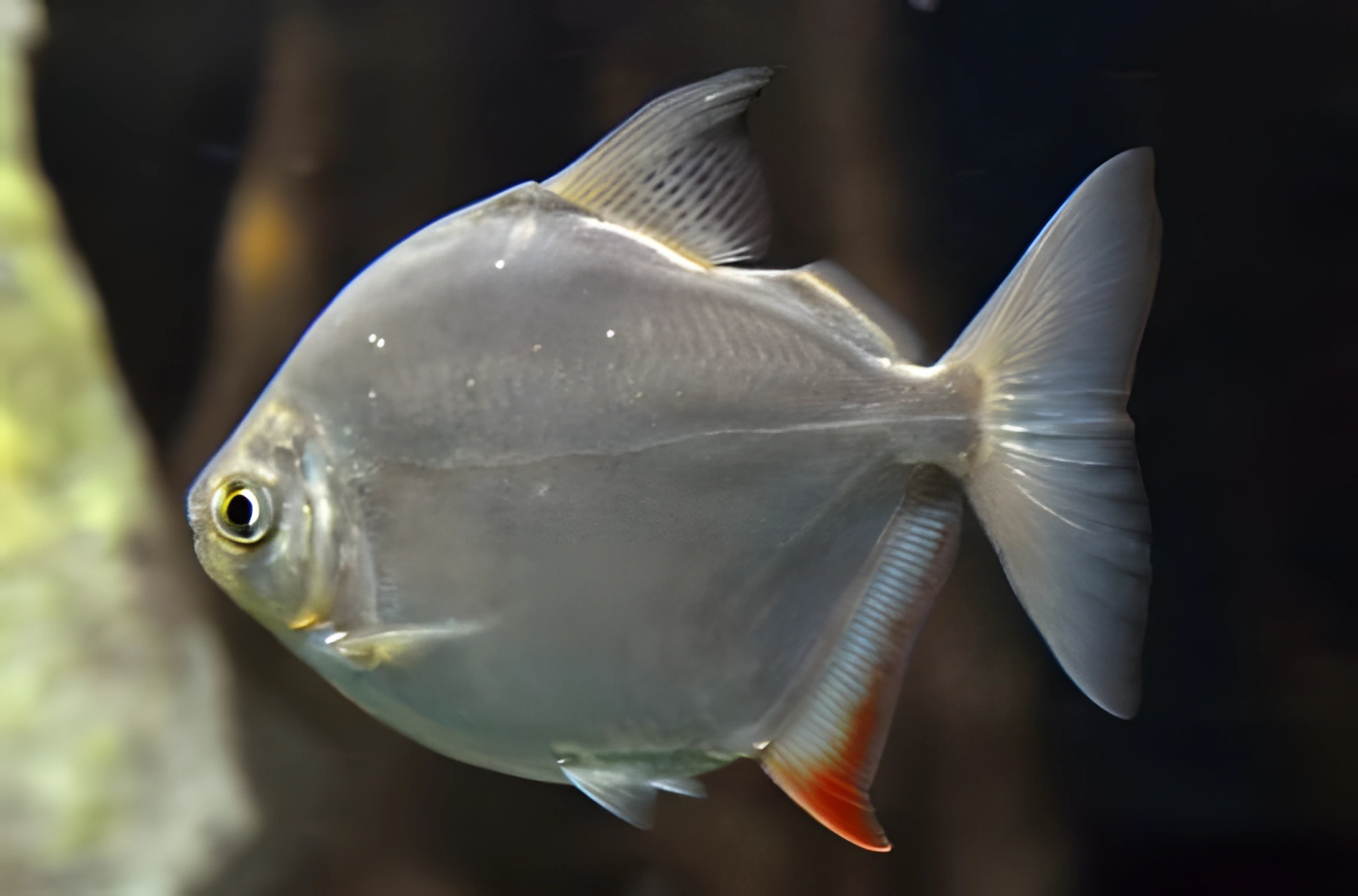
Adults grow up to 15–18 cm in length, characterized by a high, laterally compressed, rounded body. Their coloration is predominantly silver, and their fins and tail remain translucent. Outwardly, Metynnis hypsauchen is almost indistinguishable from the Silver Metynnis, except for a small dark spot above the eye. During the breeding season, males acquire a darker coloration and are distinguished by a reddish anal fin.
Habitat
These fish are native to South America, where they are widely distributed throughout most of the continent's tropical rivers. They can be found from Guyana to Paraguay, including the vast Amazon River basin. They prefer to inhabit areas of rivers where aquatic vegetation is particularly dense.
Behavior and Compatibility
It is recommended to keep them in a group of at least 4–5 individuals. These fish are peaceful towards other large species but can pose a threat to smaller fish. The Common Metynnis prefers to inhabit the middle and upper layers of the water, so fish that stay closer to the bottom, such as Plecostomus and Armored Catfish, would make good tank mates.
Care and Maintenance
Optimal conditions for keeping these fish include warm, soft water with low hardness values. For a group of 4–5 individuals, an aquarium of at least 300 liters will be required. When decorating, it is important to provide hiding places created from dense thickets of plants. However, it should be noted that the Common Metynnis can damage the soft parts of aquatic plants. Therefore, it is recommended to choose fast-growing species with tough leaves or use artificial vegetation. Lighting should be subdued. Aquarium maintenance follows a standard schedule, which includes weekly partial water changes with fresh water (maintaining the same pH and dH values), regular removal of organic waste, cleaning the tank walls of algae, and caring for decor elements as needed, as well as equipment prophylaxis. The diet should be based on foods with a high content of vegetable fibers or additional plant supplements, such as flakes or granules. They also readily accept live or frozen foods, such as bloodworms or brine shrimp. It should be noted that these fish may eat smaller aquarium inhabitants, including fry.
Diet
The basis of the daily diet should be foods rich in plant components, or additional plant supplements in the form of flakes or granules. These fish also readily accept live or frozen foods, such as bloodworms and brine shrimp. However, it should be noted that they are capable of eating smaller tank mates and fry. It is advisable to keep a group of 4–5 individuals, as they are peaceful towards large species, but small fish may be at risk. The Common Metynnis primarily inhabits the middle and upper water layers, so good companions would be fish that prefer a bottom-dwelling lifestyle, such as Plecostomus and Armored Catfish. The likelihood of successful spawning increases in soft, acidic water at a temperature of about 28°C. During the breeding season, males acquire a darker coloration and red spots on their chests. After a short courtship period, the fish lay dozens of eggs, scattering them over the substrate without forming a distinct clutch. Usually, adult fish do not eat their own eggs, but other aquarium inhabitants may. To save the brood, it is recommended to transfer the eggs to a separate aquarium. Fry hatch after three days, feeding first on the remnants of their yolk sac, and then begin to swim freely in search of food. They should be fed specialized powdered foods and suspensions for juvenile fish. Many diseases arise due to unfavorable keeping conditions. At the first symptoms, it is important to check the water quality and its hydrochemical composition, normalize the parameters, and only then proceed with treatment. Detailed information on symptoms and treatment methods can be found in the "Aquarium Fish Diseases" section.
Breeding and Reproduction
Spawning usually occurs more frequently in soft, acidic water at a temperature of about 28°C. During this period, males acquire a darker coloration, and red hues appear on their chest area. After a brief courtship, the fish lay several dozen eggs, scattering them over the substrate surface without forming a distinct clutch. As a rule, adult individuals do not eat their own eggs. However, other aquarium inhabitants may gladly feast on them. To save the fry, it is recommended to transfer the eggs to a separate tank. Fry hatch approximately three days later. Initially, they feed on the contents of their yolk sac, and then begin to actively swim in search of food. Specialized powdered foods and suspensions for juvenile aquarium fish are used to feed them.
Diseases
Most diseases in these fish are often associated with unsuitable keeping conditions. If the first signs of illness appear, you should first thoroughly check the water parameters and hydrochemical composition. It is necessary to normalize all indicators, and only then proceed with treatment. More detailed information on symptoms and treatment methods is presented in the "Aquarium Fish Diseases" section.
How to choose
When choosing a Common Metynnis, preference should be given to individuals with clean, shiny scales without visible damage, ulcers, or white film. A healthy fish should be active, exhibit schooling behavior, and show no signs of emaciation. Avoid specimens that isolate themselves, appear sluggish, or have deformed fins, as this may indicate stress or hidden diseases. Given the timid nature of the species, fish in the store may show excessive caution, making sudden movements when a person approaches, which is a normal reaction and not a sign of illness.
Frequently asked questions
The essentials: size, tank volume, water parameters and care
How big does Common Metynnis get?
An adult reaches 15–18 cm in length. Plan the tank around the maximum size: the fish quickly outgrows a cramped setup.
What size aquarium does Common Metynnis need?
The minimum recommended volume is 300 L. A smaller tank speeds up nitrate build-up and raises stress levels.
What water parameters does Common Metynnis need?
Temperature 24–28 °C, pH 6–7, hardness 2–15 dGH. Stability matters more than exact values: sudden swings are harder on the fish than a small deviation from the ideal.
How long does Common Metynnis live?
Around 10 years when kept properly. Lifespan depends directly on tank volume, water quality and a varied diet.
Is Common Metynnis aggressive?
Temperament: peaceful (regular). Keep this in mind when choosing tank mates.
How many Common Metynnis should be kept together?
Recommended setup: small group (3–4 individuals). Ignoring this is a common cause of stress and disease.
What does Common Metynnis eat?
Diet type: plant-based (algae, vegetables). Feed small portions that are finished within a couple of minutes — overfeeding does more harm than underfeeding.
What is the scientific name of Common Metynnis?
The scientific name of the species is Metynnis hypsauchen, family Piranhas (Serrasalmidae). It also appears in the literature as: Metynnis calichromus, Metynnis ehrhardti, Metynnis schreitmuelleri.